 Madame Eulalie’s Rare Plums
Pearson’s Magazine (US), March 1906
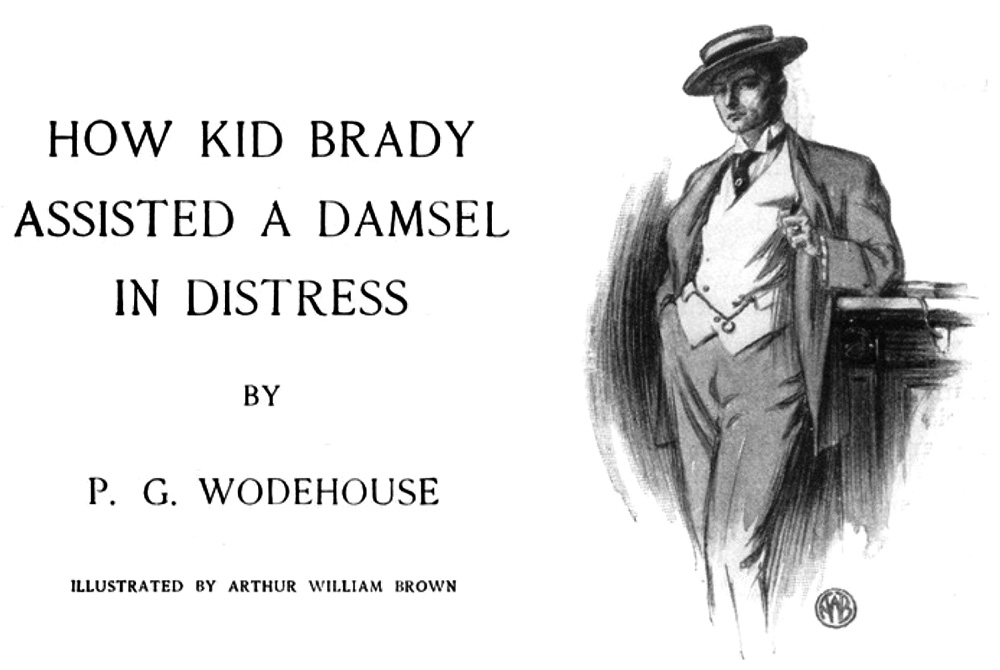
 HE Kid’s
first act after becoming champion was to open a saloon on East Fourteenth
Street. His second was to buy an automobile. There are three stages in the
career of the successful American pugilist. He begins obscurely, fighting hard
with the rank and file of the profession and endeavoring, in the intervals of
active work, to induce friendly newspaper men to put photographs of him in
defiant and scientific attitudes into their papers, together with eulogies on
past deeds and glowing prophecies respecting future matches. Then, having begun
to make a name, he starts a saloon, and, finally—the last test of
prosperity—he buys an automobile (which he refers to as his “bubble”)
and begins thoroughly to enjoy life.
HE Kid’s
first act after becoming champion was to open a saloon on East Fourteenth
Street. His second was to buy an automobile. There are three stages in the
career of the successful American pugilist. He begins obscurely, fighting hard
with the rank and file of the profession and endeavoring, in the intervals of
active work, to induce friendly newspaper men to put photographs of him in
defiant and scientific attitudes into their papers, together with eulogies on
past deeds and glowing prophecies respecting future matches. Then, having begun
to make a name, he starts a saloon, and, finally—the last test of
prosperity—he buys an automobile (which he refers to as his “bubble”)
and begins thoroughly to enjoy life.
One evening, some months after his fight with Jimmy Garvin—who was now shrieking challenges at him in the evening papers in the hope of obtaining a return match—the Kid was in his saloon, leaning against the counter with the air of careless majesty which is a characteristic of the successful fighter, and watching the austere barmen serve the customers who poured in. He was proud of his saloon, and with some justice, for it was orderly, well-appointed, and well patronized. The prize-fighters’ saloons of New York are by no means the noisy, sordid dens which those who do not know them imagine them to be. They are as clean as pins, and as decorous as A.B.C. shops. Nobody had a word to say against Kid Brady’s saloon, if we except Mrs. Carrie Nation, who, according to the papers, had bought a new hatchet and announced her intention of paying the Kid a professional visit in the near future.
But the champion light-weight of America was not the man to let a trifle like this worry him, and as he leaned on his counter he felt at peace with mankind, even with Jimmy Garvin. It was, he felt, purely the etiquette of the profession that had led that gentleman to describe him in a letter to a sporting weekly as a “skunk.” It was a mere conventional pleasantry, and showed no animus on the part of the defeated one.
To him while in this enviable frame of mind there entered a boy.
“A letter for you, Mr. Brady,” said the boy, with respect.
The Kid extended a hand for the missive. The messenger meanwhile stood eyeing him with intense reverence. It was not his luck to come frequently to such close quarters with the famous light-weight, and already, by handing him the letter, he had done enough to make himself a marked boy in his set. If he could but lure the great man into a conversation, however brief, his reputation would be made. The Kid examined the note curiously before opening it. His correspondence was not large, and what there was of it was not written, as was this letter, on the gold-stamped paper of the Hotel Universal. Also, it was delicately scented, and the scent was not tobacco.
He opened it, and glanced first at the signature. “Catherine Beaumont.” A lady! Here were mysteries and marvels!
“Dear Mr. Darrell,” it began.
Now, one of the Kid’s minor weaknesses was that he liked to be addressed as “Mr. Darrell.” “Kid Brady” was merely his professional pseudonym. His real name was Edward Darrell, and socially he liked to be called by it. Persons who endeavored to win his regard by addressing him publicly as “Kid” would have done far better to have called him “Mr. Darrell.”
The letter itself was a little unusual:
I have heard so much about you from my brother James, whom you taught to box last year, that I feel no diffidence in writing to you. I am in dreadful trouble. I need a strong man’s help immediately. My brother is in San Francisco. I have no friend in New York. Do please call at once at this hotel. I shall remain indoors for the rest of the evening.
Catherine Beaumont.
P.S.—The boy will carry an answer.
P.P.S.—It is a matter of the utmost importance.
The Kid’s comment was brief but emphatic.
“Gee!” he said.
“Any answer to de letter, Mr. Brady?” inquired the messenger by way of a conversational opening.
“You go back, sonny, and say how I’m comin’ at once. Now see if you can make the hotel in two jumps.”
The boy darted off, storing these golden words in his mind, to be retailed later to an admiring circle of his peers.
As for the Kid, he went up-stairs and put on his best clothes. This was a special occasion. The somewhat emphatic tweed suit which he affected as a rule, must give way to something more nearly resembling what the Four Hundred wore when they paid calls. He selected a dark serge, hovered a few moments over a batch of neckties, and, deciding finally in favor of a dark green, thrust a smart pin into it, and made his way to the Hotel Universal.
He remembered James Beaumont well—a man of some standing in New York society, who had come to his gymnasium to work off the effect of a strenuous course of dinners at Sherry’s and Delmonico’s. One of the evening papers had caricatured him in an imaginary contest with the Kid, who was then just beginning to achieve fame.
Miss Beaumont’s suite was at the top of the hotel. Deposited by the elevator opposite the door, he knocked and entered a neat sitting-room.
Seated in a chair at the farther end of the room was his correspondent. In his own circle of society the Kid was by way of being something of a ladies’ man. A fighter is always popular with the other sex. He was what is called in the vernacular a “strong josher.” In other words, he always had plenty to say for himself. But here was a lady of another sort. To judge from a first glance, she was the sort of lady whose portrait was in all the papers when she went to the Horse Show. He got a blurred impression of a beautiful face and an exquisite dress, and then he lost his head.
“Mr. Darrell? Please sit down.”
The Kid sat down, dimly realizing that he ought to have done something which he had left undone. Later it occurred to him that the lady had offered her hand, and he had not taken it.
“It was so kind of you to come so promptly.”
“Yes, Miss,” said the Kid.
“But I was sure you would. My brother spoke so highly of you.”
“Yes, Miss.”
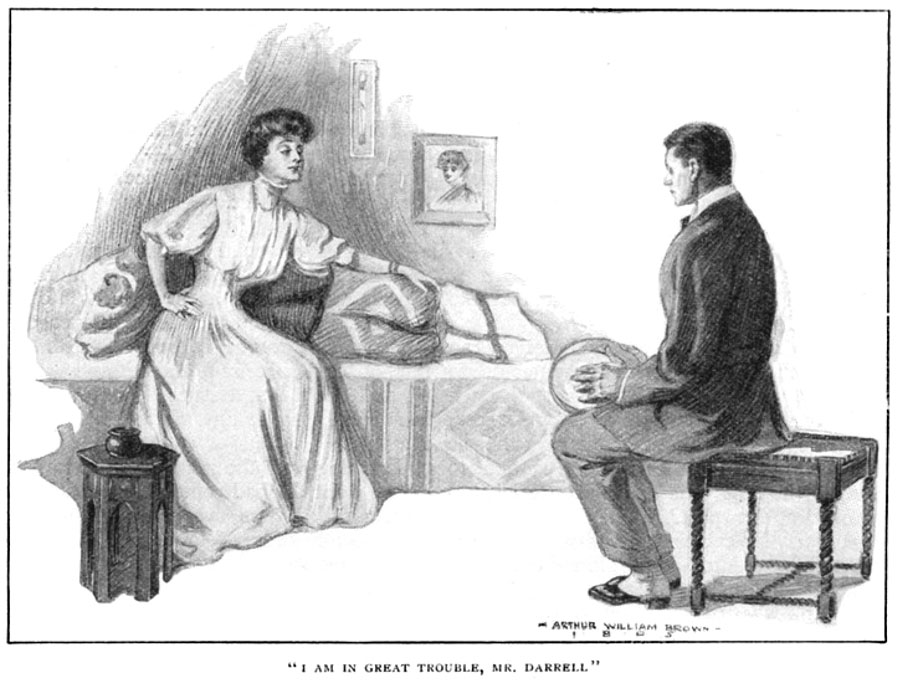
“I am in great trouble, Mr. Darrell.”
“Yes, Miss.”
Here it suddenly struck the Kid that he must pull himself together. He was rattled. His remarks, he felt, lacked variety and brilliance.
“I’m sure,” he said, with an effort, “I’m sure—anything I can do——”
He lost the thread of his discourse, and came to an abrupt stop. A drop of perspiration splashed on his wrist.
Fortunately the mind of woman is conducted with an eye to these emergencies. Miss Beaumont was tactful. It was plain that the Kid was in a parlous state, and that it would be brutal to look for conversation from him for some time to come. He sat there on the edge of his chair, fingering his hat in an overwrought manner, and gazing earnestly at the carpet. His hostess put him at his ease. For the space of three minutes, she delivered a monologue on a variety of unimportant topics in a sweet rippling voice which acted magically on the Kid’s disturbed nerves. At the beginning of the fourth minute he surprised himself by volunteering a statement. It was not very profound nor very original, but it was a statement, and he began to feel confidence slowly returning. Before the fourth minute had elapsed he was himself again.
“I can explain in a very few words, Mr. Darrell, just what it is that I want you to do for me, if you will be so kind.”
Five minutes before the Kid’s head had swum at the idea of this gorgeous being condescending to be under an obligation to him, but now he positively waved his hand deprecatingly, just as he had seen the star do at Daly’s, when the leading lady had insisted that he had a noble soul.
“It is very kind of you, Mr. Darrell. I am sure a man in your position must be extremely busy. What I want is this: Tomorrow morning I start from the Central Station to join my brother in San Francisco. I want you to be there to look after me.”
The Kid politely placed his “bubble” at the lady’s disposal. She thanked him, but declined.
“I must not put you to any more trouble than I can possibly help,” she said. “It will be quite enough if you meet me on the platform at half-past eleven. My train leaves at twenty-five minutes to twelve.”
“I’ll be there, miss,” said the Kid.
There was a pause. It was now the lady who gazed at the carpet, and looked embarrassed. The Kid was wondering whether the interview was at an end, and whether he was supposed at this point to make a graceful exit, when Miss Beaumont, blushing in an effective manner, hesitated, and finally spoke.
“I think I must tell you everything, Mr. Darrell,” she said. “It will explain what you are probably thinking is extremely curious behavior on my part.”
With incredible dexterity the Kid once more brought off the deprecating wave.
“I do not like to speak of it, but I must. Briefly then, I need your protection. I am sure you will respect my confidence, if I tell you why?”
“Sure, miss,” protested the Kid.
Miss Beaumont proceeded.
“Last summer,” she said, “when I was staying with friends at Newport, I met a gentleman whose name I will not mention. If I did you would recognize it, for he is the son of one of the wealthiest men in the city. We were thrown a great deal in each other’s way, and the end of it was that he—he asked me to marry him.”
The Kid murmured sympathetically.
“I thought that I was fond of him,” continued Miss Beaumont, “and I accepted him. We were engaged secretly. But before either of us could tell our parents, I found out what sort of a man he really was, and I broke off the engagement. He was very violent, and frightened me very much. I am afraid that he is in the habit of drinking a great deal more than is good for him. I did not find that out in time to prevent our engagement, but it was that made me put an end to it. As I said, he was very violent, and refused to accept his dismissal. Fortunately, the house party broke up almost immediately afterward, and I have seen no more of him.
“This morning, however, I received a letter from him. By some means or other, he had got to hear that I was passing through New York and intended to leave by the train I mentioned. In his letter, he says that he is determined to ‘meet me at the station, to resume,’ he says, ‘the discussion we left unfinished at Newport.’ Now, I must go by that train, for certain reasons which do not matter, and I dare not meet him alone. For a long time I was at my wits’ end. I could not think what to do. You see, though my brother has many friends in the city, I am seldom here and have but a few, and they are away just now. And I could not confide in them on such a delicate matter. There is not one of them I could trust not to talk. Now you, Mr. Darrell—”
She smiled, and in her smile pathos, compliment, and entreaty were subtly mingled.
“I’ll be as silent,” said the Kid, “as—as Peter Salt, and I couldn’t be more than that. But give me his name,” he added fervently. “I’ll give him a jolt that’ll settle him for fair. I’m no corker at the game of talk, miss, but when it’s the other thing, I’m there with the goods.”
“But above all there must be no scene, except as a last resource. If people heard of it, I think I should die.”
The Kid nodded adherence to this sentiment.
“You must talk to him. All I want is that you come to the station and stay near me in case he—the gentleman I mentioned—is violent.”
“I will,” said the Kid. “I’ll stop him gettin’ gay.”
“He may try to detain me, or, worse still, accompany me on my journey. At all costs, even if you have to employ force, you must prevent that, Mr. Darrell.”
“You may leave it,” said the Kid definitely, “to me, miss.”
“But, unless you are compelled, anything like a scene—”
“I see, miss.”
“Then, good-by. And thank you ever so much. I am more grateful—”
“Proud to be of any service, miss,” said the blushing pugilist.
The Kid was on the platform with commendable punctuality the next morning. Eleven was striking as he turned into the station. He waited till the door opened to admit people to the platform from which the San Francisco train started, and walked up and down like a sentinel, secure in the knowledge that, at any rate, he was first in the field.
Thinking over the matter in the watches of the night, he had come to the conclusion that, as there was every probability of a fracas before twenty-four minutes to twelve, it might be necessary for him, however pure and chivalrous his motives in assaulting a perfect stranger, to vanish without giving explanations and without being recognized. The callous Law which governs assaults and batteries takes no account of Chivalry. It had not failed to occur to him that his position, after the train had borne off his only witness to the excellence of his motive in committing the assault, might be a little equivocal. It might be necessary to trust to rapid flight. For this reason, his “bubble” waited at the entrance to the station in charge of a boy. Also he had invested a quarter of a dollar in a false mustache. It was becoming, and proved a very effective disguise.
Half an hour passed without the appearance of Miss Beaumont. The Kid had not expected her to arrive too early. He amused himself in the interim by scanning the passengers as they came up, and endeavoring to detect his man. The half-hour had just struck when a heavily-veiled figure passed him.
“Here I am, miss,” he said.
She started, and dropped a small bag which she carried.
“It’s all right, miss. It’s me, Darrell. Is he here?”
She had recognized him now, and he saw her smile as she caught sight of the mustache.
“The man in brown,” she whispered, and entered the train.
The Kid was surprised. He had noticed the man in brown. He had been on the platform almost as long as himself, and he, too, had patrolled it in sentinel fashion. But not for a moment had the Kid imagined that this could be his man. Anything more unlike the dissipated young society man—a type which had become familiar to him during his years at Mike Mulroon’s—he had never seen. Like all boxers, the Kid judged of a man’s condition by the whites of his eyes. An habitual drinker’s eyes are not easy to mistake. The whites of this man’s eyes were clear and healthy. He had a strong, keen face.
But there was no doubt that he was the right man, for as Miss Beaumont entered the car, he caught sight of her and darted across the now almost empty platform in her direction.
The Kid had taken up his stand opposite the steps, and when the man arrived he found the entrance blocked.
“Excuse me,” said the man, abruptly, but not impolitely.
The Kid did not move.
For the first time the man seemed to scent the partisan.
“Stand aside, you!” he cried.
A rush of steam issued from the funnel of the engine. Belated passengers dashed wildly for seats.
The mouth of the man in brown set like a steel-trap.
“Let me pass!” he hissed. “I shall not speak again.”
“All aboard! All aboard!” shouted the conductor. “Step lively there! Step lively!”
The man in brown rapped out a furious oath.
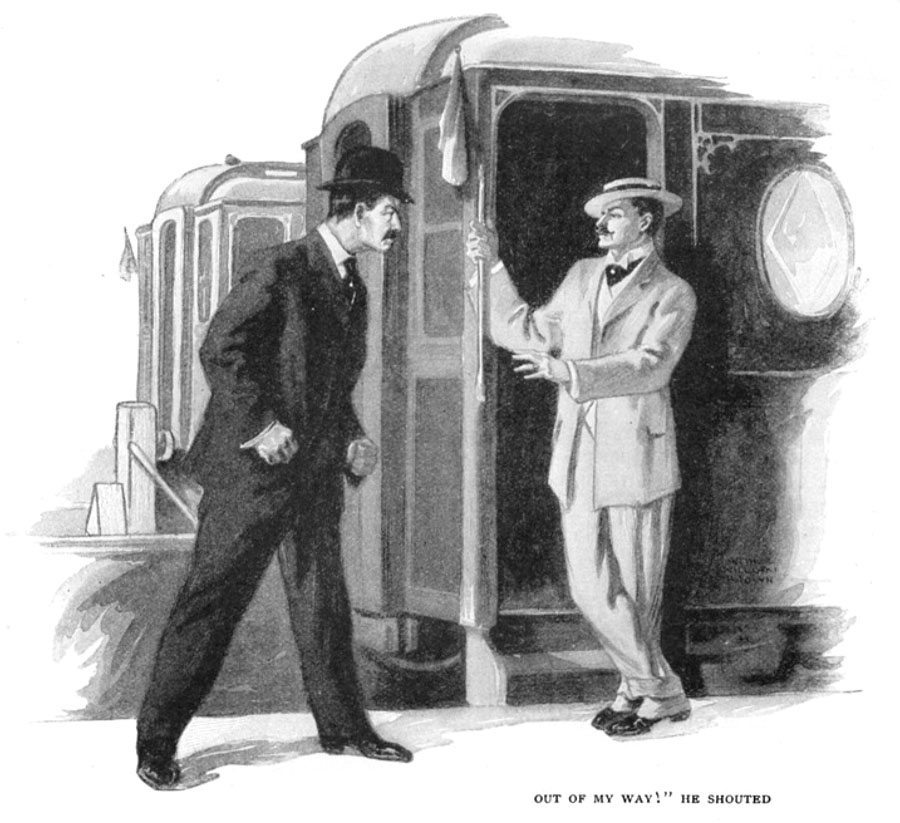
“Out of my way!” he shouted.
The Kid spoke for the first time.
“To the woods!” said the Kid.
Interested faces appeared at the windows of the train.
The Kid stood before the steps of the car in stolid silence.
Suddenly the man darted forward and seized the Kid by the shoulders. The next instant he was lying full length on the asphalt. The Kid was a hard hitter, and righteous indignation had added force to his arm. It would be a quarter of an hour before his enemy could recover from such a blow, on a spot where even a tap is enough to stun.
Even as he fell, the train steamed out of the station.
“This,” thought the Kid, as running figures began to approach from the end of the platform, “is where I leave for the tall timber!”
Customers at the Kid’s saloon during the ensuing week wondered what made the champion so gloomy and disinclined for casual conversation. He seemed to have something on his mind, and once, when Officer Kelly of the police force strode into the bar, he was noticed by the observant to turn a clear shade paler. When Kelly retired after drinking a modest Würzburger, his countenance resumed its normal hue, and he began to talk rapidly, almost incoherently.
The cause of this strange demeanor was a certain “sensation” of which the papers had made the most during the week. The Manhattan Daily had started it, and the other papers had followed in its wake.
It had been heralded by head-lines:
OUTWITTED
BY A WOMAN
Gem-Grabber Grace Grant Gets Away.
DUNN STUNNED
Detective Dunn Tells How He Was Felled
By An Accomplice.
STILL AT LARGE
Interview with Detective Dunn
“He Was a Tall, Burly Man.”
That was how the Manhattan Daily opened fire.
Having broken it gently, as it were, in this fashion, it went on to describe how Detective Dunn, of the metropolitan force, having received information that Grace Grant, the heroine of the latest New York jewel robbery, was about to make an attempt to leave for California by the morning express, had gone to the station to arrest her. There, however, when on the point of effecting a capture, he had been severely attacked by an accomplice and stunned. The accomplice, said the writer, was being searched for by the police; and it relieved the Kid a little to find that the injured detective described him as a “tall, burly man with a long black mustache.” His own stature was small, his figure, though sturdy, far from massive, and his long black mustache had gone for ever.
But he passed an unhappy week.
Eight days later a considerate cyclone destroyed most of a small town out West, and Detective Dunn and his troubles ceased to interest the public.
(This series will be continued in the May issue of Pearson’s)
Notes:
a saloon on East Fourteenth Street: in Manhattan, historically a posh, upscale location, denoting Kid Brady’s successful arrival on the sporting scene
“bubble”: an interesting instance of slang in Wodehouse. No published dictionary of either British or American slang from the advent of the automobile in 1885 till the publication of the Kid Brady material in Pearson’s Magazine in 1905 denotes “bubble” in relation to automobile, and though Cassell’s contemporary Dictionary of Slang (1998, 2005) tells us that “bubble” was used (orig. US) to denote an automobile from 1900–1960, the earliest instance of such use in The Oxford English Dictionary is from 1918, in Wodehouse’s own Piccadilly Jim. The March 1906 installment of Kid Brady here predates the OED’s example by a dozen years.
Jimmy Garvin: in paragraphs two and three, the former light-weight champion of America Jimmy Garvis has been renamed Garvin.
The prize-fighters’ saloons of New York . . . imagine them to be: in an America fast approaching prohibition, conservative interest and the conservative press demonized liquor, liquor establishments, and the “lower life” (read “gaming” or “gambling”) such environments fostered. From church pulpits and street missionaries to The New York Times, the subcultures of drink in America took on vastly different significations than in England, where, excepting the Hogarth school of thought, the cozy village or city pub or the idea of the alcoholic tonic or restorative—think iconic image of butler and tray, offering restoration—found little cultural exchange.
A.B.C. shops: In England, these were genteel tea-shops operated by the Aerated Bread Company, staffed mostly by women, where it was considered socially acceptable for women to dine alone. New York City directories of the period do not list A.B.C. shops, but Wodehouse must have assumed his American readers knew about them. [NM]
Mrs. Carrie (or “Carry”) Amelia “Saloon Smasher” Nation: (25 November 1846–9 June 1911) Kentucky-born, Texas-raised temperance vigilante who cultivated a Wild West persona in her spirited destruction of drinking establishments throughout the American Midwest. Nation infamously employed a hatchet on her smashing raids or “hatchetations,” as both she and the American press dubbed her vigilante excursions. She was frequently accompanied by increasing numbers of proselytes who sang hymns as she destroyed liquor stock, gambling tables, barroom mirrors, and lewd paintings, all the while lecturing patrons at host saloons. Nation lived largely in the popular mind of the early twentieth century and indeed in later years performed in vaudeville and music hall acts throughout the US and Britain.
bought a new hatchet: metaphorically, “had a new axe to grind”; likely an allusion to Nation’s career in vaudeville which was still fresh in the minds of Wodehouse’s Kid Brady readers, if only from Nation’s 1904 autobiography The Use and Need of the Life of Carry A. Nation. Nation claimed that her work in vaudeville was on the “largest missionary field in the world. No one ever got a call or was ever allowed to go there with a Bible but Carry Nation. That door never was opened to anyone but me. The hatchet opened it” (p. 270). Significantly, Nation’s chief vaudeville performances, Ten Nights in a Bar-room, were held in Boston and in the Bowery, so that her latter performances would have been in the same region as Kid Brady’s new saloon.
Nation manufactured and sold “little hatchets” to supporters, the proceeds from which she funded her excursions and paid her legal bills.
the gold-stamped paper: given the posh signifier, we can likely situate the hotel in Manhattan’s uptown region.
Hotel Universal: the ritziest and likeliest of the three possible Universal Hotels in New York and Manhattan during this era was situated on Manhattan’s 6th Avenue and 28th Street, which operated until 1909. This location was within easy walking distance of Brady’s new saloon. Alternative sites include Morgan’s Universal Hotel, which operated throughout the 1890s in NY, at 75 Clarkson Street, but could not exactly be described as “two jumps” from Brady’s 14th Street saloon. There was also a Universal Hotel at 325 Bowery.
the Four Hundred: a phrase coined by Samuel Ward McAllister to denote the elite and controlling interests of New York City. McAllister was a social commentator and veritable Master of Ceremonies of New York social life. He cultivated and advertised expertise in social etiquette and groomed clients for the social scene in NY from the 1860s to the ’90s.
McAllister’s 1890 memoir Society as I Have Found It would likely have appealed to Wodehouse for its neat categorization of New York’s moneyed society. McAllister identified the old money or “Nobs” of New York as well as the new money or “Swells.” His “Four Hundred” was a list of wealth and privilege in America in the late nineteenth century.
serge: a twill fabric fashioned on a diagonal weave pattern
Sherry’s: a favorite restaurant amongst the Four Hundred and noted as such in McAllister’s Society as I Have Found It. Founded by Louis Sherry, a Gilded Age New York socialite, hotelier, and restaurateur. Likely a reference to Sherry’s first restaurant in NY, at 38th Street and 6th Avenue.
Delmonico’s: premier and innovative lower Manhattan restaurant at 2 South William Street, favored by NY’s social elite
at the top of the hotel: the penthouse or most expensive suite at the hotel; as with the earlier references to Sherry’s, Delmonico’s, gold-stamped paper, and the Hotel Universal itself, this reference denotes class, wealth, and privilege—everything the Kid aspires to. Given the conclusion of the installment, such building up of wealth and privilege might also denote a degree of superficiality not always found in Wodehouse.
a “strong josher”: Wodehouse’s subsequent “In other words, he always had plenty to say for himself” amplifies rather than defines this vernacular American slang phrase. A josher is one who ridicules, banters, chaffs, or makes fun of others. The suggestion here is that Brady has a free-and-easy disposition and is generally comfortable around others, often needling them familiarly and endearingly. With Miss Beaumont, however, Brady is tongue-tied.
The National Horse Show was founded in New York in 1883 by a group of wealthy sportsmen so exclusive that its 1887 directory formed the basis for the first New York Social Register. [NM]
just as he had seen the star do at Daly’s: likely an elision here between the Fifth (or New Fifth) Avenue Theatre at 31 West 28th Street and Broadway, managed by Augustin Daly during the 1870s (and subsequently a favorite venue for Gilbert and Sullivan and, in the early twentieth century, though not under Daly’s management, vaudeville), and Daly’s Theatre at Broadway and 30th Street, opened by Daly in 1879 after leaving the Fifth. Daly was celebrated for the quality of his hired talent and for his exuberant and melodramatic productions, particularly of Shakespeare’s comedies. Hence the melodramatic nature of Brady’s wave of the hand.
ought to have done something: echoing the General Confession from the Book of Common Prayer: “We have left undone those things which we ought to have done. . . .” [NM]
Central Station: The Manhattan terminal of the New York Central Railroad at 42nd Street and Park Avenue, originally built 1871 as the Grand Central Depot and much expanded in 1900 as the Grand Central Station. The current building, dating from 1913, is properly called “Grand Central Terminal,” but the second name is still commonly used. From 1902 the New York Central’s “20th Century Limited” train was the fastest and most elegant rail route west to Chicago. [NM]
This morning, however, I received a letter from him. . . .: this bit of dialogue along with subsequent paragraphs, particularly the one beginning “Thinking over the matter in the watches of the night,” sound remarkably close to what will become the conventions of hardboiled crime fiction, particularly in the sexual politics of the scene, the initial bedazzling and conscious manipulation of the hero, and the later cooler reasoning of the Kid and awareness of other possible angles and anticipation of private trouble. Such nodes are remarkable here because hardboiled crime or detective fiction wasn’t pioneered until the 1920s, during which time many such stories appeared in Pearson’s Magazine. Wodehouse, if only minutely, seems to anticipate here what will become defining features of crime writing in the twentieth century. He has never been celebrated for the contribution.
as silent as Peter Salt: in the second story of this series, “the most silent man connected with the Ring” [NM]
stop him gettin’ gay: stop him from getting overly familiar, dissolute, promiscuous, uninhibited, wild, crazy
the watches of the night: biblical metaphor (found in the King James version of the Psalms) and commonly used phrase since the 1662 Book of Common Prayer, alluding to the guard that kept watch over various hours of the night. Also a short-story title for an 1887 work by Rudyard Kipling, a tale about scandal, scandalmongering, and mistrust.
fracas: disturbance, noisy quarrel
a type which had become familiar to him during his years at Mike Mulroon’s: see note on “enervated youths” from installment one of this series, September 1905.
a man’s condition by the whites of his eyes: alcoholic liver disease, cirrhosis, and acute pancreatitis are all noted disorders from excessive alcoholic drink or excessive alcoholic drink and tobacco usage which impact the color of the whites of the eyes; infectious mononucleosis and chlamydia, both associated with sexual promiscuity, are further noted for discoloring the sclera. The allusion here, again, is in keeping with the “enervated youths” from installment one who apply to Mulroon for exercise and better health.
scent the partisan: a Wodehouse original metaphor; the man begins to sniff out—appropriate, since he will turn out to be a detective—that the Kid is an associate of the woman on the train
To the woods!: catch phrase from “the well-known children’s dialogue game which starts with a man pursuing a girl” (Partridge, p. 207); a naughty running joke about a young girl who tries to escape the lecherous advances of a vicar, beginning with the wood as the place for a tryst and ending with the wood as a place of escape, viz.:
Vicar: To the woods, to the woods
Girl: No! Not the woods, anything but the woods.
Vicar: ANYTHING!!!
Girl: To the Woods, to the woods
Both meanings seem to be on Brady’s mind, given the “I’ll stop him gettin’ gay” reference above.
Noted in Partridge’s Dictionary of Catch Phrases as a diversion for servicemen while in the barracks (p. 479) and attributed to the mid-1920s but likely earlier and conjecturally from a bawdy vaudeville skit contemporary with the Kid Brady stories.
on a spot where even a tap is enough to stun: likely the chin
This . . . is where I leave for the tall timber!: extension of the earlier bawdy catch phrase, but here with the latent idea of escape
Würzburger: Würzburger Hofbräu, a German brewed pilsner; the German brewing company was one of the first to establish a market in America, where it exported beer since 1887
Detective Dunn: a Detective James Dunn appears in the City Record of New York on 11 December 1906 (34:12, page 11504) and a Detective Dunn appears often enough in print in the New York Times during 1905–06 to suppose that Wodehouse’s appeal to verisimilitude here extends to partial borrowings from his daily paper.
The technique here, early in his career, shows an aspect of Wodehouse that he would never lose: a seamless weaving of fictional characters and settings into the actual fabric of history. As with his later Blandings material, for example, based upon the random snippets that Wodehouse lets fall, readers feel certain they should be able to locate the actual events and personages they read about in their surrounding environment. The tendency in Wodehouse has caused many scholars to search out the very brick-and-mortar of chief locations in his works, as with Blandings Castle.
Eight days later a considerate cyclone destroyed most of a small town out West: likely a reference to the cyclone that destroyed Snyder, Oklahoma on 10 May 1905, and if so, one of the best indicators of historical time yet in the Brady stories. This particular tornado flattened Snyder, save only a few buildings, a town with a reported population at the time of nearly 2000 people. The Magnum Star in neighboring Magnum, Oklahoma reported “The Most Appalling Visitation of Nature Ever Visited Upon a Rural Population in the History of the United States” in its 11 May issue.
—Notes by Troy Gregory, with contributions from Neil Midkiff
Printer’s errors corrected above:
In first paragraph of last section of story, magazine had “inconherently”; corrected to “incoherently”