 Madame Eulalie’s Rare Plums
Pearson’s Magazine (US), November 1905
 EAR what
Mr. Robert Fitzsimmons says, heavy-weight champion of the world until the star
of Jim Jeffries rose and eclipsed him: “If I were preparing a man for an
important fight,” he states, “I would allow him to read the daily papers after
breakfast for an hour.” Mike Mulroon held the same view. In the first week of
his training he gave the Kid the Sunday edition of the Manhattan Daily
to read. And the Kid read it. And that was how all the trouble began.
EAR what
Mr. Robert Fitzsimmons says, heavy-weight champion of the world until the star
of Jim Jeffries rose and eclipsed him: “If I were preparing a man for an
important fight,” he states, “I would allow him to read the daily papers after
breakfast for an hour.” Mike Mulroon held the same view. In the first week of
his training he gave the Kid the Sunday edition of the Manhattan Daily
to read. And the Kid read it. And that was how all the trouble began.
The Kid slipped his left glove neatly over Peter Salt’s guard and into that gentleman’s earnest, serious face. Peter Salt, who had the twofold reputation of being a persevering middle-weight and the most silent man connected with the Ring, had come to White Plains to take some of the burden of the Kid’s training off Mike’s shoulders.
He took the blow without emotion, and swung around his right for the Kid’s ribs. But the Kid, as quick on his feet as a kitten, had side-stepped out of danger before the blow arrived. Once more his left shot past Peter’s guard, as he ducked out of the corner of the gymnasium, into which the determined rushes and extra weight of the silent one had forced him. Out in the middle of the floor Peter was helpless. The Kid was in and out and in again with that wonderful straight left of his, and the other’s heavy returns wasted themselves on air. “Time,” said Mike Mulroon from his place by the window. “Kid, ye’re in rare shape to-day.”
“That upper-cut of Peter’s is goin’ to put me out of business one of these times,” said the light-weight modestly.
Peter said nothing. He was engaged in delivering scientific hooks at the punching-bag, by way of rest and relaxation between the rounds.
A year had passed and a great many stirring things had happened since the Kid had made his first appearance in the roped ring. He was now a person of importance. His victory over such a noted man of his hands as Eddie Brock had given him a reputation, which he had maintained and increased. Mike had proceeded with caution in his arrangements with regard to the Kid’s professional career. There were many, after his fight with Brock, who considered that the new man should have been matched at once with Jimmy Garvis, the champion. Mike, however, preferred to feel his way. A championship fight is a big thing for a novice to undertake. The Kid had certainly shown splendid form against Eddie Brock, but it needs more than one trial to prove a man a world-beater.
He took advantage of the fact that Jimmy Garvis was on a tour through the States with a theatrical company, to arrange a match with Wallis, the Denver light-weight.
The great Jimmy had beaten Wallis in eight rounds. It took the Kid seven.
When the champion returned from his tour, flushed with the applause of the multitude and bursting with pleasantly-earned dollars, he found that his title was urgently required of him by a young gentleman of New York, whose very name he did not remember ever to have heard. Jimmy’s manager, a business-like young man, who chewed gum, talked the thing over with Mike, while the champion, in a fur-lined coat, sat on two chairs and smoked a cigar a size smaller than his walking-stick.
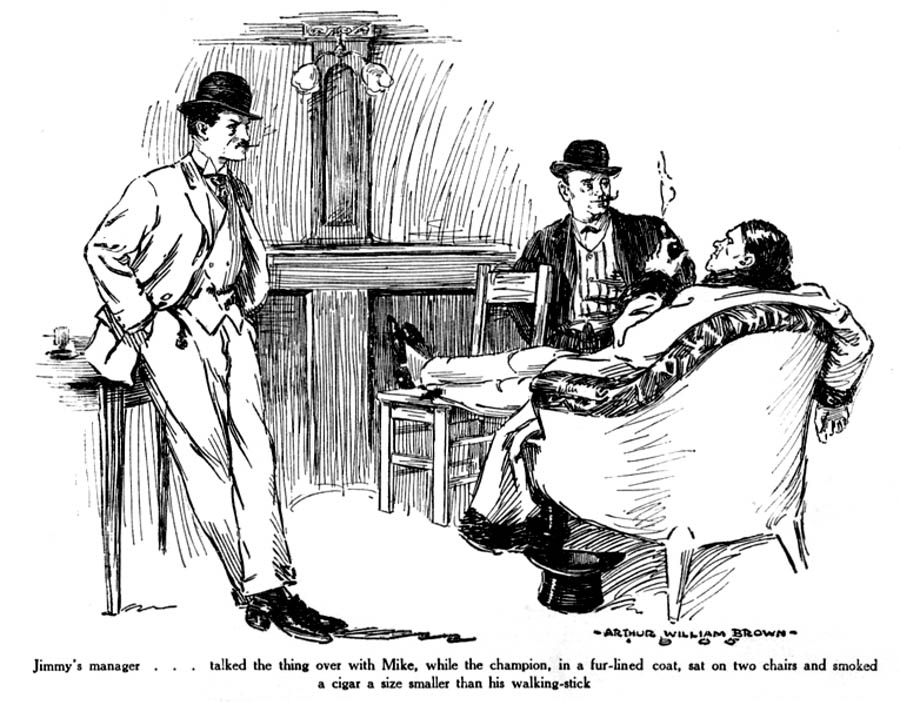
If this Brady person of whom Mike spoke meant business, said the manager, and if the purse was of that bulk which we like to see in purses, and if he was not required to scale less than a hundred and forty pounds at the ring-side, his man would be only too charmed to accommodate him. He referred to his principal.
“Does it go, Jimmy?” he asked.
“Su-u-ure,” drawled the great man amiably, reaching out with his foot for a third chair. And the thing was settled.
From the very beginning of his training, the Kid had done all that man could to meet Mike half-way. He was desperately in earnest about this fight. He realized that it meant everything to him. Once let him win the championship, and he was a made man. If he lost it again a year later, he would at least have been at the top of the tree for a while. Even an ex-champion commands respect.
But he did not mean to lose if he could once win it. His heart was in his profession. Like most pugilists he was something of a philosopher. He was of opinion that it was a better thing to seek fortune in a twenty-foot ring than to work for wages in a shop. The moral aspect of the trade did not trouble him. He felt no more enmity toward Jimmy Garvis than Jimmy felt toward him. He took it for granted that the other man objected to hard blows as little as he did himself.
He threw himself into his work with a single mind. Peter Salt had instructions to hit as hard as he liked—or could—and the Kid took the stiffest punches with an imperturbable cheerfulness which promised well for his coolness in the hour of battle. In a word, everything was running as smoothly as possible until that copy of the Manhattan Daily fell into his hands.
It was at nine fifteen, precisely, on Sunday morning that he read the article which was the cause of his undoing. He had risen at eight as usual, and had gone through a dumb-bell exercise with one pound bells, a couple of rounds with Peter Salt, a salt-water sponging, and an energetic rubbing-down. After that he had made a simple but pleasant breakfast of oatmeal, eggs and a chop. He was now basking in the sun on the low veranda of the Wheatsheaf Hotel with his Sunday paper in his hand, wondering lazily what Jimmy Garvis was doing with himself at this hour by the sad sea waves at Atlantic City.
After a while he dismissed Jimmy from his thoughts, and turned his attention to the paper.
He chuckled over the colored comicalities of the humorous supplement, skipped an indignant article about a gas bill, gazed with interest at a misty photograph of himself on the sporting page, and finally began to read a column of the magazine section headed “Is Steak a Mistake?” to which was appended as a sub-title “Eat more Fruit, say Doctors.”
He read idly at first, but soon his face grew serious and his attention became riveted. It was a specious little bit of writing, the work, evidently, of a clever man. The author, building up his case with considerable skill, and marshalling his points with excellent judgment, set out to show that the habit of eating meat was ruinous to the constitution. He instanced the Japanese, who attained to great strength on a diet of rice. He peppered his article with the names of various vegetarian athletes. Most of his arguments were old, but the Kid had never heard them before, and they electrified him. Instead of getting into condition, he felt he had been lowering his constitution and throwing away his chances of success by eating meat every day. And twice a day! It was not an hour since he had taken a great chop. The recollection chilled him. He read on.
It seemed that the writer, while deprecating meat, was not satisfied with mere vegetarianism. He went further. He advocated a diet consisting exclusively of fruit. He urged that what was natural must be the best. Cooking, he said, was unnatural, and therefore wrong. “Man’s natural diet was fruit, and nothing but fruit. It is the opinion of the medical men who lead the new thought that the man who feeds exclusively on fruit is healthier, happier, stronger, and has far greater powers of endurance than the ordinary man.”
“Powers of endurance,” murmured the Kid to himself, thinking of Jimmy Garvis’s famous rushes. He would need all the powers of endurance at his disposal to stave them off. Could fruit be the secret of victory?
“It purifies the blood,” continued the writer, “and clears the eyes. The old idea of building up strength on beefsteak is out of date. Fruit is a thousand times better. I cannot close this article more suitably than by transcribing the recipe for health given by Mr. Alexander Pontey, the famous fruitarian. ‘Begin,’ he says, ‘gradually. Eat a pound of Brazil nuts, some almonds and raisins, and six or seven bananas for breakfast; more bananas, half a dozen apples, and a fruit pudding midday; with a milk pudding and as many apples, pears, and raisins at night as you can eat. You can drop the puddings as you get on.’ In those words are contained the secret of Perfect Health.”
The paper fluttered to the ground.
“Gee!” whispered the Kid, astounded.
It was at the moment that Mike Mulroon came out into the veranda.
“Mike,” said the Kid, “you’re not trainin’ me right.”
Mike looked shocked and horrified.
“What!” he shouted.
“You’re giving me meat, and I’ve no use for meat. It isn’t right. I ought to be taking fruit.”
Mike stared.
“Fruit?” he repeated in a dazed manner.
The Kid put the paper into his hand, and indicated the important article. Mike sat down and began to plow slowly through it. He was not a rapid reader; on the other hand, he did not skip, and when he returned the paper to the Kid he had read every word of the column.
“Well?” said the Kid. “So you see.”
Mike was perplexed. He said nothing.
“You see,” continued the Kid earnestly, “I’ve been wasting strength all the time instead of putting it on. And I’m getting slower instead of quicker.”
This roused Mike to protest.
“You’re quick enough,” he said. “Whatever y’are, ye’re quick.”
“I should be quicker still,” retorted the Kid, ignoring the compliment, “if I’d the right feed. But it’s only the first week, an’ there’s plenty of time to change it. Here’s what I’ll have. Pound of Brazil nuts. And almonds and raisins. And some bananas. That’ll be breakfast. I’ll cut out this bit, an’ keep it, so we shan’t forget what I’m to have.”
Mike’s bewildered eye, roaming to and fro, lit on Peter Salt seated in the room behind the veranda with a paper.
“Peter,” he called.
Peter looked up, and came out to him.
“Peter,” he said, “here’s the Kid says he wants to give up mate of all description, and train on fruit.”
Peter looked thoughtfully at the Kid, and shook his head.
“Shouldn’t,” he said.
“You don’t understand,” cried the Kid, “and Mike, he don’t understand. It’s what doctors say. Here’s this man Pontey—Alexander Pontey. The famous fruit—fruitarian they call him. That means he’s no farmer. He knows his business. He’s a dead sporty mug, and listen what he says.”
And once more he read out the recipe for health. “You see. That’s a man who knows. He’s to the good. He’s no farmer. What he says goes. Don’t eat meat, he says, but fruit, and you’ll beat the world.”
Peter Salt lit a cigar and grunted. To those who knew him well all his grunts had their special meanings. This one, being translated signified “My dear, good young friend, you may be a clever fighter, but here you are talking straight through the center of your hat.”
Mike interpreted it correctly, and, encouraged by support, endeavored to overcome the Kid by argument.
“This Pontey,” he said——
“Alexander Pontey,” added the Kid, dwelling on the name reverently.
“What’s he done?” demanded Mike.
“He’s a famous fruitarian,” said the Kid, warily, on his defence.
“Yes, but what’s he done, Kid? Here’s me. I’ve trained bhoy after bhoy for fights on good mate, an’ I’ve fought meself—eighteen battles—on mate. An’ all my bhoys, bar wan or two, have got the decision, an’ I won thirteen of me battles. And on what, mind ye? On mate. An’ what’s your fruit gazebo done? Is he a champeen? Nit! Has he trained champeens? Not wan. Show me one bhoy that’s won a fight on fruit, and I’ll show ye twilve that’s done it on mate. Now, Kid, what do ye say to that?”
He slapped his leg triumphantly as he delivered this coup de grâce. But the Kid, who had slipped many a knock-out punch in the ring, did so now in argument.
“Ah,” he said, “but you’re forgetting, Mike, that the others, the ones your men beat, were trained on meat, too.”
For five minutes, while Peter Salt sat unmoved in his seat, blowing smoke rings, and gazing absently across the square at the gymnasium opposite, Mike wrangled with the Kid. But he was fighting a losing fight. He could not recover from that counter with which his opponent had replied to his best argument. At the end of five minutes he sat back, and mopped his forehead.
“Well,” he said despairingly, “if you must, you must.”
For, being an experienced trainer, he knew that a man getting into condition for a fight must be led, not driven. And after all, there was just a chance that the unorthodox method on which the Kid had set his heart might do him good. One of the best trainers who ever trod New York pavements has put it on record that there are no rules for training a man. Individuals and their physical needs vary as widely as do the seasons. What sets one man up would break another down. Apples and bananas, which would have reduced Mike himself to a wreck in a week, might turn the Kid into a world-beater.
But it was with a marked lack of enthusiasm that he went out that afternoon to make his purchases. The energetic citizen from whom he bought the Brazil nuts was left with the impression that he had either suffered some sad bereavement, or that he had begun to feel gloomy respecting the chances of his man in the fight with Jimmy Garvis. After much thought he favored the latter reason, and proceeded to back the Californian heavily. And Mike, with the bag of nuts in his hand, went back to the hotel to prepare the Kid’s lunch.
For the first two days the new system answered, to all appearances, admirably. The Kid was such a whole-hearted convert to fruitarianism that the diet worked on the faith-cure system. He hypnotized himself into believing that he was gaining strength and quickness, and on the evening of the second day, put in a left-right on Peter Salt’s jaw with such emphasis that the latter himself became a temporary and unwilling fruitarian, and dined off oranges and apples, chopped small. But on the third day came the reaction. He lost weight, not healthily and by slow degrees, as a man in training should, but with a rush.
“At this rate,” said Peter Salt, startled by the figures into a whirl of eloquence, “there won’t be enough of you left on the day to go into the ring.”
And Mike, lifting up his voice, cursed the man who invented Brazil nuts.
The Kid was sitting on the veranda on the afternoon of the fourth day, brooding over his loss of form, and wondering whether perhaps Mike’s old-fashioned, out-of-date diet was not, after all, as good as any other, when there entered to him, from the road, a young man in a light flannel suit. On the back of the young man’s head was a Panama, and in addition to these articles of clothing he wore that indescribable air of jaunty self-confidence which is the peculiar property of the New York newspaper young man. It is a curiously compelling air. The most reticent man becomes confidential beneath its influence. Trust magnates, fascinated by it, babble forth their most shady secrets.
“Mr. Brady, I believe,” said the young man.
“Sure,” said the Kid.
The young man drew up a chair, sat down, and tilted his hat over his eyes.
“We’ve met before,” he said, “though you don’t remember me. But don’t apologize. We can’t all be celebrities. I interviewed you after your fight with Eddie Brock. Garth’s my name. Tom Garth. I’m on the Manhattan Daily.”
“Sure,” said the Kid. “I remember you now. Have a cigar?”
“If you guess again,” said Mr. Garth, “you’ll be wrong. Well,” he continued, throwing away the match, “you’ve been doing great things since our last merry meeting. I’ve got two dollars on it that you’ll stop Jimmy in a dozen rounds. Remember that, when you get into the ring, and let it inspire you. How are you getting on here?”
“Bully,” said the Kid.
“No difficulty in getting down to the weight?”
“Dead easy.”
Mike Mulroon came out on the veranda, and was introduced.
“Looks pretty fit,” said Garth, jerking his head at the Kid.
Mike grunted disconsolately.
“Now, I’ve come here,” said Garth, “professionally. Our sporting editor wants a story about you for to-morrow, Mr. Brady. It will appear in company with alleged comic pictures of you by our artist, but these are things which must be borne patiently. We all have our troubles. I should be glad if you would answer a few questions. Peter Salt is sparring with you, isn’t he?”
“Yes.”
“He’s a good man. Saw him smother Martin Morse in a couple of rounds once in San Francisco.”
The conversation turned on Peter’s ring exploits.
“Now about yourself,” said Mr. Garth. “Once more into the breach, dear friends, once more. What do you feed on? That’s what the public wants to know. What do you eat?”
“Fruit,” said the Kid.
“Fruit!” snapped Mike.
“Yes?”
Mike stared stonily before him.
“What else?” asked Garth.
“Nothing,” said the Kid, “only fruit.”
“What!” said Garth. “Nothing?”
The Kid shook his head. The interviewer’s eyes opened.
“Well,” he said at length. “I don’t want to set my opinion up against yours, and you probably know best what’s good for you, still—fruit! Well, it’ll be the first time a man has won a championship on that, I’ll bet.”
Mike glanced at him with awakening hope. Here was a newspaper man, and so likely to be handy in an argument, backing up his own opinion on the great fruit topic.
“The Kid,” he said, “will have it that fruit is what a bhoy should train on, an’ he’s killing himself with it.”
“So I should think. Whoever heard of training on fruit!”
The Kid produced his trump card, and prepared to play it.
“You’re wrong. It purifies the blood, an’ makes you strong. Dr. Pontey says so.”
Mr. Garth sat up.
“Dr. which?” he said.
“Dr. Alexander Pontey. It’s all wrote here. Read it.”
Tom Garth took the newspaper cutting, and burst into a roar of laughter. The Kid eyed him with grave disapproval.
“Do you mean to tell me that you’ve been converted to fruitarianism by that article? You dropped meat simply on the strength of that?”
“Sure,” said the puzzled Kid.
Tom Garth rose to his feet.
“Now, look here,” he said, “before I say a word I must ask you to promise not to hit me. I enjoy life, and have no wish to be hustled out of it prematurely. Will you promise not to let your angry passions arise?”
The Kid looked at Mike, and Mike looked at the Kid. They were not feeling equal to the intellectual pressure of the conversation.
“What—” began the Kid.
“Promise,” said Garth, “go on, promise!”
“I promise,” said Mike.
“Me, too,” said the Kid. “It’s not up to me to start in jolting people.”
“Then,” said Garth, “listen. I wrote that article, and it’s meant to be funny.”
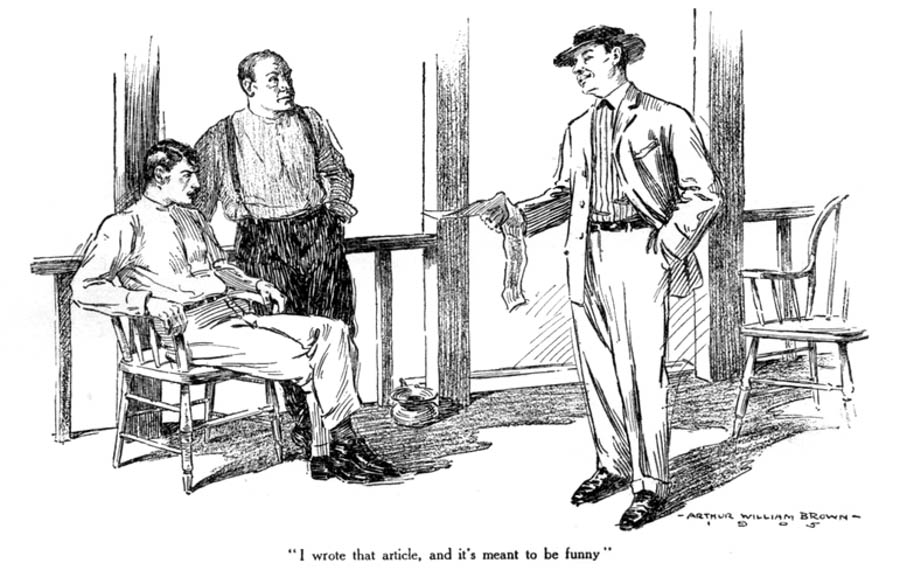
“What!”
“But so subtle and delicate is my humor that apparently the thing is misleading. Our magazine editor wanted something light last Sunday, so I did that. And you thought it was serious! Why there isn’t a word of sense in the thing. You’ll remember you promised not to hit me, won’t you.”
The Kid clutched at his last straw.
“But Dr. Pontey——”
“There isn’t such a man. I got him out of a book. I tell you the whole thing’s absurd from start to finish. Read it again, and you must see. And you’ve been living on fruit on the strength of it! Oh, Lord! It’s lucky I turned up in time, or you’d have gone into the ring a wreck—if you hadn’t died before. But why on earth didn’t you ask a doctor, if you thought of changing your diet?”
Mike had been standing open-mouthed during this speech, and now he essayed a comment. But the thought of those wasted days in which the Kid had been going back, instead of forward in his training, proved too much for him; his jaws snapped like a trap, and he strode off without a word.
At seven that evening the ranks of the fruitarians lost a proselyte.
Notes:
Bob “Ruby Robert” Fitzsimmons: b. 26 May 1863 in Helston, Cornwall, England; d. 22 October 1917 in Chicago, Illinois. Bob Fitzsimmons fought in New Zealand, Australia, and America. He established considerable fame in the last as a multiple-crowned world champion in three different weight divisions: middleweight, heavyweight, and light-heavyweight. Fitzsimmons defeated “Nonpareil” Jack Dempsey for the middleweight crown on 14 January 1891, in New Orleans, Louisiana. He resigned the title on 17 March 1897 after defeating “Gentleman” Jim Corbett for the heavyweight strap, in Carson City, Nevada. He subsequently held the light-heavyweight title, won from George Gardner on 25 November 1903, in San Francisco. Noted for immense strength, developed from a young life in a New Zealand smithy, Fitzsimmons still lives in boxing lore as one of the hardest hitting champions of all time and the acknowledged master of the “solar plexus punch,” which he used to knock out Corbett in 1897.
James Jackson “Jim, the Boilermaker” Jeffries: b. 15 April 1875 in Carrol, Ohio; d. 3 March 1953 in Burbank, California. Jim Jeffries defeated Bob Fitzsimmons for the world heavyweight crown on 9 June 1899, at Coney Island, New York. He held the title until 1905 and retired undefeated. Among his six successful title defenses, he scored two knockouts over Gentleman Jim Corbett and a second victory over Fitzsimmons.
Peter Salt: given associations in Wodehouse’s contemporary imagination of Kid Brady with the American West—a Kid Brady from Wyoming appears in Psmith, Journalist, and the Kid here fights Wallis “the Denver light-weight”—then Peter Salt might well be a veiled portrait of Peter Sullivan. Sullivan was a journeyman boxer who favored the Salt Lake City region, extending into southwestern Wyoming, and indeed contracted a career-crippling typhoid fever there in September 1910. The Morning Standard (Ogden, Utah) for 18 September 1910 (“Big Benefit for Pete Sullivan”) reports Sullivan in terms strongly reminiscent of Wodehouse’s serial: “He has fought all of the good ones in his class and has always boxed in that honest, aggressive manner that wins a permanent place in the memory of the fight fans.”
White Plains, NY: already a famous training region at the time of Wodehouse’s Kid Brady material. The locale certainly occupied Wodehouse’s imagination, appearing later in Chapter 6 of Something New (1915), where American millionaire, J. Preston Peters, recalls two weeks at the establishment under William Muldoon’s care. In fact, Wodehouse’s Mike Mulroon is likely drawn from the Irish-American William “the Solid Man” Muldoon: wrestler, strongman, boxing trainer, “physical culturist” and eventual chairman of the New York State Athletic Commission. Muldoon, like Mike, set up shop in White Plains, where he ran a health farm and trained boxers (he had previously trained John L. Sullivan and established his fame on Sullivan’s bare-knuckle victory over Jake Kilrain in 1889), wrestlers, and devotees of his system of athletics generally (including such “enervated youths” as Wodehouse spoke of in his September, 1905 installment). Muldoon was born 25 May 1852 and died 3 June 1933. The New Yorker profiled Muldoon late in his life, in its July 16, 1927 issue. The Saturday Evening Post did likewise in its September 28, 1929 issue.
wonderful straight left of his: left jab, a straight and often rapid-fire punch adopted offensively by right-handed fighters to keep opponents off balance and off guard; sometimes called a “fib” because the real danger came from the other hand, the one the jab would attempt to set up. Wodehouse’s description of Salt’s strategy—keeping the Kid against the ropes to minimize his free range—and the Kid’s response “as he ducked out of the corner” speaks to Wodehouse’s intimate knowledge of “the noble science.”
Jimmy Garvis was on a tour through the States with a theatrical company: see note to “pugilist to take to the boards” from the September, 1905 installment. See particularly this article for a broader history of boxers on stage.
smoked a cigar a size smaller than his walking stick: William Edwards’s 1888 Art of Boxing and Science of Self Defense warns specifically against “excesses that sap the system” and states that there is “none so disastrous as . . . smoking” (p.36). Edwards further cautions “it is imperative that [the professional] abstain entirely from the use of tobacco” (p.37).
not required to scale less than a hundred and forty pounds at ring-side: an allusion to body weight. Jimmy Garvis evidently now fights as a middle-weight and the Kid as a light-weight. Indeed, the Kid recently scored a seventh-round win over “Wallis, the Denver light-weight” and of course he is taking over for Joe Johnson, “colored champeen of Brooklyn at the light-weight limit.” Garvis’s manager evidently wants the stipulation in place that his man will not come down to the light-weight division, which tops out at 135 pounds. Garvis will, however, concede to fight at merely five pounds above weight, at 140 pounds, even though his middle-weight division tops out at 160 pounds. The stipulation nevertheless constitutes an edge for Garvis.
in a twenty-foot ring: Edwards’s Art of Boxing and Science of Self Defense states that: “All contests should take place in a roped square enclosure, twenty feet square or as near that as possible, with eight posts, which should be padded on the inside. Three ropes of one inch diameter should be used, the top one to be four feet from the floor or ground and the others at equal distances below it or sixteen inches apart. There should be a circle three feet in diameter drawn in the middle of the enclosure, to be known as the centre, where contestants shall meet for the beginning of each round” (p.100).
instructions to hit as hard as he liked—or could: evidently a sparring philosophy devised by Mulroon for a two-fold purpose: to train the Kid to keep his cool in the ring and to prepare him for the greater blows of the heavier fighter, Jimmy Garvis.
for his coolness: noted in Ira Wood’s 1901 manual How to Box: Boxing for Skill and Health as one of “the fine points of the art,” namely “the cool, nice head work” of the first-rate fighter (p.12). Writes Wood: “Always keep cool, and though you are getting more blows than you give, don’t for one moment get confused and want to take the gloves off or show your temper by getting angry; then is just the time to study the different ways of defense and how to land effective blows” (p.16).
dumb-bell exercise with one pound bells: In the Art of Boxing and Science of Self Defense, Edwards states: “The weight of these must never be over a pound each, for in boxing, rapidity of movement is the essential to be aimed at, so do not attempt to handle any dumb-bells that make the motions slow and labored” (p.40). Edwards adds: “The best exercise with the dumb-bells and the one that occupies most of the attention of the professional boxer, is hitting out rapidly and continuously with both hands in rapid succession. This motion must be repeated over and over again many times every turn you take with the dumb-bells, and you should increase the duration of this exercise at each practice.”
pleasant breakfast of oatmeal, eggs and a chop: in perfect accord with Edwards’s dieting system. See particularly “Breakfast Diet” (p.38).
Wheatsheaf Hotel: Here Wodehouse’s brief acquaintance with America (five weeks in 1904) fails him; though Wheatsheaf is a common name for English inns and pubs, it does not seem to be used thus in the USA. (from NM)
sad sea waves: This unusual phrase must be a reference to an 1895 music-hall song, “By the Sad Sea Waves.” (from NM)
“Is Steak a Mistake”: the vegetarian diet that Alexander Pontey puts forward is in direct refutation of period manuals on diet for fighters. Not only does Edwards prefer the 19th-century preference for “under-done to well-done meats” (pp.49–50), a commonplace in British athletic lore since Robert “Captain” Barclay Allardice’s pedestrian feats in the early 1800s, but he strongly advocates against vegetables. “Of vegetables be sparing, but a little spinach, cabbage, beetroot, or turnip won’t hurt you in ordinary training, but must be totally discarded when preparing for a severe contest of any kind” (p.50). On one level, Wodehouse seems to be merely inverting the standard diet here with his farce on “Eat more Fruit.” We nevertheless see just how wide of the mark Kid Brady’s adopted ideas are, at least by the conventional wisdom of his day.
“Eat more Fruit, say Doctors”: despite Tom Garth’s profession at the close of this installment that his fruitarian ideas were farcical, “light,” that “there isn’t a word of sense in the thing,” and that they are “absurd from start to finish,” vegetarianism and fruitarianism were, in fact, presences in early 20th century dietary practice. For instance, the International Vegetarian Union was established in Germany in 1908, shortly after the Kid Brady material, while the ideas of the founder of the German vegetarian society, Eduard Baltzer, were still part of the cultural memory of the early century. Baltzer’s ideas were carried forward by Arnold Ehret, who moved to America in 1914 to promote fruitarianism to American consumers. Moreover, Ehret’s ideas were largely tied to the German naturalist movement advocated by such avant-garde intellectuals of the 19th century as Nietzche, Goethe, and Hermann Hesse. Wodehouse’s ideas here seem not entirely flippant. He may even be having a shy at trendy German intellectual thought in a very inconspicuous way.
eating meat every day. And twice a day!: Mulroon’s system of diet is certainly consistent with period manuals. See Edwards on “Breakfast Diet” (p.38) and “Dinner Diet” (pp.49–50).
“Man’s natural diet was fruit . . .”: near direct quotation from The Curious and Diverting Adventures of Sir John Sparrow Bart. (1902) by Harold Begbie, who Wodehouse worked with and later replaced as the editor of the “By the Way” column of the Globe newspaper.
Mr. Alexander Pontey: character from The Curious and Diverting Adventures of Sir John Sparrow Bart. (1902) by Harold Begbie. See page 114 at the link above.
with a milk pudding: interestingly, boxing authorities of the day counsel strongly against milk while in championship training. Edwards, for instance, advises not to “indulge in large draughts of new milk; it is very fattening and too rich, and goes rather to the flesh and fat than to muscle” (p.38).
“Eat a pound of Brazil nuts . . . You can drop the puddings as you get on”: direct quotation from The Curious and Diverting Adventures of Sir John Sparrow Bart. (1902) by Harold Begbie. See pages 117–18 at the link above.
mate: Irish-American dialect pronunciation of “meat”
you are talking straight through the center of your hat: a Wodehousian original locution. In the sporting tradition, to punch out the top of one’s hat was a sign of utmost enthusiasm. Cf. Lord Scamperdale in R. S. Surtees’s Mr. Sponge’s Sporting Tour, Chapter 28—even though Scamp, less typically, gets his crown knocked out by an overhanging branch. The meaning of the locution in Wodehouse is akin to: “you’re speaking loudly (as in a megaphone) out of pure enthusiasm for your new, adopted system, and therefore speaking irrationally.” (But KS suggests that it is merely Wodehouse’s variation on the commonly used “you’re talking through your hat” meaning “you don’t know what you’re talking about.”)
bhoy: Irish-American dialect pronunciation of “boy”
wan: Irish-American dialect pronunciation of “one”
gazebo: Irish slang term for “fool”; also (with several variant spellings including ‘gazabo’) USA slang for an odd person, or any fellow. See this entry from Green’s Dictionary of Slang. [TG/NM]
champeen: Irish-American dialect pronunciation of “champion”
One of the best trainers . . .: very possibly “the Professor” William Muldoon himself, who was extraordinarily unorthodox in his training methods
faith-cure system: a remedy for physical ailment or disability based solely on the strength of a religious or philosophical belief (from NM)
Panama: a brimmed hat of plaited fine palm-leaf straw that connoted leisure and a kind of careless sophistication during this period
Tom Garth . . . Manhattan Daily: an amalgam of the period’s sporting journalists. In humor and attitude, Garth seems very close to Damon Runyon, though Runyon at the time of the Kid Brady serial still worked the sporting pages of the Denver Daily News. Brady of course fights “Wallis, the Denver light-weight,” which perhaps lends some credence to the association.
“If you guess again . . .”: Garth’s speech mannerisms likely denote an historical original here, consistent again with Damon Runyon. Here, he makes a humorous inversion of “Right the first time!”
Bully: admirably, worthily, in a jolly good fashion; a favorite word of President Theodore Roosevelt.
It will appear in company with alleged comic pictures of you by our artist: the practice in early 20th-century periodicals of sketching public figures, often depicted in quasi-comic representation to offset breaches of realism
Martin Morse: probably to be identified with Martin Julian, full name Stephen Martin Samwell (1869–1919): circus performer, actor, boxing manager. Martin Julian performed acrobatic feats with his sister Rose and hence Wodehouse’s possible confusion or elision, “Martin Morse”—”M or[inverted]se.” Martin Julian famously managed Robert Fitzsimmons until 1899, and Fitzsimmons had married Martin’s sister, Rose, in 1894. The association of the two in Wodehouse’s imagination is clearly evident in this installment.
Once more into the breach, dear friends, once more: A slight misquotation of Shakespeare; in Henry V (III, i), it’s “unto” the breach. (from IM)
not to let your angry passions rise: Dr. Isaac Watts, “Against Quarreling and Fighting” from Divine Songs for Children (1715):
But, children, you should never let
Such angry passions rise;
Your little hands were never made
To tear each other’s eyes. (from NM)
equal to the intellectual pressure: W. S. Gilbert, The Gondoliers (1889), Act II:
Don Alhambra (puzzled): I’m afraid I’m not quite equal to the intellectual pressure of the conversation. (from IM)
jolting people: likely a slang phrase for physical assault; otherwise standard meaning, as in the process of jolting or shaking up another
And you thought it was serious!: see fruitarian notes above
I got him out of a book: The Curious and Diverting Adventures of Sir John Sparrow Bart. (1902) by Harold Begbie. See link above, page 114.
At seven that evening . . .: i.e., at dinner hour that night, Kid Brady feasted on meat.
—Notes by Troy Gregory, with contributions from Ian Michaud, Neil Midkiff, and Karen Shotting
Printer’s errors corrected above:
Magazine had ‘ “Mr. Brady,” I believe, said the young man. ’; corrected by moving the closing quotes to after ‘believe’.
Magazine had ‘ “If you guess again,” said Mr. Garth. “You’ll be wrong.” ’; corrected to read as a single spoken sentence with a comma after Garth and a lowercase ‘you’ll’.
Two other speeches were missing closing quotes which have been supplied silently.
—Edited by Neil Midkiff