 Madame Eulalie’s Rare Plums
Pearson’s Magazine (US), January 1906
 LANCY’S
Saloon in the Bowery is not far from the one made famous by Bishop Potter, but
it differs largely in character from its neighbor. It is looked on with
suspicion by the police, who consider it, in the vernacular, a “pool-joint.” In
other words, a great deal of gambling goes on there. Indeed, the attentions of
the Force are so marked that Clancy, who is something of a humorist, has often
thought of exhibiting in his window the notice, “Please wipe your boots before
raiding.” There is nothing much known against Clancy himself. The quarrel the
police have with him has to do chiefly with the company he keeps, for his
patrons include some of the most finished scoundrels in New York.
LANCY’S
Saloon in the Bowery is not far from the one made famous by Bishop Potter, but
it differs largely in character from its neighbor. It is looked on with
suspicion by the police, who consider it, in the vernacular, a “pool-joint.” In
other words, a great deal of gambling goes on there. Indeed, the attentions of
the Force are so marked that Clancy, who is something of a humorist, has often
thought of exhibiting in his window the notice, “Please wipe your boots before
raiding.” There is nothing much known against Clancy himself. The quarrel the
police have with him has to do chiefly with the company he keeps, for his
patrons include some of the most finished scoundrels in New York.
Some days before the date fixed for the Kid’s fight with Jimmy Garvis for the championship, three of the saloon’s older customers sat at a little table near the bar. Like everybody else in the city they were discussing the coming battle.
“Say, Kid’s gone up in de betting,” said one of the three.
“How?”
“Sure. Six to four.”
The two speakers were typical products of the Bowery at its worst. There is nothing innately vicious about the Bowery atmosphere, hundreds work and live honestly in that noisy quarter; but it is apt to produce citizens who are of no extreme value to the community.
The third of the trio was higher in the social scale. He had a certain air of refinement. He looked as if he was accustomed to move in a somewhat loftier sphere of life. He was, as a matter of fact, something of a celebrity in his own line. Until recently he had been making a good income by card-sharping on Atlantic liners. His face was familiar in the smoke-room of many a strasse hotel. It was to prevent its becoming too familiar that he was now taking a brief holiday on shore. His occupation was thus to a great extent gone, for it is only on liners that that child-like trust which the poker player so admires in his fellow-man is to be found. Players in New York were keener, and the resultant gains smaller. The best holiday being a change of occupation, he had temporarily abandoned cards, and was now endeavoring to make both ends meet by means of the Higher Finance. He had betted heavily against Kid Brady, and he meant to insure himself against loss.
“So much the better for us,” he said. “I wish I could find some rub who’d give me a hundred to four. The bigger the odds are, the more we win. We can’t lose.” The man who had spoken first looked cautiously around, and was reassured to find that nobody was within earshot.
“Say,” he whispered, “what’s doing? I ain’t next to de game.”
“It is perfectly simple. Brady is not going to fight.”
“On your way! What’s to keep him?”
“I thought I had made that clear. If you must be told again, listen now. I happen to know that the Kid will be in Carson City at least two days before the fight. He is to stop at Pauley’s. Mike Mulroon will be with him, and Peter Salt. They have engaged rooms. We must go, too, take rooms at the same hotel, kidnap him, and keep him till after the fight.”
“But, say——”
“Yes, yes,” said the other impatiently, “you’re going to say that it can’t be done. It can be done. It will be difficult, but it only requires care. I know the number of the Kid’s room. It is seventy-three, on the second floor. Mulroon and Salt are sleeping in seventy-four, across the passage. I have been there and talked to the hotel clerk. Two other rooms in the same passage are vacant. I telegraphed for them today. Now, listen. On the night before the fight the Kid will go to bed early. Mulroon and Salt will see him to bed, and then go down-town or to the smoking-room. That will be our time. We let him get to sleep, go to his room——”
“ ’Twill be locked, sure.”
“That won’t keep us long. We get in, chloroform him, and carry him down the passage to one of our rooms. There we tie him up and keep him, and one of you will stay in the room and guard him. Lock the door, and don’t let any one come in. I will tell them that you’re ill, and not to be disturbed.”
“But if de Kid doesn’t fight,” objected one of his companions, “all de bets ’ll be off.”
“I shall look after that. You can make your minds easy about the bets.”
“Put us wise, mister.”
“Not yet. You shall know when we get to Pauley’s. Not till then. I’m taking no risks.”
It was Peter Salt who had insisted that the Kid should stay at Pauley’s on the night before the fight. There was a grain of superstition in Peter, and his belief in the luck of Pauley’s amounted to a craze. Certainly past events justified it. The house had never sent a loser into the ring. Jack O’Neil had stopped there on the night before he beat Smith, the Australian middle-weight. Frank Willard had used it as his headquarters on three separate occasions, and each time he had won. It had not been a difficult matter to persuade Mike Mulroon that a couple of nights at Pauley’s spelt victory.
So thither the Kid went with his guardians, and from the day he arrived the hotel began to do double business. The bar-room was crowded every night with sportsmen who hoped to see the Kid and judge of his form before placing their money. But Mike, whom habit had made wary in these matters, kept his man close, started on the daily walk from the back of the house, and did the necessary sparring in a private room behind locked doors. His spare time he spent in receiving interviewers from all cities—for all the leading journals had their men on the spot—and informing them that the Kid had never felt better in his life, but was seeing no visitors. So the newspaper men had to go away content with that, and wire highly imaginative and worked up articles to their editors on: “What Mulroon Thinks.”
Jimmy Garvis, in the meantime, housed at the Hotel Splendid, two blocks down the street, made no secret of his intention of putting it all over his opponent, as he phrased it. Public opinion wavered. But the betting continued six to four on Brady until the morning of the last day of waiting. Nobody appeared to know what had changed it. No new reports had come in as to the men’s form. But at mid-day even money was being offered and taken, and in the evening Mulroon, repairing to the bar after seeing his man to bed, found people, who certainly looked perfectly sane and sober, offering ten to six against the Kid. And other people, equally sensible to all appearances, were fighting shy of taking the odds.
Mike had the courage of his convictions. He had seen Jimmy Garvis fight, and he had seen the Kid fight, and he had never been so convinced of anything in his life as of the superiority of the latter. For skill there was no comparison. The champion was a willing fighter and had no objection to taking whatever his man liked to give him, provided he could put in something of his own in exchange. He was all pluck and muscle. But the Kid was there with the goods when it came to science. Unless one of the champion’s fierce swings came home on a vital spot, his man must win.
His Irish blood was up. He joined the gathering at the bar, and took every offer that was made. His confidence led others to follow his example, and gradually the odds were reduced. By that time the finances of Mike were in a perilous position. His liabilities, if the Kid were to lose, would sweep away the savings of a busy life. For a moment he thought of hedging. Then he set his jaw and turned away. It was an insult to himself to think a man he had trained and watched over could be beaten so contemptibly. He believed in the Kid, and he would back his belief to his last dollar. But he was mopping his forehead as he left the bar at midnight to take a last look at his man. He turned the handle of Room 73 softly, and peeped in.
“Sleepin’ like a baby,” he murmured, and went off to bed, content.
It was not until the following evening that he began to have apprehensions. During the day the Kid had remained in bed, dozing. He was well below the weight agreed upon in the articles of the battle, so that it would not matter if he was to put on a couple of pounds before he entered the ring. In fact, Mike generally liked his men to begin their fight a shade on the heavy side. He had seen too many fail through being over finely drawn.
But when the time approached for the contest, for the first time he could not restrain a doubt. Somehow the Kid did not look that picture of all that was fit and well which he had presented to a small, but select and admiring audience on the previous evening. There did not seem so much of him. He was, moreover, taciturn. He did not speak a word from the time he rose from his bed. To Mike’s occasional questions he replied with grunts. Peter Salt himself could not have been less conversational. This, however, did not trouble Mike to any great extent. The Kid had always relapsed into a more or less unbroken silence on the day of a fight, and Mike had respected the eccentricity of genius and refrained from bothering him with talk.
But the matter of his weight was more serious. Instead of having put on a couple of pounds, he had lost five. And when a boxer suddenly loses weight at the end of a course of training, it is ominous.
Looking at him, too, Mike could not resist a feeling that there was something missing, something more than a few pounds. A man in perfect training seems to diffuse an atmosphere of electricity from within. There is an indefinable something about him which tells the practised eye that he is exactly fit, that physically nothing more can be done to improve him. Yesterday the Kid had worn this air. To-day he had lost it. He did not look unhealthy, but he certainly did not look as if he had been training for a month.
These things Mike’s mind perceived dimly, but sufficiently clearly to make him feel gloomy and ill at ease.
“Hwhat is ut?” he said to Peter Salt, as he had said on another occasion when the waywardness of the Kid’s mood had caused him discomfort. “Do ye see anything, Peter? Is the lad well?”
Peter Salt shrugged his shoulders. He, too, had noticed the alteration.
“He looks,” he said slowly, “as if he’d been doped.”
Mike started. The thing was incredible. Yet cases had been known where a pugilist had been drugged on the eve of a contest.
“Peter, it can’t be! My heavy hand on the man that did it.”
“Doctor,” said Peter briefly.
Mike saw his point. A doctor would examine the men before they entered the ring. If drugs had been administered, he could not fail to detect them.
Half an hour later his fears were dispelled. The doctor passed the Kid without hesitation. He looked very keenly at him, however, and after the examination he did a thing which would have disturbed Mike Mulroon not a little if he had seen it. He sought out a sporting friend, and unostentatiously betted twenty dollars with him, giving the odds, that Jimmy Garvis would retain the championship. “If a man in that condition can put it over Jimmy, I’ll eat my stethoscope,” he said to himself. “What on earth can Mulroon have been doing to him? Why, the boy’s not trained worth a cent!”
The hall was filling rapidly now. All sorts and conditions of men were shuffling their way past the knees of those already seated, and establishing themselves in their places; men in evening dress, looking prosperous and comfortably excited; men in blue jerseys, smoking villainous cigars and shouting greetings to distant friends in strange dialects. Here and there an impassive black face showed up among the white. At one side of the ring was the reporters’ table. Keen-faced, weary-eyed young men sat here, nibbling pencils and drawing idly in note-books. The atmosphere was charged with smoke.
A man in evening dress clambered with an effort into the ring, to be greeted with a round of applause and cries for silence.
“Gentlemen,” he shouted, “I must ask you kindly to stop smoking.”
The effect of this request on the audience was not remarkable. A few conscience-stricken sportsmen threw down their cigars hastily and ground the lighted ends under foot, but the majority continued to smoke, though for the most part in a furtive manner behind a protecting hand. The referee, having got his request off his mind, did not seem to care about pressing the point. He made a signal to some one invisible in the passage that led to the dressing-rooms, and the next moment a roar of welcome sent the smoke-cloud swirling, as the champion, clad in a long blue bath-robe, ducked under the ropes, and seated himself with a bow and a grin in the farther corner. And the roar greeted the Kid, in a pink bath-robe. Each pugilist was attended by three companions, burly and jersey-clad. Mike Mulroon and Peter Salt, in the Kid’s corner, came in for a special cheer on their own account.
The referee climbed into the ring again. Dead silence reigned in all parts of the building. “Gentlemen, this is a fight between Jimmy Garvis of California”—a wave of the hand toward the farther corner, a shout of applause from the audience, and a gratified bow from Mr. Garvis—“and Kid Brady of New York”—another wave of the hand, and renewed cheering—“for the light-weight championship of the United States. The fight is for—” He paused. “I must wait,” he said in a pained voice, “until those gentlemen at the door are quiet.”
For what seemed to be a bye-battle on a small scale had suddenly begun at the entrance to the hall. Two doorkeepers were struggling with a third man, and a group had gathered around to watch.
“Silence! Order! Bounce him!” roared the justly indignant hall.
From the center of the struggling group a voice made itself heard.
“Mike!” it cried. “Mike! Mike Mulroon!”
Mulroon literally sprang into the air. He stood gasping.
“Go and tell your friend, Mr. Mulroon,” said the referee severely, “to be quiet, or he must leave the hall. He is interrupting the proceedings.”
There was a crash. One of the doorkeepers flew back against the wood panel. A small, compact figure darted past him and flung himself into the ring.
“Friend!” shouted Mike Mulroon. “But, friend! By the Powers, ’tis the Kid himself!”
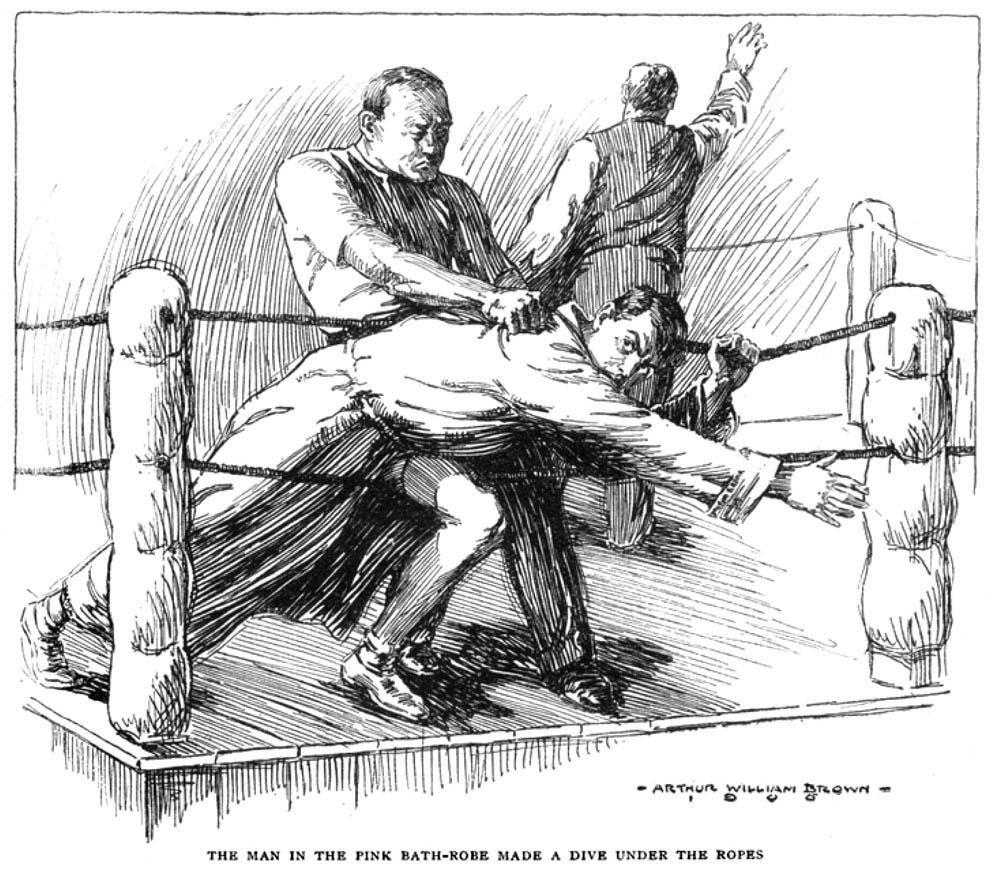
The noise was deafening. Everybody in the building was standing, everybody was shouting. The man in the pink bath-robe made a dive under the ropes, but Mike was too quick for him. He seized him in a grip of steel. Two policemen, stationed at the ring-side, closed in on the captive, and hustled him out of the hall. The referee stood in the middle of the ring, sawing the air with his hands in a fruitless appeal for silence. Beside him stood the Kid, panting and disheveled, but himself beyond the shadow of a doubt. The howls died away.
“Gentlemen,” said the referee rapidly, “in the whole course of my ring experience I have never met a case like this. Some one has been playing it on us. There has been foul play. If you want to know who the man I introduced to you just now really is, you had better read your newspaper for the next few days, when he will be up in court. I can tell you who he is not. He is not Kid Brady. This is Kid Brady.”
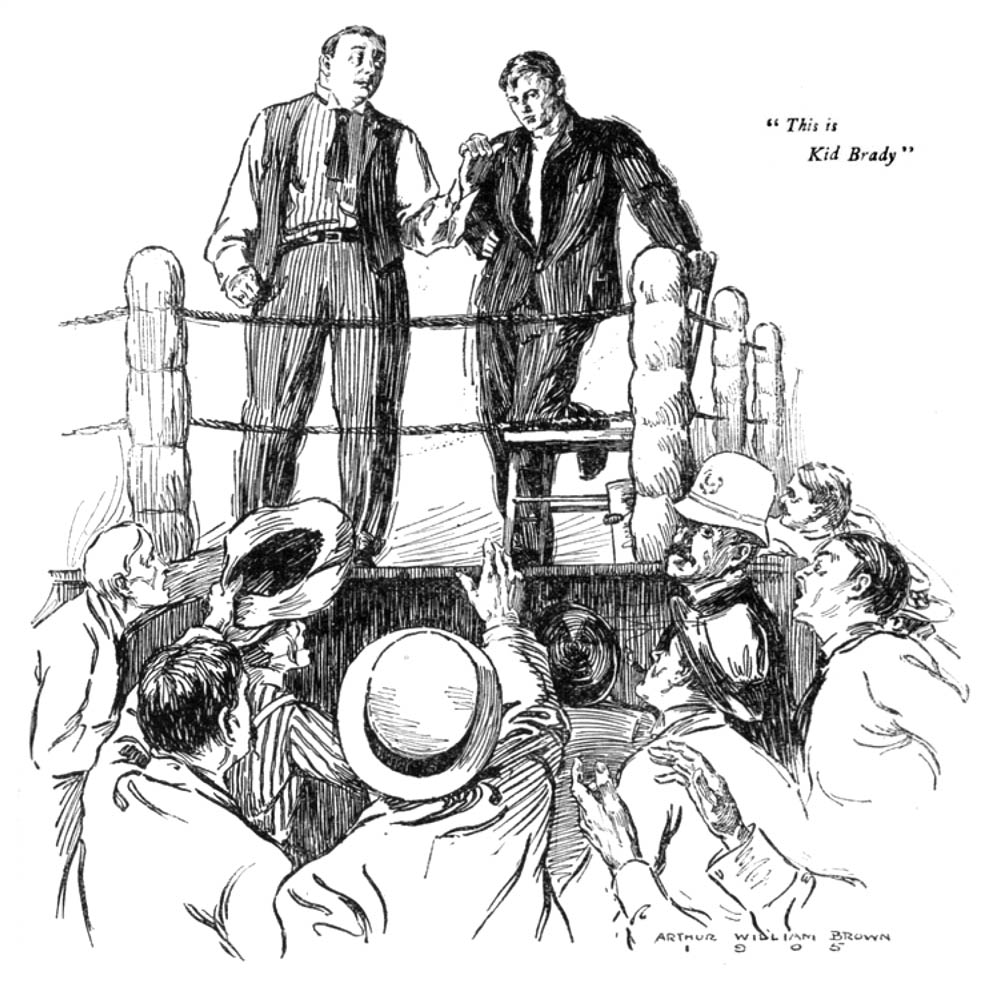
Applause.
“Gentlemen, under the circumstances I must crave your kind indulgence. The championship fight will be postponed for half an hour, to enable Brady to put on his fighting clothes. During the intermission Tom Allen will spar with Joe Watson. Gentlemen, I thank you most sincerely.”
The Kid’s story did not take long to tell. He had wakened, he said, with a bad taste in his mouth, to find himself in a strange room, with a gag between his teeth and ropes around his hands and ankles. After several hours’ labor he had loosened these, and taking advantage of the fact that his warder, wearying probably of his charge, and thinking that he could trust the ropes to guard the prisoner, had left the room, he had freed himself, broken the lock, and escaped. That was all he knew.
The rest came out at the trial. It seemed that the Kid’s double was an out-of-work actor who had consorted with the baser kind of sporting man, and had thus fallen in with the astute card-sharper who patronized Clancy’s Saloon in the Bowery. The latter had seen the possibilities that lay in his resemblance to the Kid. With a little make-up, such as the actor knew well how to apply, their best friends could hardly tell them apart. His scheme was simplicity itself. The “double” would appear in the ring as the Kid, be summarily despatched by the unsuspecting Mr. Garvis, and thus win for the confederate the extensive bets he had made. But for the Kid’s unexpected reappearance, nothing could have prevented the success of the plan.
As for the fight—if you read the sporting pages in the papers you will know all about that. There were columns describing how Jimmy Garvis, going in to hit from the first sound of the gong, had the best of the opening rounds, nearly put his opponent out in the fifth, and ended the sixth with a distinct balance of points in his favor; how he seemed to weaken in the seventh and eighth; and, finally, how in the second minute of the ninth, the Kid, pulling himself together, sent in a blow with his right which made him light-weight champion of America. For the details, picturesque as only an American journalist can make them, the reader is referred to these official reports.
The Story of “How Kid Brady Assisted a Damsel in Distress” will be printed in the March Pearson’s.
Notes:
Clancy’s Saloon: Irish saloon and betting house, evidently well connected; see note on “pool-joint” below
the Bowery: historically, an infamous street in Manhattan noted for cheap popular entertainment and a vibrant, diverse nightlife. At the time of the Kid Brady stories, New Yorkers and Americans generally were apt to view the Bowery in starkly contrasted fashions. On the one hand, established citizens viewed the neighborhood as a cesspool of disreputable life that provided cheap lodging and entertainment to transient cultures such as newly arrived American immigrants, the unemployed or unemployable, visitors to NY out for a lark, and soldiers on shore leave. Such a view was quick to note the thug life of the region and to accentuate its subculture of gaming, drunkenness, prostitution, alternative (gay and lesbian, historically “fairy”) lifestyles, saloon life, and riot generally. On the other hand, the more avant-garde celebrated the region’s vibrant bohemian life and saw there the genesis of something much larger, a region, indeed, where early vaudeville and American popular culture and popular entertainment took root. Wodehouse’s American contemporary Stephen Crane said simply of the Bowery that it was “the most interesting place in New York,” while Vaudeville historian Donald Travis Stewart claims “the Bowery is the cradle of American entertainment.”
Though Wodehouse’s views, we might comfortably assume, ran to the more liberal spectrum, the region would live in his imagination in some ambivalence. As late as Service with a Smile (1961), Lord Ickenham would reprimand his nephew Pongo Twistleton for his peculiar ideas concerning the goings-on at Blandings Castle: “You appear to look on that refined home as a kind of Bowery saloon with bodies being hurled through the swing doors all the time, and bounced along the sidewalk” (ch. 2, §2).
the one made famous by Bishop Potter: the Subway Tavern at the corner of Bleecker and Mulberry, in Manhattan. [Wodehouse had already mentioned it in the British Vanity Fair in 1904. —NM]
Bishop Potter: Henry Codman Potter, b. 25 May 1835 in Schenectady, NY; d. 21 July 1908. 7th Bishop of the Episcopal Diocese of New York, from 1887 to 1908. Potter was a social reformer noted for his progressive thoughts and particularly for the institutions he implemented for New York’s working-class poor, such as educational reform (initially geared toward the children of immigrant workers), working-class social clubs, and church youth programs and day-cares.
differs largely in character from its neighbor: Potter dubbed the Subway Tavern “a moral tavern” and advocated moderation and even abstinence. Potter’s tavern served soda as the preferred alternative to alcohol and limited the number of alcoholic beverages that patrons could receive—preferably one, never more than two. His social experiment was christened on 2 August 1904 and was opened to a large, curious public in the familiar form of a church service, complete with Doxology and Potter’s blessing to patrons and visitors. The Subway Tavern lasted exactly one year, from August 1904 to August 1905. The Sacred Heart Review: For God and Country reported in its 9 September 1905 issue (34:11) “Bishop Potter’s Saloon Fails”: “The Subway Tavern in New York, which was opened with Bishop Potter’s benediction, and which was hailed by many as a step toward the solution of the drink problem in New York, has given up the battle. Henceforth, it will be a plain, every-day saloon, without any pretense at being a moral force. ‘You can’t follow the Lord and chase the devil at the same time,’ says the new manager. ‘I am going to run this place hereafter as a plain gin mill.’ ” For the excitement surrounding its opening, see this 4 August 1904 New York Times article. For the tavern’s close and the failure of Potter’s social experiment, see this 31 August 1905 New York Times article.
a “pool-joint”: poolroom, a particularly lucrative gaming establishment because of its government endorsement through the Gambling Commission. The proprietors of such establishments often reached high up the social ladder, even to State senators, and were therefore noted for exerting the particular corruption of “fixing” sporting events, particularly such easily manipulated events as in the fight game. Such establishments played the odds, and the odds determined the outcome. Though poolrooms were officially censured and exposed in July 1900 for their shady dealings, poolrooms continued throughout this period to operate under government “protection,” and they therefore lived in the better-informed imagination as reminders of corruption and enemies to sporting. See this 20 July 1900 New York Times article.
“Please wipe your boots before raiding”: not merely humorous but one of Wodehouse’s typically ironic understatements, here concerning the out-of-reach nature of the proprietors of such establishments. They were typically beyond the reach of the police because of their ties to corrupt politicians or criminal kingpins with political aspirations or connections. Clancy himself therefore was little known to the public (i.e., for his criminal behavior). Those who patronized his establishment were better known to the public, because of their run-ins with police and their publicized doings in, for instance, the National Police Gazette—a periodical that frequently reported on the fashionable fight scene. Wodehouse’s knowledge of the workings of corruption and the shadier side of the sporting life should throw his understated good humor, here as elsewhere, in a much more significant light. Such apparently off-hand allusions, in fact, open the text much larger significations.
his patrons include some of the most finished scoundrels in New York: likely an allusion to the front-line men involved in the rigging of bets, fixing of bouts, and in extortion and corruption more generally, as again alluded to here.
Six to four: fractional betting odds, in favor of the desired outcome. Six to four in the Kid’s favor was an equivalent return on the dollar of 1.50. For instance, a $10 winning bet would return $15.
card-sharping: using skill and deception to swindle others at card games, typically poker
the smoke-room of many a strasse hotel: “strasse” is German for street, literally the common rooms of road-side or main thoroughfare hotels; figuratively, the common area on Atlantic liners, where patrons gather to mingle
the Higher Finance: wagering money at fixed odds against a larger, gambling community rather than against an established table for an agreed-upon pot, as is typical at cards.
rub: more often spelled “rube” or “reub”; an unsophisticated or naïve person, especially one from a rural area; derived from the name “Reuben” [NM]
I ain’t next to de game: I don’t know the scheme or scam; i.e., fill me in
On your way!: an exclamation of disbelief, akin to “you must be joking”
Carson City: Nevada was the first state to legalize prizefighting, in 1897, to attract the tourism revenue associated with the Bob Fitzsimmons–James Corbett fight. [NM]
kidnap him: if intentional an almost unforgivable pun, given Brady’s full moniker
The house had never sent a loser into the ring: superstitious anecdotes abound in boxing lore; here, so small and apparently innocuous a detail again belies Wodehouse’s intimate knowledge of boxing culture.
Jack O’Neil: Jack O’Neil appears regularly in the “Small Talk About Boxers: Lively Gossip of Interest Concerning the Doings of the Fighters” section of The Police Gazette, New York City, likely a source for much of the minutiae of Wodehouse’s Kid Brady story. See for instance this column [which also mentions Wodehouse’s idol “Kid” McCoy —NM].
a couple of nights at Pauley’s spelt victory: as with “the faith-cure system” from the last installment, a superstitious belief that often reinforced confidence and therefore the likelihood of victory, like a self-fulfilling prophecy.
and wire highly imaginative and worked up articles to their editors on: “What Mulroon Thinks”: indicative of an older brand of sports reporting where journalists embellished what little information they could collect with conjecture, anecdote, stock information, backstory, etc., concerning an athlete or contest between athletes. Largely also a product of the sports pulp. Though this type of writing was chiefly a feature of amateur sport and pulp publications, and though it was slowly replaced by the statistical and factual reporting of the professional era, it still was recognizable by mid-century, fifty years following Wodehouse’s comment. The American golfer Ben Hogan, for instance, as a boy would have been familiar with the type of reporting alluded to here by Wodehouse. Later in life Hogan complained to a reporter in search of an angle: “One of these days a deaf mute is going to win a golf tournament, and you guys won’t be able to write a story.”
putting it all over his opponent: proverbial smack talk to increase interest in the outcome of the fight and more particularly of the betting
at mid-day even money was being offered and taken: a wagering proposition where the odds are even, often referred to as 50–50. Bettors at even odds stand to double their principal: 50–50 or one-to-one in the Kid’s favor was an equivalent return on the dollar of 2.00. For instance, a $10 winning bet would return $20.
This is an important distinction in the text for bettors and sportsmen in the know, presumably Wodehouse’s imagined audience. Even odds meant that the fight could be contested without rigging, so that literally the best man could win. Wodehouse will indeed refuse to tell us the particulars of the fight at installment’s end. Here again Wodehouse’s irony is rife with meaning. There would, of course, be no point in describing a fixed fight, as Wodehouse suggests most professional or title fights were. By not describing a fight at even odds, Wodehouse is denying his audience in the know—bet-savvy sportsmen—the very thing they themselves care less about: the science of the fight itself.
all pluck and muscle: denoting a fighter who relies on courage and brute strength to carry him to victory; generally the stronger fighter, or often the fighter at greater weight than his opponent, who is not afraid to be hit if he can return fire, almost always to greater effect
the goods when it came to science: denoting a fighter who relies on the science of defense, of parrying blows and generally waiting patiently for an opening or a mistake on his opponent’s behalf, upon which he can capitalize. [From his earliest writing days, Wodehouse frequently praised science in boxing, both in his sports reporting (here is a 1901 example) and his fiction, including his 1902 novel The Pothunters, in which “the feather-weights gave excellent exhibitions of science” in Chapter I. —NM]
on a vital spot: with the indefinite article, any weak spot on a boxer that could temporarily weaken and immobilize him, often for the ten count: viz., solar plexus, point of the chin, kidney area (illegal punch), behind the ear (rabbit punch, now illegal); with the definite article, either the button as it is typically conceived: the spot on the center of the chin which will drop a fighter instantly; or, the button as Wodehouse conceives it:
The “mark,” it may be explained for the benefit of the non-pugilistic, is that portion of the human form divine which lies hid behind the third button of the waistcoat. It covers—in a most inadequate way—the wind, and even a gentle tap in the locality is apt to produce a fleeting sense of discomfort. A genuine flush hit on the spot, shrewdly administered by a muscular arm with the weight of the body behind it, causes the passive agent in the transaction to wish fervently, as far as he is at the moment physically capable of wishing anything, that he had never been born.
(The Captain, September 1903, “The Manœuvres of Charteris”)
hedging: putting money on both parties to minimize losses
He was well below the weight agreed upon in the articles of the battle: the Kid, remember, was to fight within the light-weight limit, no more than 135 lb; his opponent was to fight five pounds over limit. Such a weight difference between fighters is substantial.
Mike generally liked his men to begin their fight a shade on the heavy side: to maximize hitting power as well as to keep a little energy in reserve; to avoid feeling tired and sluggish partway through a contest
when a boxer suddenly loses weight at the end of a course of training, it is ominous: cutting weight just before a contest is usually the result of a poor diet while training: i.e., being too heavy and needing to shed pounds to make weight; such a practice results in drastically reduced levels of performance because it leads to fatigue and sluggishness.
“Hwhat is ut?”: absolute statement of disbelief: the hyper-corrective “h” is more Cockney than Midwest, though the utterance as a whole works. Peter evidently cannot believe what he sees. Literally, “what is it” or “what is that”?
cases had been known where a pugilist had been drugged on the eve of a contest: the case closest to Wodehouse’s memory here was in the 1890s in Australia’s thriving fight game, reported in the sporting pages of such British periodicals as the Sporting Life and The Sporting Times. Benny Monks was allegedly doped before a contest with the much lighter Joe Pluto, evidently the underdog in the betting, and subsequently Monks lost his bout.
Much closer to Wodehouse’s memory would have been the incident in the 1904 Olympics involving not a boxer but the marathon runner Thomas Hicks. Hicks nearly overdosed on a mixture of strychnine and brandy. Such doping was common and included formulae of heroin, cocaine, caffeine, strychnine, and alcohol (often brandy or wine). Heroin and cocaine were available without prescription into the 1920s.
I must ask you kindly to stop smoking: typically the cry at vaudeville saloon entertainments because of the increased likelihood of fire from the cigarette or cigar ends of excited and hence careless patrons
for the light-weight championship of the United States: contested since 1896
Bounce him!: remove him by force from the premises
Tom Allen: likely a reference to the British-born American heavyweight champion who came to America in 1867 and won the title in 1869. Though Tom Allen died in April 1904, nothing in Wodehouse firmly suggests, aside from such topical allusions as to Bishop Potter’s Subway Tavern, that the Kid Brady material is contemporaneously set in the 1905–06 of the publication date. Wodehouse is typically fluid with dates.
spar: a display of boxing only, neither fighter vying for the outright victory over the other; sparring matches featured boxing rather than individual boxers; used here merely to whet the appetite of the audience and to train them on the “science” of the sport
As for the fight—if you read the sporting pages in the papers you will know all about that: initially it appears odd that Wodehouse should opt not to report the fight, given his obvious knowledge of boxing, boxing lore, and his careful building up of Kid Brady for the past three installments. One plausible explanation involves satiric intent: Wodehouse likely refuses to report the fight because fights were notoriously rigged or fixed affairs, and therefore he is suggesting that those with an interest in the fight care only about the outcome, which he does report. This view is particularly interesting in light of the last minute odds against Brady, ten to six. Such odds would turn the fight even more in Brady’s favor, if Garvis himself and his camp were true members of the fight game and properly rewarded for taking the fall. A rematch would obviously see Brady as the favored, and so make likely a “win” by Garvis. Wodehouse therefore is exposing the shadier side of boxing.
a distinct balance of points in his favor: fights are judged by an odd number of judges, typically three; judges score each round and tabulate their scores at the end of the fight, if the fight should go the distance. Knockouts or technical knockouts render the judges’ scores null and void. Because of the odd number of judges, in the event of a contest going the distance, one clear victor usually emerges; reported to be the most objective way to adjudicate a contest, but in actuality the easiest way to rig a fight.
For the details, picturesque as only an American journalist can make them, the reader is referred to these official reports: most certainly a shy at American sports journalism, particularly for reasons noted above. “Picturesque” here is likely ironic, as noted in the Oxford English Dictionary when applied to language or narrative: “careless of truth, esp. for effect.” See for instance the OED’s illustrative quotation for this meaning just prior to Wodehouse’s Kid Brady stories: “1904 J. London Sea-wolf vi. 66 For the first time in my life I experienced the desire to murder—‘saw red,’ as some of our picturesque writers phrase it.” Note also, in such a construction, the biting meaning of “official.”
—Notes by Troy Gregory, with contributions from Neil Midkiff
Printer’s errors corrected above:
Magazine had “It was an insult to himself to think a man he had rained and watched over”; corrected to “trained”