 Madame Eulalie’s Rare Plums
The Weekly Dispatch (London), Sunday, January 24, 1926

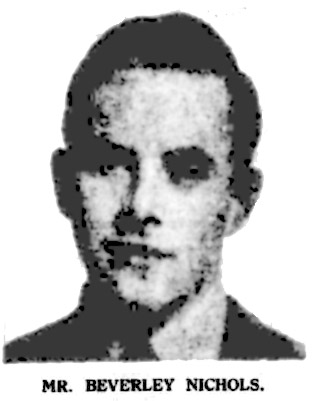
THE first thing about Mr. Beverley Nichols’s book which anyone who is writing a review ought to mention is the charming note of amiability that runs through it. Its tone throughout is pleasant and friendly, and the extraordinary spectacle is presented of a man, admittedly young and obviously clever, who can see a celebrity without wanting to throw a brick at him. If all young men were like Beverley Nichols this would be a better world for celebrities to live in.
 A tough time they have had, poor devils, in the last few years. If you saw a man slinking down side-streets with his hat drawn over his eyes and a nervous twitch in the back of his neck, you could be pretty sure that it was some wretched celebrity trying to avoid the gangs of brilliant youths who were scouring the town to find him and include their opinion of his method of drinking soup in their forthcoming volumes of pungent personalities.
Self-Respect Restored.
There was no escape for them. If they kept out of “Written in Vitriol,” they were sure to find themselves in “Blisters I Have Met,” by the Young Man With a Bludgeon. I have had celebrities break down in my presence and cry like children.
“He says I’ve got a face like a fish,” one would sob. “This fellow,” another would moan, “says he met me at lunch one day and I got the spaghetti twisted round my neck and the head waiter had to cut me loose with a Boy Scout pocket-knife to keep me from strangling.” Well, I would say, “There! There!” and try to cheer them up, but it was no good. It needed a book like “Twenty-Five” to bring back their self-respect.
A cheery volume and well written withal, as anybody who has read Mr. Nichols’s novels would have anticipated. Having reached the age of twenty-five, and learning from the medical profession that by that time a young man’s bones are duly set and his teeth all present and correct, Mr. Nichols decided to wait no longer before publishing his autobiography.
As he very justly says, by the time one is thirty—(are there really people as old as that? Poor wrecks!)—the first flush of enthusiasm may have worn off to such an extent that one will get practically no kick even out of seeing Arnold Bennett twist his forelock.
Crowded Days.
So here it all is—the Complete Life of Beverly Nichols, with thumb-nail sketches of all the interesting people he has met, set down not in malice and written by a stylist and a man of humour. And you will have to admit that Mr. Nichols has managed to crowd a remarkable number of interesting people into a fairly brief life. Some he met when he was President of the Oxford Union, others while travelling widely about the world.
The bag includes queens, Cabinet Ministers, actors, authors, pugilists, painters, gamblers, Greeks with revolvers, Horatio Bottomley and a genuine ghost. You can dodge from Georges Carpentier to Lady Oxford; from Osbert Sitwell to Elinor Glyn; and, if by the time you have finished, you are in doubt as to whether you have had your seven-and-sixpence worth, you are harder to convince than was the writer of this review. To me it seemed as satisfying a macedoine of the famous as I have ever come across.
Senile Sadness!
Of course, there is a touch of sadness about the thing, as there must always be about the mumblings of old men recalling their vanished youth. Mr. Nichols is getting on for twenty-six now, and the boys are beginning to call him “Grandpa.”
Still, if you can forget that the author has practically lived his life and that there is now nothing before him but the decrepit thirties, you will enjoy “Twenty-Five.”
And the thing that astonishes me most about the book is the excellence of the writing. When I was twenty-five I was not only pie-faced and almost completely inarticulate, but I wrote like a child with one lobe of its brain missing.
⸪ “Twenty-Five,” by Beverley Nichols (Jonathan Cape, 7s 6d.).
Notes:
The Internet Archive has a scan of the Penguin 1937 edition of Twenty-Five.
Nichols interviewed Wodehouse later in 1926 for his series “Woad!—Celebrities in Undress” for the London Sketch. His interview, transcribed on this site, was published on June 16, and later collected and expanded in his book Are They the Same at Home? (1927). Barry Phelps in Man and Myth and Robert McCrum in Wodehouse: A Life drew on this latter article to describe the relationship between Wodehouse and Nichols.
Back to Menu
www.MadamEulalie.org
2026-01-12 AK/DS/NM
Wodehouse’s writings are copyright © Trustees of the Wodehouse Estate in most countries;
material published prior to 1931 is in USA public domain, used here with permission of the Estate.
Our editorial commentary and other added material are copyright
© 2012–2026 www.MadamEulalie.org.