Much Obliged, Jeeves
[U.S. title: Jeeves and the Tie That Binds]
by
P. G. Wodehouse
Literary and Cultural References
This is part of an ongoing effort by the members of the Blandings Yahoo! Group to document references, allusions, quotations, etc. in the works of P. G. Wodehouse. These notes are by Mark Hodson and Neil Midkiff, with contributions from others as noted below.
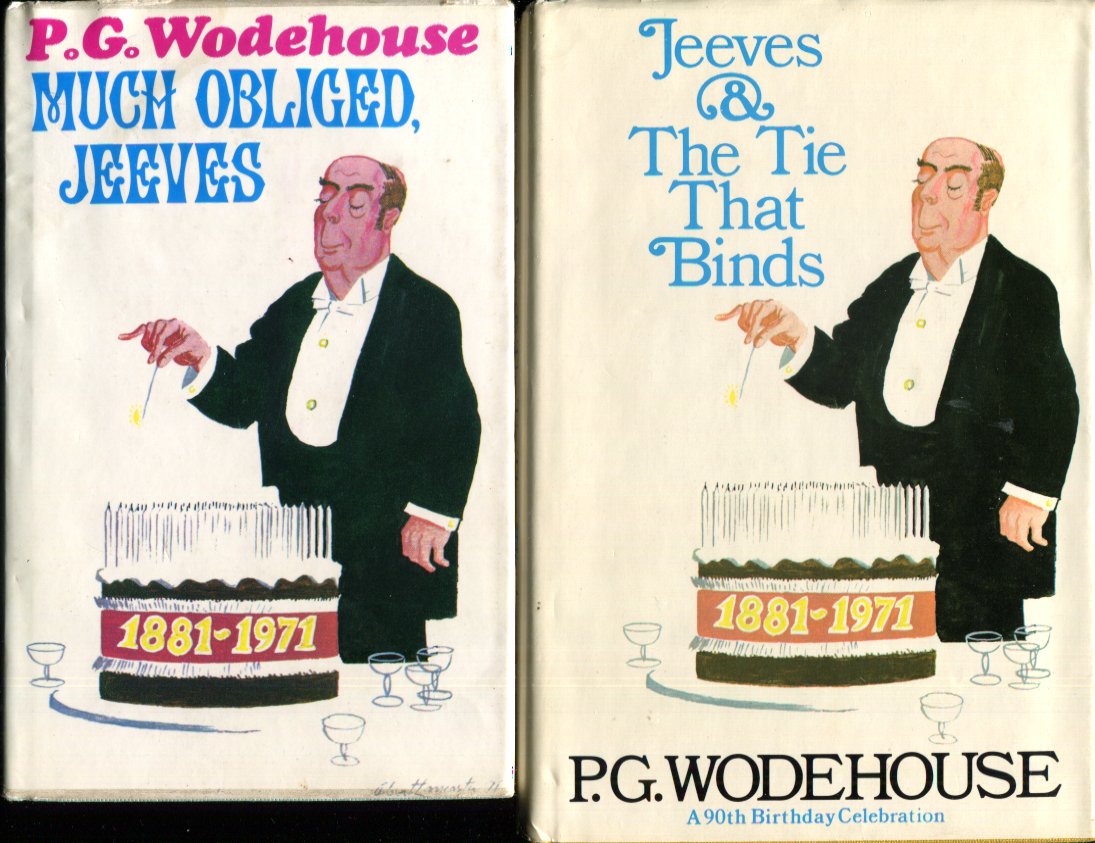 Much Obliged, Jeeves was first published in the UK on 15 October 1971 by Barrie and Jenkins, and appeared simultaneously in the US under the title
Jeeves and the Tie That Binds, published by Simon and Schuster, to mark the occasion of Wodehouse’s 90th birthday. Both editions used the same dust jacket artwork by Osbert Lancaster, though of course with different typography for the titles. Lancaster pictures Jeeves as older than we imagine him to have been, as do many other illustrators.
The two editions are essentially the same until the final pages. According to McIlvaine, the American title was given by Wodehouse’s editor Peter Schwed at Simon & Schuster, who rewrote the last page to justify the new title. Indeed, the last paragraph of Bertie’s narration and two short speeches (one of which is “Much obliged, Jeeves”) in the British version are replaced by about a page worth of Schwed’s new material, in which Jeeves tells Bertie that “There is a tie that binds, sir.”
Diego Seguí reminds us of the source of the American title, a hymn by John Fawcett (1739–1817): “Blest be the tie that binds”.
The book is of course still in copyright, so the text cannot be found online at Madame Eulalie or Project Gutenberg. You can, however, “borrow” it (read it online, subject to availability) from the Internet Archive digital library, which also has an audiobook version and even a German translation. If you have only the UK edition and you’re curious to compare the US ending pages, a large-print edition of the US version is also scanned at the Internet Archive.
Page references below are to the circa-1999 Penguin paperback edition with cover art by David Hitch. For readers of other versions, a table (opens in new tab or window) shows the correspondences between the paginations of some available editions.
|
Chapter 1
Chapter 2 Chapter 3 Chapter 4 Chapter 5 Chapter 6 Chapter 7 Chapter 8 Chapter 9 |
Chapter 10
Chapter 11 Chapter 12 Chapter 13 Chapter 14 Chapter 15 Chapter 16 Chapter 17 |
Chapter 1
runs from p.1 to p.8 in the 1999 Penguin paperback
toothsome eggs and bacon (p 1)
Bertie has told us of toothsome meals cooked by others, but this seems to be the first time he applies it to Jeeves’s culinary efforts. In “Sir Roderick Comes to Lunch”, Biffy’s cook has served up a fricasee of chicken which Sir Roderick Glossop describes as “singularly toothsome.” Sir Watkyn Bassett’s cook serves a toothsome fish in chapter 6 of The Code of the Woosters, and Emerald Stoker provides an excellent lunch, everything most toothsome, in chapter 10 of Stiff Upper Lip, Jeeves.
This seems to be Bertie’s favorite breakfast, whether he spells it in full, as here, or abbreviates it.
He uncovered the fragrant eggs and b., and I pronged a moody forkful.
[…]
He shimmered out, and I took another listless stab at the e. and bacon.
“Jeeves and the Impending Doom” (1926; in Very Good, Jeeves, 1930)
…the next moment I was feeling that nothing mattered in this world or the next except about a quart of coffee and all the eggs and b. you could cram on to a dish.
Thank You, Jeeves, ch. 17 (1934)
Then the scent of bacon floated to the nostrils, and feeling that it was improbable that a wraith would be horsing about the place with dishes of eggs and b., I calmed down a bit.
The Mating Season, ch. 8 (1949)
Jeeves placed the sizzling eggs and b. on the breakfast table…
Jeeves in the Offing/How Right You Are, Jeeves, ch. 1 (1960)
It is no secret in the circles in which he moves that Bertram Wooster, though as glamorous as one could wish when night has fallen and the revels get under way, is seldom a ball of fire at the breakfast table. Confronted with the eggs and b., he tends to pick cautiously at them, as if afraid they may leap from the plate and snap at him.
Stiff Upper Lip, Jeeves, ch. 1 (1963)
I had cleaned up the eggs and b., and got the toast and marmalade down the hatch to the last crumb with all the enthusiasm of a tiger of the jungle tucking into its ration of coolie, and was smoking a soothing cigarette, when the telephone rang and Aunt Dahlia’s voice came booming over the wire.
Aunts Aren’t Gentlemen, ch. 4 (1974)
given of his plenty (p 1)
This sense of “plenty” appears in the story of the Widow’s Mite (Luke 21:4) in some American Bible translations, but not in the Authorised Version (which has “…of their abundance”). Nineteenth- and early twentieth-century sermons and moral lessons on wealth in both the US and the UK commonly paraphrased the Bible story as saying the others had given of their plenty, while the widow had given all she had.
Diego Seguí notes an early usage by Wodehouse, in the sense of money:
Every one in the form subscribed a certain sum; the form master gave of his plenty a further ten shillings; and the nett result was divided up as prizes.
“An Affair of Boats” (1905)
A search finds many further examples, not all in the financial sense:
The gardener had given me of his plenty, and I had just scattered them carelessly, like a sower going forth sowing.
Frogs, that is, in Laughing Gas, ch. 17 (1936)
“Emsworth, therefore, shall give us of his plenty, and I will be going along now and putting the thing in train.”
Lord Ickenham, getting money for Polly Pott in Uncle Fred in the Springtime, ch. 17 (1939)
On his departure for America, Lord Emsworth’s younger son, Freddie Threepwood, had bequeathed to Beach his library of who-dun-its, generally supposed to be the most complete in Shropshire, and he was always glad to give of his plenty.
Pigs Have Wings, ch. 7.3 (1952)
“And now you have come to plead with him to do the square thing and give you at least a little something of his plenty?”
Mortimer Bayliss to Keggs about Roscoe Bunyan’s money, in Something Fishy/The Butler Did It, ch. 25 (1957)
“Now that Tuppy has given of his plenty, the thing’s in the bag.”
Ukridge about borrowing George Tupper’s dress clothes in “A Tithe for Charity” (1955; in A Few Quick Ones, 1959)
‘I once heard of a fellow who used to go up to prosperous-looking blokes in the street and whisper in their ear “I know your secret”, rightly taking it for granted that every prosperous-looking bloke has one, whereupon the party of the second part, starting guiltily, gave him of his plenty in order to keep his mouth shut.’
Company for Henry, ch. 1.2 (1967)
Totleigh Towers … Sir Watkyn Bassett … Madeline … Spode (p 1)
Cf. Stiff Upper Lip, Jeeves (1963) — evidently the action of the present novel takes place shortly after those events.
or Lord Sidcup (p 1)
Roderick Spode had succeeded to the title of the seventh Earl of Sidcup upon the demise of his uncle, some time prior to Jeeves and the Feudal Spirit, although we do not learn the exact title until chapter 7 of the present book.
medium dose for adults (p 1)
Cf. Money for Nothing.
patent medicines (p 1)
Wodehouse loved patent medicines and the advertising clichés associated with them. Cf. also Runkle’s Magic Midgets in this book.
impart a gentle glow (p 1)
contented hens (p 1)
Cf. Heavy Weather.
on top of the world with a rainbow round my shoulder (p 1)
Cf. Ice in the Bedroom.
Vitamin B (p 1)
A broad class of water-soluble vitamins associated with cell metabolism and red blood cell synthesis. Frequently added to breakfast cereals and the like, hence commonly mentioned in advertising. Most were discovered between about 1910 and 1935. They don’t normally have any direct effect on state of mind.
Full many a glorious morning (p 2)
From Sonnet 33: see Shakespeare Quotations and Allusions in Wodehouse.
Carpe diem (p 2)
“Seize the day” — this is the first time that Jeeves cites this very familiar Latin tag.
… dum loquimur, fugerit invida
aetas: carpe diem, quam minimum credula postero.
: Odes 1:11
Herrick … rosebuds (p 2)
Old hat … déjà-vu (p 2)
Not quite synonyms — “old hat” (cf. German “alter Hut”) is generally something hackneyed and over-familiar; déjà-vu tends to imply something that gives us an uncomfortable sensation that we have experienced it before. (The OED tells us that in the 17th century, “old hat” was slang for female genitalia, but that can scarcely be relevant here.)
…escaped from Totleigh Towers … current euphoria (pp 2–4)
This section summarises the plot of Stiff Upper Lip, Jeeves.
Glos. (p 3)
Conventional postal abbreviation for “Gloucestershire”.
pin-up class (p 3)
The term pin-up came into use in the US during World War II for magazine photos of girls intended to be pinned up on a wall. The OED cites this passage for pin-up (2b).
as ever broke biscuit (p 3)
Seems to be a naval expression, originally — sailors ate biscuit instead of bread, so someone who “broke biscuit” with you would be a mess-mate. The earliest example Google Books turns up is Tobias Smollett’s Peregrine Pickle (1751). Wodehouse uses it quite frequently, but there are few other modern examples.
“Well fare thy soul! old Hawser Trunnion,” said he: “man and boy I have known thee these five-and-thirty years, and sure a truer heart never broke biscuit. Many a hard gale hast thou weathered; but now thy spells are all over, and thy hull fairly laid up. A better commander I’d never desire to serve; and who knows but I may help to set up thy standing rigging in another world?”
Peregrine Pickle, ch. 73
Normally as genial a soul as ever broke biscuit, this aunt, when stirred, can become the haughtiest of grandes dames before whose wrath the stoutest quail.
Jeeves in the Offing, ch. 18 (1960)
‘It’s the most extraordinary thing that you, admittedly one of the smallest little pipsqueaks that ever broke biscuit, should have eyes more fitted to a girl of twice your stature. They bulge from their sockets.’
Company for Henry, ch. 1.4 (1967)
the stars are God’s daisy chain (p 3)
Madeline Bassett maintains this image from Right Ho, Jeeves, ch. 1 (1934), through The Code of the Woosters (1938), Joy in the Morning (1946), The Mating Season (1949), and Stiff Upper Lip, Jeeves (1963) to the present book.
every time a fairy blows its wee nose a baby is born (p 3)
This whimsy was introduced in The Code of the Woosters and repeated in Stiff Upper Lip, Jeeves.
dead in a ditch (p 3)
Conventional British expression — “I’d rather be dead in a ditch”. Wodehouse often uses the other version of this, referring to something “I wouldn’t be seen dead in a ditch with”:
“You seem by bad luck to be stocked up with just the sort of things I wouldn’t be seen dead in a ditch with.”
Uneasy Money, ch. 1 (1915/16)
“Let me tell you that I’m a changed man and wouldn’t be seen dead in a ditch with a Follies girl.”
Bill the Conqueror, ch. 2.1 (1924)
“I can but repeat my statement, made to you at the time, that, apart from being the sort of tie no upright man would be seen dead in a ditch with, its colours were those of a cycling, angling, and dart-throwing club of which I am not a member.”
“Portrait of a Disciplinarian” (1927; in Meet Mr. Mulliner, 1928)
His apartments both at Brinkley Court and at his house in Charles Street are full of things I wouldn’t be seen dead in a ditch with.
Bertie’s Uncle Tom’s silver in Jeeves and the Feudal Spirit, ch. 9 (1954)
“For mark you, Corky, though you and I wouldn’t be seen dead in a ditch with the average antique, there are squads of half-wits who value them highly—showing, I often say, that it takes all sorts to make a world.”
“Ukridge Starts a Bank Account” (in Plum Pie, 1966/67)
preux chevalier (p 3)
sackcloth and ashes (p 4)
Cf. Biblia Wodehousiana.
grand sweet song (p 4)
Cf. Right Ho, Jeeves.
life … stern and earnest (p 4)
A Wodehouse misquotation of Longfellow — see also “Jeeves and the Yule-tide Spirit”.
mists of sleep (p 4)
This could well be the oldest cliché in Wodehouse, as it goes all the way back to The Epic of Gilgamesh. Wodehouse uses it frequently.
He looked up. The mists of sleep shredded away. A ragged youth with a crop of fiery red hair was standing in the doorway, regarding the occupants of the shelter with a grin, half whimsical, half defiant.
Jimmy recognized him. It was Spike Mullins.
A Gentleman of Leisure, ch. 9 (1910)
Charlie Silversmith (p 4)
Jeeves’s uncle is the butler at Deverill Hall in The Mating Season (1949).
a club for butlers … Curzon Street (p 4)
The Junior Ganymede; see The Code of the Woosters.
throwing the breakfast porridge (p 5)
Not merely a hypothetical example — the Senator throws his porridge at (temporary) valet Blair Eggleston in Hot Water, ch. 7, and Ivor Llewellyn does the same to Bosher in Bachelors Anonymous, ch. 7. The British TV sitcom You Rang, M’Lord? in the late 1980s featured a porridge-throwing dowager, with Su Pollard usually on the receiving end.
what will the harvest be? (p 5)
Conventional religious image, originating in things like the Parable of the Sower and Galatians 6, although the wording Bertie uses is closer to Victorian hymns.
Sowing the seed by the dawn-light fair,
Sowing the seed by the noonday glare,
Sowing the seed by the fading light,
Sowing the seed in the solemn night:
O what shall the harvest be?
Emily S. Oakley: Hymn (1850)
Twenty-three cats (p 5)
See “Sir Roderick Comes to Lunch” (1922). Actually, there were only three cats in his bedroom.
marooned A. B. Filmer … on an island (p 5)
See “Jeeves and the Impending Doom” (1926).
old Bassett’s amber statuette (p 6)
Recounting an episode in Stiff Upper Lip, Jeeves (1963).
let the dead past (p 6)
Longfellow’s “Psalm of Life” again, cf. life is stern above. See Right Ho, Jeeves and Biblia Wodehousiana.
Brinkley … Bingley (pp 7–8)
See Thank You, Jeeves — he was called Brinkley there, but has clearly become Bingley since then, perhaps to avoid confusion with the name of Aunt Dahlia’s house, Brinkley Court. Both are favourite Wodehouse names for minor characters.
banjolele (p 8)
See Thank You, Jeeves — it is interesting that Much Obliged, Jeeves is one place where Jeeves and Bertie don’t have a major disagreement that has to be resolved by Bertie humiliating himself in some way. In this case it is Jeeves whom Bertie considers to be in the wrong for refusing to suppress the entry about Bertie in the Club Book.
an impatient cigarette holder (p 8)
A fine example of a transferred epithet, one of Wodehouse’s favorite rhetorical devices.
to split straws. Or is it hairs? (p 8)
Cf. Right Ho, Jeeves.
angry passions were rising (p 8)
Cf. Right Ho, Jeeves.
Chapter 2
(pp 9–13)
Aunt Dahlia (p 9)
Aunt Dahlia (Dahlia Travers, née Wooster) is a sister of Bertie’s late father. She first appeared in “Clustering Round Young Bingo” (1925).
hog-caller (p 9)
Wodehouse explores hog-calling in detail in the Blandings story “Pig-hoo-o-o-o-ey!” (1927).
Quorn and Pytchley (p 9)
Two of the most famous English fox-hunts. The Quorn was established in Leicestershire in 1696. The Pytchley is based in Northamptonshire and was first established at Althorp in 1635. Both have moved around within their respective counties. Fox-hunting with hounds was banned on grounds of animal cruelty in England and Wales in 2004, but both these hunts still exist and seem to manage to find something to do, purportedly staying within the law. For literary accounts of the mystique of fox-hunting, see e.g. the novels of R. S. Surtees and Anthony Trollope.
riding over hounds … chase rabbits (p 9)
Things that shouldn’t happen during a fox-hunt and would be expected to lead to foul language from those in charge. A member of the hunt riding too close to or ahead of the hounds would get in the way of their efforts to locate the scent of the fox, whilst the hounds themselves obviously have to keep their minds on the fox and not let themselves be distracted by other interesting scents like rabbits.
Market Snodsbury (p 9)
See Right Ho, Jeeves.
aged relative (p 9)
Bertie is probably riffing off “Aged Parent”, the term popularised by its use in Dickens’s Great Expectations to refer affectionately to Mr Wemmick’s elderly father. Bertie also uses both “aged r.” and “aged relative” in Jeeves and the Feudal Spirit.
obiter dicta (p 9)
Anatole (p 10)
First appeared in “Clustering Round Young Bingo” (1925).
my beamish boy (p 10)
An allusion to Lewis Carroll’s poem “Jabberwocky”, cf. Uncle Fred in the Springtime. Apart from being an invented adjective in this poem, “Beamish” is a village in County Durham and the name of many characters in the canon, especially J. Hamilton Beamish in The Small Bachelor (1926).
the excellence of the early trains (p 10)
Bertie usually drives, of course, but many other of Wodehouse’s young men have had to make hurried exits from country houses on the milk train, perhaps most famously Freddie Widgeon in “Goodbye to All Cats” (1934).
Ginger … Harold Winship (p 11)
Ginger is of course a conventional nickname for someone with red hair. He seems to be the only Winship in Wodehouse, and this is his only appearance in the canon. Possibly Wodehouse was thinking of the British footballer Tommy Winship (1890–1976), or the Winship family in New England, which held the editorship of the Boston Globe for two generations.
Damon and Pythias (p 11)
See also Wodehouse’s poem “Damon and Pythias” written for Punch in 1903.
chez (p 11)
French: at the home of.
by-election (p 11)
An election in a single constituency, cf. e.g. Leave It to Psmith.
Conservative (p 11)
The Conservative Party was one of the two main political parties in the UK throughout the 19th and 20th centuries, founded under that name by Sir Robert Peel in 1834. In the 20th century its main opponent was initially the Liberal Party, then the Labour Party. At the time Wodehouse was writing, the Conservatives were in power under Prime Minister Edward Heath (1970–1974). Wodehouse would perhaps have seen a Conservative affiliation as the most obvious for Ginger, implying in those pre-Thatcher times that he was a gentleman and a person of goodwill but held no strong political opinions.
warm the what-d’you-call-its of my heart (p 12)
Cockles. This expression goes back to the 17th century, and appears to derive simply from the resemblance between a cockle-shell (Cardiidae) and the shape of the human heart. [OED: cockle, n.2]
Barribault’s grill-room (p 12)
Chapter 3
(pp 14–23)
Kipper Herring … Catsmeat Potter-Pirbright (p 14)
Herring appears in Jeeves in the Offing (1960); Potter-Pirbright in numerous places starting with The Code of the Woosters (1938).
plucked the gowans fine (p 14)
See Leave it to Psmith.
Steeple Bumpleigh in Essex (p 14)
Said to be in Hampshire in Joy in the Morning (1946), which is set there. There is a real village called Steeple Bumpstead in North Essex (it does not currently have a steeple, though).
Oh for the touch of a vanished hand (p 14)
From Tennyson’s “Break, break, break” — cf. Young Men in Spats.
gargle (p 14)
See The Old Reliable.
one for the tonsils (p 15)
on the waggon (p 15)
Abstaining from alcohol — cf. Piccadilly Jim which has “waggon” in one place and “wagon” in another. According to Google’s n-gram viewer, “waggon” ceased to be the more common spelling in print about the time Wodehouse was born. Indeed, the Barrie & Jenkins first edition uses “wagon” where the current Penguin paperback reads as above.
gone and got hitched up with a popsy (p 15)
dashed the cup from his lips (p 15)
The expression is famously used in Frankenstein, although it might be older than that.
Unhappy man! Do you share my madness? Have you drunk also of the intoxicating draught? Hear me – let me reveal my tale, and you will dash the cup from your lips!
Mary Shelley: Frankenstein, Letter 4
…while I didn’t think that any drama written by Bobbie’s mother was likely to do the theatre-going public much good, I couldn’t dash the cup of happiness, so to speak, from the blighted girl’s lips, as it were. Noblesse oblige about sums the thing up.
“Jeeves and the Dog McIntosh” (1929)
iron heel (p 15)
See The Girl in Blue.
Uncle Percy (p 15)
This is Lord Worplesdon, who when first mentioned in the early stories such as “Jeeves Takes Charge” is merely a family friend and father of Lady Florence Craye. Not until he becomes Bertie’s Aunt Agatha’s second husband shortly before Joy in the Morning (1946) is he an uncle to Bertie.
Florence Craye (p 15)
First appeared in the Reggie Pepper story “Disentangling Old Duggie” (1912) (which was adapted into the Jeeves story “Extricating Young Gussie” in 1915). Has been engaged to Bertie at least three times since then (“Jeeves Takes Charge” in 1916, Joy in the Morning in 1946, and Jeeves and the Feudal Spirit in 1954). And to several others, including Stilton Cheesewright (Joy in the Morning and Jeeves and the Feudal Spirit), Percy Gorringe for a time in Jeeves and the Feudal Spirit, as well as Ginger in the present book. England is strewn with ex-fiancés whom she bounced because they did not come up to her expectations.
Gorringe (p 15)
Appeared in Jeeves and the Feudal Spirit. His first name is also Percy, and no doubt it is suppressed in this mention to avoid confusion with Lord Worplesdon’s birth name of Percival Craye.
vers libre (p 15)
Free verse: poetry that does not have a fixed rhythmic pattern or rhyme-scheme. Wodehouse frequently uses the term as shorthand for the horrors of modernist literature, and devoted a whole essay to “The Alarming Spread of Poetry” in 1916.
It is at moments such as these that a man reaps the reward of a good upbringing. In similar circumstances those who have not had the benefit of a sound training in golf are too apt to go wrong. Goaded by the sudden anguish, they take to drink, plunge into dissipation, and write vers libre. Chester was mercifully saved from this.
“Chester Forgets Himself” (1924; in The Heart of a Goof, 1926)
After attending eleven debates and fourteen lectures on vers libre poetry, the Seventeenth Century Essayists, the Neo-Scandinavian movement in Portuguese literature, and other subjects of a similar nature, he grew so enfeebled that, on the rare occasions when he had time for a visit to the links, he had to take a full iron for his mashie-shots.
“The Unexpected Clicking of Cuthbert” (1921; in The Clicking of Cuthbert, 1922)
Officer Garroway shifted his Adam’s apple up and down once or twice; and, closing his eyes, began to recite in the special voice which he as a rule reserved for giving evidence before magistrates:
“ ‘Streets!’ ”
“That is the title, eh?”
“Yes, sir. And also the first line.”
Hamilton Beamish started.
“Is it vers libre?”
“Sir?”
“Doesn’t it rhyme?”
“No, sir. I understood you to say that rhymes were an outworn convention.”
“Did I really say that?”
“You did, indeed, sir. And a great convenience I found it. It seems to make poetry quite easy.”
The Small Bachelor, ch. 7 (1926)
She adored him with a passion which already had produced six sonnets, a ballad and about half a pound of vers libre, but all engaged girls have the poorest opinion of the intelligence of the men they are engaged to, and she had never wavered in her view that her loved one’s I.Q. was about equal to that of a retarded child of seven.
“A Good Cigar is a Smoke” in Plum Pie (1966/1967)
The Woosters do not like drinking alone (p 15)
Bertie seems to be overlooking the example of his Uncle George, Lord Yaxley, whom he mentioned for independently discovering that alcohol is a food in “The Delayed Exit of Claude and Eustace”.
But see the end notes to “Absent Treatment” for more on the history of this subject.
old oil (p 16)
See Spring Fever.
Grade A. Gravel soil… (p 16)
Wodehouse always enjoys the joke of having someone talk like an estate agent’s prospectus, with gravel soil and Company’s own water invariably being part of the mix. The joke is of course that none of these “selling points” is of practical relevance to a short-term houseguest (or to a reader addressed by the narrator). Cf. e.g. Summer Lightning (gravel soil) or The Girl in Blue (water).
Even if you have never been in Wood Hills, that Suburban Paradise is probably familiar to you by name. Situated at a convenient distance from the city, it combines in a notable manner the advantages of town life with the pleasant surroundings and healthful air of the country. Its inhabitants live in commodious houses, standing in their own grounds, and enjoy so many luxuries—such as gravel soil, main drainage, electric light, telephone, baths (h. and c.), and Company’s own water, that you might be pardoned for imagining life to be so ideal for them that no possible improvement could be added to their lot.
“The Unexpected Clicking of Cuthbert” (1921; in The Clicking of Cuthbert, 1922)
Anatole’s cooking (p 16)
See “Clustering Round Young Bingo” (1925) for the story of how Anatole came to cook for the Travers household.
bared his head, only he hadn’t a hat on (p. 16)
His hand moved upwards, and I think his idea was to bare his head reverently. The project was, however, rendered null and void by the fact that he hadn’t a hat on.
Gussie Fink-Nottle in The Code of the Woosters, ch. 3 (1938)
“Ah!” I said, and would have bared my head, only I hadn’t a hat on.
Responding to Kipper Herring praising Anatole’s cooking in Jeeves in the Offing, ch. 9 (1960)
tremolo (p 16)
a male turtle dove cooing to a female turtle dove (p 16)
See Uncle Dynamite.
beasel (p 17)
(Thus in Penguin; beazel in the UK and US first editions)
See Hot Water.
Esmond Haddock … Deverill Hall (p 17)
In The Mating Season (1949).
fell an ox with a single blow (p 17)
See Jeeves and the Feudal Spirit.
Black Hole of Calcutta (p 17)
overbearing dishpot (p 18)
Despot. The housemaid in question is surely Elsie Bean, in Uncle Dynamite (1948) — it isn’t immediately obvious how Bertie got to know her, though, as they have never appeared in the same book. Presumably they have mutual acquaintances in the Drones Club, or possibly Jeeves is acquainted with the unnamed butler at Ashenden Manor.
There is a time to call someone an overbearing dishpot (p 18)
A paraphrase of Ecclesiastes: see Biblia Wodehousiana.
Oxford boxing Blue (p 18)
A Blue is someone who has been selected to represent Oxford (which traditionally uses the colour dark blue) in a match against Cambridge (light blue), or vice-versa. Most of Wodehouse’s muscular young men are Blues in one sport or another.
secretary-bin (p 18)
Evidently a jocular term for a secretarial agency (a temp agency these days), presumably by association with “loony-bin” — Bertie is ludicrously imagining a place where unemployed secretaries are confined for their own protection. Unknown to the OED.
Boko Fittleworth (p 18)
Member of the Drones Club and friend since school days of Bertie Wooster, who first appeared in Joy in the Morning (1946).
Boko dictates his stuff (p 18)
Wodehouse himself couldn’t imagine dictating to a stenographer, as he wrote in the Preface to the 1975 reprint of Thank You, Jeeves:
How anybody can compose a story by word of mouth, face to face with a bored looking secretary with a notebook is more than I can imagine.
He had given that attitude to Corky Corcoran in “Ukridge Sees Her Through” as well, so this practice by Boko is a change probably required for plot purposes.
Magnolia Glendennon (p 18)
Like other flower-names (Hyacinth, Dahlia, Marigold, etc.), Magnolia became popular as a given name in the US around the end of the 19th century and declined thereafter.
The name may be most familiar to modern readers from the female lead Magnolia Hawks Ravenal in Edna Ferber’s Show Boat and its stage and film adaptations with music by Wodehouse’s frequent collaborator Jerome Kern, including one song “Bill” with a lyric written by Wodehouse with Kern for an earlier show. [KS]
Glendennon is a relatively unusual variant form of the Dumfriesshire name Glendinning. There’s a Glendennon Lake in Wisconsin, but it’s not obvious why Wodehouse would have known about that. There don’t seem to have been any notable Glendennons that the internet knows about, nor are there any characters with similar names in Wodehouse.
nomination (p 19)
Nomination for election is an administrative step that requires the signatures of ten registered electors from the constituency, plus a cash deposit. Between 1918 and 1985 the deposit was £150, refunded if the candidate got at least 12.5% of the votes. Ginger would also have to be selected as candidate by the local Conservative Association, which was probably what he needed A. B. Filmer’s help with. Bertie’s former headmaster Aubrey Upjohn is seeking selection as the Conservative candidate for Market Snodsbury in Jeeves in the Offing (1960).
A. B. Filmer (p 19)
See “Jeeves and the Impending Doom” (1926; in Very Good, Jeeves, 1930).
a wild surmise … Darien (p 19)
One of Wodehouse’s favourites, Keats’s sonnet “On first looking into Chapman’s Homer”, referenced in just about every book he wrote. See Thank You, Jeeves for a selection of quotations.
if I hadn’t been seated I would probably have reeled (p 19)
See Ice in the Bedroom.
Stilton Cheesewright (p 19)
Another of Bertie’s beefy school and college friends. He was engaged to Florence in Joy in the Morning (1946) and again in Jeeves and the Feudal Spirit (1954).
Spindrift (p 19)
Bertie accidentally picks up Florence’s book whilst shopping for Spinoza in Joy in the Morning:
He pushed off, Spinoza-ing under his breath in a hopeless sort of way, leaving me clutching a thing called Spindrift.
It looked pretty foul. Its jacket showed a female with a green, oblong face sniffing at a purple lily, and I was just about to fling it from me and start a hunt for that Poisoned Pin of which he had spoken, when I became aware of someone Good-gracious-Bertie-ing and, turning, found that the animal cries proceeded from a tall girl of commanding aspect who had oiled up behind me.
“Good gracious, Bertie! Is it really you?”
I emitted a sharp gurgle, and shied like a startled mustang. It was old Worplesdon’s daughter, Florence Craye.
Joy in the Morning, ch.1 (1946)
Duke of York’s Theatre (p 19)
Theatre in St Martin’s Lane, Westminster; renamed in 2026 in honour of the late Tom Stoppard (Dukes of York are slightly out of fashion these days…). The Wodehouse & Bolton play If I Were You premiered at this theatre in 1934.
a wild surmise (p 20)
Not again! See p 19 above.
in heaping measure (p 20)
In generous quantities; used as opposed to level measure when referring to spoonfuls and the like.
wearing the mask (p 20)
See Laughing Gas.
‘Couldn’t put it down’ (p 20)
Technically, Bertie did pick up Spindrift in Joy in the Morning (see quotation above), but as far as we know, he didn’t actually open it.
the Rev. Stinker Pinker … Totleigh Towers (p 21)
Rugby-playing college friend of Bertie. See Stiff Upper Lip, Jeeves (1963) for the scene described. He previously appeared in The Code of the Woosters (1934).
cracked gramophone record (p 21)
Bertie is referring to the effect where damage to the surface of the record can make the stylus jump back a groove, thus repeating the same short snippet of sound indefinitely. Unlike modern vinyl discs (introduced in 1948), shellac gramophone records were brittle and could crack.
Perhaps your mother was frightened by one? (p 21)
Referring to an older theory that prenatal experiences could transfer from the mother to an attitude in an unborn baby.
“He has never kept a secret, and never will. His mother was frightened by a B.B.C. announcer.”
Stanwood Cobbold in Spring Fever, ch. 6 (1948)
practically perfect in every respect (p 21)
“Millicent, though practically perfect in every other respect, is one of those girls who might misunderstand this little night out of mine, did it but come to her ears.”
Hugo Carmody in Summer Lightning, ch. 4.2 (1929)
In the 1964 Disney film, Mary Poppins claims to be “practically perfect in every way”. The phrase is not in the P. L. Travers book, so one wonders if the screenwriters were Wodehouse fans.
scaling a mountain of glass (p 22)
The Mountain of Glass is a classic European fairy tale, originally from Poland.
Great Cham of Tartary (p 22)
From Much Ado About Nothing: see Shakespeare Quotations and Allusions in Wodehouse. “Cham” is an obsolete form of “Khan”.
Now is the time for all good men to come to the aid of the party (p 22)
like a ton of bricks (p 22)
Chapter 4
(pp 24–33)
restored the tissues (p 24)
See Bill the Conqueror.
my own sports model (p 24)
Wodehouse, unlike other popular novelists like Ian Fleming (to name an extreme case), rarely got into the business of product-placement in his books. Bertie has always had cars that are either generic (“sports model”, two-seater”) or fictional (“Widgeon Seven”, etc.). Cf. Right Ho, Jeeves.
There are a few minor exceptions as indications of wealth, mainly referring to Rolls-Royce automobiles; Mrs. Steptoe in Quick Service, ch. 1, has both a Rolls and a Packard as well as a two-seater. Blandings Castle, of course, has a Hispano-Suiza for grand occasions, though it is temporarily out of active service in Summer Lightning, ch. 17.
at the vet’s (p 24)
The usual colloquial British term for “veterinary surgeon”. Bertie is playfully equating the car with a domestic animal. The plot here requires a car that can carry four people, thus Bertie’s two-seater has to be temporarily unavailable.
Wooster G.H.Q. (p 24)
General Headquarters (military abbreviation). The term itself dates back to the 18th century, when “head quarters” was still written as two words. The OED’s first recorded use of the abbreviation is by Florence Nightingale in 1856.
maze of mumbling thoughts (p 24)
Unsurprisingly, Google Books is unaware of any previous use of this phrase. There are a few examples of “mumbling thoughts” by themselves:
The ancient tales of magic were the mumbling thoughts of a distant shabby little world — so, at least, thought Flecker, offended. The tales gave him no guidance. There was too much difference between his world and theirs.…
Norman Matson: Flecker’s Magic, quoted in E. M. Forster: Aspects of the Novel, ch. 6 (1927)
Unfamed as hero, bard, or sage,
And yet in secret proud,
A hermit lived, whose hermitage
Was life’s unthinking crowd.
For though at times his lips might jest,
His cloistered soul, despising rest,
Kept mumbling thoughts within his breast
Which were not said aloud.
Joseph Thomas Chapman: Lyrical Poems and Thoughts in Rhyme, p.44 (1870)
like the paper on the wall (p 24)
den of the Secret Nine (p 24)
See The Mating Season.
outer crust (p 24)
See The Girl in Blue.
at the time when she was engaged to Stilton Cheesewright … willowy … profile … platinum-blonde hair (p 24)
She is tall and willowy and handsome, with a terrific profile and luxuriant platinum blonde hair, and might, so far as looks are concerned, be the star unit of the harem of one of the better-class Sultans.
Jeeves and the Feudal Spirit, ch. 3 (1954)
Hollywood Yes-man (p 25)
See Blandings Castle and Elsewhere.
private school (p 25)
Malvern House, Bramley (or Bingley)-on-Sea. See Thank You, Jeeves.
Scripture Knowledge (p 25)
Bertie first tells us about his school prize in Right Ho, Jeeves, and it is mentioned disparagingly by Gussie Fink-Nottle during his drunken prize-giving speech in chapter 17 of that book. But Bertie continues to boast about it in most of his subsequent accounts, as he will do several times in the present novel.
the story of the military chap (p 25)
The Centurion. See Biblia Wodehousiana.
plucked a lemon in the garden of love (p 25)
Bertie is showing his age — this is a song from a show that opened at Daly’s Theater on Broadway in December 1906.
To my fond imagination,
Ev’ry woman in creation
Was a peach in the garden of love.
In its pleasant shade I wandered
O’er my choice I slowly pondered,
As I gazed at the branches above.
Filled with fatal indecision,
I was dazzled by the vision,
All the peaches were so temptingly divine,
And my eyesight was affected,
For since then I have suspected,
That I couldn’t see when I picked mine.
Will someone kindly tell me,
Will someone answer why?
To me it is a riddle
And it will be till I die.
A million peaches round me,
Yet I would like to know,
Why I picked a lemon in the garden of love
Where they say only peaches grow.
Though no man perfection reaches,
In the art of picking peaches,
Had I started to practice when young,
Now I’d not be always meeting
Lemon flavors while I’m eating,
And this song might have never been sung
Nor would I be sitting daily,
Trying hard to chatter gaily.
With a better half of forty lemon power,
One I cannot care a bit for,
For the only thing she’s fit for,
Is to make another lemon sour.
“A Lemon in the Garden of Love,” song from The Spring Chicken (1906), lyrics by M. E. Rourke, music by Richard Carle — Sung by Laurence Rubenstein on YouTube
the little w (p 25)
Bertie’s one-letter abbreviation for ‘woman’ is lacking its period in both US and UK first editions as well as in the Penguin paperback.
rammed amidships (p 25)
Nautical expression for a side-on collision.
The trouble about whirling on your axis… (p 26)
Bertie seems to be channeling his nonagenarian creator here — losing your balance when turning around quickly is not a problem that afflicts many young people.
adagio dancer (p 26)
some noble tree beneath the woodman’s axe (p 26)
a maze of numbing thoughts (p 26)
Cf. “mumbling thoughts” two pages earlier. There seem to be slightly more “numbing thoughts” around in literature than “mumbling” ones, but Bertie still appears to be the only person who puts them together with “maze”.
astral body (p 26)
A theosophical reference: see The Girl in Blue.
United States Marines (p 26)
Curzon Street (p 26)
See the note on the Junior Ganymede, p 4 above.
Less than the dust beneath thy chariot wheels (p 27)
See Right Ho, Jeeves.
rose perhaps an eighth of an inch (p 27)
See Aunts Aren’t Gentlemen for more examples of Jeeves displaying extreme emotion.
to play a return date (p 27)
Bertie is using imagery from the theatrical world as a figurative description of a resumed engagement. See Very Good, Jeeves for more usual references to this phrase.
within an ace of hauling me to the altar rails (p 28)
For within an ace see Leave It to Psmith. In Anglican weddings, the betrothed couple faces the pastor at the altar rails at the beginning of the wedding service.
bandying a woman’s name (p 28)
The rule of etiquette against mentioning the names of living women seems to have originated in the 19th century as a safeguard against provoking duels in all-male groups (colleges, clubs, officer’s messes, etc.). It is only occasionally associated with the verb “to bandy” before Wodehouse. Cf. The Mating Season.
It is a sad thing when a girl’s name is bandied about in this way; it is like handling the bloom on the fresh ripe fruit, or brushing the down from the butterfly’s wing. The plum is just as good as it was before, but it does not seem the same; and the butterfly is not hurt, perhaps, but its beauty is dimmed, and its brilliant hues are for ever tarnished.
Emma Jane Worboise: Grey and Gold, p.423 (1871)
“And I must say too” — dropping his quiet tone — “that I consider it a low thing which we have done — bandying the name of a woman who ought to be sacred to you, at least.”
Hunneman faced about with a quick gesture of anger, and then, checking himself, shrugged his shoulders.
“You are old-fashioned," he said. “Isn’t ‘bandying’ a strong word to apply to a harmless little chat?"
Mary G. L. Underwood: “Agatha Sage” in The New England Magazine, Vol. XII No.2 (April 1895)
‘I don’t know what the dickens you’re talking about,’ he said, ‘but bring your drink up to my room and we’ll go into the matter there. We cannot bandy a woman’s name in a saloon bar.‘
‘Who’s bandying a woman’s name?’
‘You are. You bandied it only half a second ago. If you don’t call what you said bandying, there are finer-minded men who do.’
“Tried in the Furnace” (1935; in Young Men in Spats, UK version, 1936)
Besides, a chivalrous man always shrinks from bandying a woman’s name, and he was wondering what would happen if this loose talk were to come to the ears of Horace Davenport, the Drones Club’s leading Othello.
“The Shadow Passes” (1950; in Nothing Serious, 1950)
An extremely cosy club (p 28)
In reality, entering it could have been something of a social minefield. Jeeves in his younger and more pompous days would never have dreamed of sitting down for a drink with his employer, even when off-duty, and he would surely have had qualms about introducing him as a guest into a club that was meant to be a refuge from the world of domestic service. Of course, if we really were in the London of the early 1970s, the Junior Ganymede would probably have been full of off-duty Beatles and Rolling Stones relaxing with their butlers.…
handed … the pink slip (p 30)
Gawd-help-us-ish (p 30)
tie … Brigade of Guards (p 30)
Bertie has doubts because the Brigade of Guards usually recruited only tall and good-looking individuals. The Guards tie has diagonal stripes of navy blue and deep red, see e.g. here: (opens a new tab or window for the shop).
The American financier T. Paterson Frisby wears a Brigade of Guards tie (with a Panama hat) in Big Money, Chapter 3.
Dictionary of Synonyms (p 30)
There have been numerous dictionaries of English synonyms published over the years, e.g. by the Episcopalian Bishop and Civil War Colonel, Samuel Fallows, in 1882. But the most commonly used book for this purpose still seems to be Roget’s Thesaurus, first published in 1852. Wodehouse himself freely confessed to using a thesaurus and a quotations dictionary when writing.
Diego Seguí found the source in The Synonym Finder, by J. I. Rodale (1961), under Familiar: “5. Unduly intimate, taking liberties, too free, forward, lacking in proper reserve, disrespectful, deficient in due respect, impudent, bold, presuming, intrusive.” PGW skips “taking liberties” and “presuming.”
an uncouth forefinger (p 30)
All this talk of synonyms obviously reminded Bertie that he hadn’t used a transferred epithet for a while. See Right Ho, Jeeves for the background to these.
Reginald (p 30)
There are many other Reginalds — human and canine — in the Wodehouse canon. Perhaps it was the poet Reginald Bunthorne from Gilbert and Sullivan’s Patience who lodged the name in Wodehouse’s consciousness?
Terry Mordue commented in his note on Jeeves: While Bertie is understandably surprised to discover that Jeeves’s first name is Reginald, what seems to astonish him more is that Jeeves actually has a first name at all.
wild surmise I was speaking about earlier (p 31)
Keats again, cf. pp 19 and 20 above.
functioning on all twelve cylinders (p 31)
Liqueur brandy (p 31)
A liqueur brandy is a sweetened liqueur made with a brandy base. It is one of the many ingredients of Lord Ickenham’s May Queen cocktail in Uncle Fred in the Springtime.
views … change when they come into money (p 32)
Compare Orlo Porter, a Communist in the early chapters of Aunts Aren’t Gentlemen (1974), but who feels the need to get an advance distribution of his inheritance by chapter 17:
I had never talked things over with a Communist before, and it came as something of a shock to find that he wasn’t so fond of the hard-up proletariat as I had supposed.
the coming revolution … Park Lane … dripping knife (p 32)
See The Old Reliable.
Chapter 5 (pp 34–44)
the face that launched a thousand ships (p 34)
Miss America (p 34)
Wodehouse seems to have waited until moving permanently to the USA in 1947 to mention the annual beauty contest held in Atlantic City, New Jersey, since 1921. Somewhat curiously, the present book seems to be the only mention of Miss America in the Bertie and Jeeves series; all the other references so far found are from the Blandings saga.
You might not admire Lady Hermione Wedge as you would admire Helen of Troy, or the current Miss America, but there was no gainsaying her intelligence.
Full Moon, ch. 8.2 (1947)
His O. C. Pigs had a mouth like a halibut’s, a broken nose acquired during a political discussion at the Emsworth Arms, and lots of mud all over him, but when you are engaging a pig man, Sir Gregory felt, you don’t want a sort of male Miss America, you want someone who knows about pigs.
Pigs Have Wings, ch. 2.3 (1952)
He still felt that the words in which he had described her hair, feet and general appearance had been well chosen, but we cannot all be Miss Americas and he was prepared to condone her physical defects in consideration of this womanly sympathy.
Lord Tilbury about Lavender Briggs in Service with a Smile, ch. 9 (1961)
“He couldn’t have gone overboard more completely if you had been the current Miss America.”
Galahad at Blandings, ch. 6.2 (1965)
“But it doesn’t matter if you don’t think she’s a Miss America.”
A Pelican at Blandings, ch. 8.4 (1969)
stuffed frog (p 35)
See Bill the Conqueror for many more examples of this image.
sconces, foliation, … (p 35)
Cf. The Code of the Woosters where Bertie complains about exactly the same list of silversmithing terms.
mal au foie (p 35)
Sickness of the liver, something the French like to suffer from. Cf. A Damsel in Distress.
extensive grounds and messuages (p 35)
More real-estate jargon. Messuages is a land-law term for the land occupied by a building and its immediate out-buildings.
a hell of a thunderstorm (pp 35–36)
The fickle English summer weather comes into the plots of numerous other stories, in particular at Blandings Castle — Summer Lightning and Heavy Weather, or the storm in Chapter 9 of Galahad at Blandings. And in many other places.
Panama hat (p 36)
See The Girl on the Boat. Panama hats often mark unsympathetic characters, e.g. T. Paterson Frisby (see above) in Big Money, or Mr. Mortimer in The Girl on the Boat/Three Men and a Maid, who expresses a desire to buy one.
Soapy Molloy, pacing the terrace, was looking his best in a suit the colour of autumn leaves, a Panama hat, a red and yellow tie and a pair of those buckskin shoes with tan toecaps which add so much diablerie to a man’s appearance.
Money in the Bank, ch. 2 (1942)
“Stand back!” cried Oofy, brandishing his panama hat. “I am armed!”
“Leave It to Algy” (in A Few Quick One, 1959)
Entering it at a rapid gallop, he collided with a solid body, and this proved on inspection to he none other than Professor Pepperidge Farmer, looking more sinister than ever in Bermuda shorts, a shirt like a Turner sunset and a Panama hat with a pink ribbon round it.
“Sleepy Time” (1965; in Plum Pie, 1966/67)
But not always — Lord Emsworth is a frustrated Panama-wearer, too:
“We must look out for one another there,” he said, cordially. “You will remember me again? I shall be wearing——” he gulped—“a top-hat.”
“Ern’s going to wear a stror penamar that’s been give ’im.”
Lord Emsworth regarded the lucky young devil with frank envy. He rather fancied he knew that panama. It had been his constant companion for some six years, and then had been torn from him by his sister Constance and handed over to the vicar’s wife for her rummage-sale.
“Lord Emsworth and the Girl Friend” (1928)
not a wrack behind (p 36)
See Shakespeare Quotations and Allusions in Wodehouse.
never strikes twice in the same place (p 37)
“Mrs. Cream won’t show up this time. Lightning never strikes twice in the same place.”
Bobbie Wickham in Jeeves in the Offing, ch. 8 (1960)
preliminary spadework (p 37)
A favorite term for preparations and plans in Wodehouse. The earliest so far found:
It seemed to me that what you might call the preliminary spade-work had been most satisfactorily attended to and that the success of the good old bulb could be in no doubt whatever.
“The Rummy Affair of Old Biffy” (1924)
Sir Watkyn Bassett … umbrella (p 38)
See The Code of the Woosters, ch. 1 for this incident.
fifty-seven trucks (p 38)
Wodehouse frequently used this number for comic exaggeration. Cf. The Inimitable Jeeves.
refrain or burthen (p 38)
See Jeeves and the Feudal Spirit.
‘I stopped and I looked and I listened’ (p 38)
As performed by George Robey, this is more of a comic recitation than a song, it doesn’t seem like something you would sing in the bath.
Refrain:
I stopped, and I looked, and I listened,
And I tried to locate the sound.
First I thought it was here,
Then I thought it was there—
A most peculiar sound;
And I really declare
That I’d heard it before,
But I cannot tell where—
So I thought that this noise must be found.
So I stopped, and I looked, and I listened,
The sound seem’d to come from the ground;
Someone said “You—,” someone said “Won’t,”
Someone said “Do—,” someone said “Don’t,”
So I stopped, and I looked, and I listened.
“I stopped and I looked and I listened” Music by Nathaniel D Ayer, Lyrics by Nathaniel D Ayer and George Dyer (1916). Sheet music.
Performed by George Robey on YouTube.
from hair-do to shoe sole (p 39)
See Galahad at Blandings for many other versions of this image.
Lord Sidcup … Spode (p 39)
First appeared in The Code of the Woosters (1938), as a would-be fascist dictator and secret lingerie designer (under the name “Eulalie Soeurs”). Inherited his title in Jeeves and the Feudal Spirit (1954) and also appeared in Stiff Upper Lip, Jeeves (1963). Wodehouse may well have had the association of “Spode” (the name of an English maker of fine china) and “teacup” in his mind when he gave Spode his title. For more on this, including the real-life antecedent for Spode, see The Code of the Woosters.
dusting the dust of Totleigh Towers (p 39)
See Biblia Wodehousiana.
seeking whom he might devour (p 39)
See Biblia Wodehousiana.
a hissing and a by-word (p 39)
This is a common expression in Protestant sermons and the like from the 19th century. There are several places in the Bible where similar phrases of commination occur, e.g. 1 Kings 9:7, or Deuteronomy 28:37, but oddly no standard translation of any of these seems to put together ”hissing” and “byword”. The only citation in the OED for “a hissing and a byword” is an 1874 book by Henry Rogers, The Superhuman Origin of the Bible Inferred from Itself. The OED cites the Geneva Bible, Jeremiah 19:8, for this sense of a hissing as an object of opprobrium (in fact “hissing” appears nine times in the Geneva Bible, but never in combination with “byword”). The Authorised Version has “an hissing, and a reproach” in Jeremiah, and elsewhere seems to prefer Latin proverb to Anglo-Saxon byword. See also Right Ho, Jeeves.
everything seemed to go black (p 39)
“Then everything seemed to go black—I don’t mean you, of course. You were black already—”
Eustace Hignett on Sam’s makeup in Three Men and a Maid (1921/22)
Everything seemed to go black to Barbara. Through a murky mist she appeared to be looking at a negro octogenarian, sipping ink.
“The Heart of a Goof” (1924)
For some minutes he stood staring, while everything seemed to go black.
“The Luck of the Stiffhams” (1933; in Young Men in Spats, 1936)
His whole soul seethed like a cistern struck by a thunderbolt, and everything seemed to go black.
Oofy Prosser in “The Fat of the Land” (in A Few Quick Ones, 1959)
clutch at a passing rose bush to keep from falling (p 39)
See Ice in the Bedroom.
many a time and oft (p 39)
See Shakespeare Quotations and Allusions in Wodehouse.
fusion of souls (p 39)
Another Theosophy reference (cf. “astral body” above) — it describes the subjective, ego-less blending of individual spiritual identities to achieve collective unity.
England … a land fit for heroes to live in (p 39)
A common paraphrase of a famous promise made by Prime Minister David Lloyd George in a speech at the end of the First World War. Given that Lloyd George was a Liberal, not English, and not exactly exemplary in his private life, he seems an unlikely person for someone of Spode’s opinions to be quoting.
What is our task? To make Britain a fit country for heroes to live in.
Speech at Wolverhampton, November 24, 1918
fewer and better Woosters (p 39)
See Uncle Dynamite.
a ton of bricks (p 40)
Sherlock Holmes … Professor Moriarty (p 40)
Holmes only seems to have met his arch-enemy in person twice, the second of those occasions being their fight to the (presumed) death at the Reichenbach Falls. Watson never meets him.
in an antique shop … ‘Mistaken kindness.’ (pp 40–42)
The umbrella and the cow-creamer incidents are from The Code of the Woosters; the amber statuette appears in Stiff Upper Lip, Jeeves.
Girls will be girls (p 41)
See the section about this phrase under boys will be boys at A Damsel in Distress.
the elves’ bridal veils (p 42)
Madeline expressed this fancy in Stiff Upper Lip, Jeeves, ch. 12, leading to a disagreement with Gussie Fink-Nottle.
the Bassetts took the biscuit (p 42)
See Ice in the Bedroom.
the village blacksmith’s (p 43)
The Longfellow poem is another Wodehouse favourite. See Ukridge for the poem and Galahad at Blandings for a selection of Wodehouse references to it.
shiver my timbers (p 43)
A mock nautical oath popularised by Long John Silver in Stevenson’s Treasure Island (1883). The OED cites the novelist Captain Marryat for the first use in print (1843), but the editors of Wikipedia claim to have found an instance from 1795. It may or may not derive from oaths actual sailors used.
St. Bernard (p 43)
See Something Fresh.
cup-bearer (p 43)
Wodehouse’s classical education linked this term to the office of a butler, as well as to the name of the Junior Ganymede club for Jeeves and his fellow servants. In Greek mythology, Ganymede was cup-bearer to the gods.
Seppings (p 43)
First appeared in Right Ho, Jeeves (1934). It seems a little cruel to give him indigestion just so that Bertie can have a dialogue with Jeeves here.
very white of you (p 43)
The reference here is to purity of soul, not to paleness of skin.
Raffles (p 44)
See Something Fresh.
pinch bags at railway stations (p 44)
In The Code of the Woosters, ch. 1, Sir Watkyn Bassett misremembered the case (“Without the Option”) when Bertie had come up before him for stealing a policeman’s helmet, and insisted that he “gave him three months not long ago for snatching bags at railway stations.”
‘Most disturbing, sir.’ (p 44)
See Jeeves and the Feudal Spirit.
Who steals my purse, steals trash (p 44)
From Othello: see Shakespeare Quotations and Allusions in Wodehouse.
my second rather more slowly than my first (p 44)
Chapter 6
(pp 45–53)
tall and thin (p 45)
…there’s about five-foot-nine of Aunt Agatha, topped off with a beaky nose, an eagle eye, and a lot of gray hair, and the general effect is pretty formidable.
“Aunt Agatha Makes a Bloomer” (1922; as the chapter “Aunt Agatha Speaks Her Mind” in The Inimitable Jeeves, 1923, or “Aunt Agatha Takes the Count” in The World of Jeeves)
vulture in the Gobi desert (p 45)
Wodehouse may have been thinking of the bone of an extinct species, Gobicathartes, found in the Gobi Desert about the time he would have been writing Much Obliged, Jeeves. There’s no other obvious reason to associate vultures particularly with the Gobi Desert. Other references to the region in Wodehouse usually relate to the likelihood of a clumsy person tripping over something there.
The manner in which he now tripped over a rug and cannoned into an occasional table, upsetting it with all the old thoroughness, showed me that at heart he still remained the same galumphing man with two left feet, who had always been constitutionally incapable of walking through the great Gobi desert without knocking something over.
Stinker Pinker in The Code of the Woosters, ch. 8 (1938)
For more, see The Code of the Woosters.
scrum half (p 45)
The scrum half is the player who feeds the ball into the scrum, and is traditionally of a smaller build than other team members (although Wikipedia tells us this is no longer necessarily true).
human sacrifices at the time of the full moon (p 45)
my Aunt Agatha, who is known to devour her young and conduct human sacrifices at the time of the full moon.…
Jeeves in the Offing/How Right You Are, Jeeves, ch. 12 (1960)
stealing jam (p 45)
A clearly autobiographical essay, written before Wodehouse’s twentieth birthday, mentions being exposed for stealing jam. This tells us that Bertie is in this respect a stand-in for the author himself. See “Under the Flail”.
Other jam-stealers include The Babe (1902) and Frederick Mulliner (1927).
pantomime dame (p 45)
See Psmith in the City.
‘Yoicks’ (p 45)
The OED records Yoicks as a hunting cry dating back at least to 1774.
the Quorn and the Pytchley (p 45)
basic English (p 45)
This has two senses — ‘basic English’ could be read as an allusion to Dahlia’s earthy vocabulary from the hunting field, but ‘Basic English’ is also the name of a specific simplified form of English with a limited vocabulary, developed for language learning and international communication by Charles Kay Ogden in the 1920s.
Up and doing, with a heart for any fate (p 46)
The third reference to Longfellow’s “Psalm of Life” in this book. See pp 4 and 6 above, and see Right Ho, Jeeves for the poem in full; this quotation is from the last stanza.
fiend in human shape (p 46)
purely medicinal (p 46)
See Bill the Conqueror.
many a time and oft (p 46)
See Shakespeare Quotations and Allusions in Wodehouse.
nature’s gravest blunders (p 46)
Not very many a time — this seems to be the only instance of the phrase in the canon, even though it sounds like a quotation from something. Google Books finds no other occurrences prior to this book. There are a few instances of “nature’s greatest blunders” from 19th century medical journals.
In “Comrade Bingo” (1922; in The Inimitable Jeeves, 1923), Bingo’s rival in love, Comrade Butt, is described as “nature’s worst blunder”.
Diego Seguí notes an echo of W. S. Gilbert here, in Princess Ida (1884, with Arthur Sullivan), in which King Gama asks “Now, am I not the worst / Of Nature’s blunders?”
off your onion (p 46)
See Sam the Sudden.
blush of shame … mantled her cheeks (p 46)
See Leave It to Psmith. The earliest example of the full expression in Wodehouse seems to be in “Sundered Hearts” (1920; in The Clicking of Cuthbert, 1922). By itself, blush of shame appears as early as 1910 in The Intrusion of Jimmy/A Gentleman of Leisure.
as cool as some cucumbers (p 46)
“Don’t they allow lords in?” (p 46)
Technically, members of the House of Lords can enter the chamber of the Commons and observe debates (but the Sovereign may not). However, they cannot become Members of Parliament, or vote in parliamentary elections. Also excluded from membership are minors, prisoners, bankrupts, people who are not British nationals, serving members of the armed forces, and holders of certain kinds of official posts. These rules have been revised numerous times over the years, but the exclusion of members of the Lords still stands — see Wikipedia for more details.
I jumped about six inches (p 47)
See Jeeves and the Feudal Spirit.
all of a twitter (p 47)
population explosions (p 47)
The growth in world population in the 20th century began to feature as a cause of general alarm in the 1950s and 60s (together with the fear of nuclear war, the greenhouse effect, and the exhaustion of petroleum resources), especially in the light of the work of the British scientist Thomas McKeown. Wikipedia.
This seems to be the only reference in Wodehouse to growth as such, but see the next note for calculations of the scale of the human race.
standing on the other half’s shoulders (p 47)
This brings to mind Lord Uffenham’s pit for the human race in Money in the Bank.
Uncle Tom … cabin (p 48)
This is the first instance so far spotted of Wodehouse succumbing to the temptation to link Bertie’s uncle Tom Travers to the word cabin in the title of Harriet Beecher Stowe’s famous anti-slavery novel of 1852. There are of course numerous references to the book elsewhere in the canon.
Thomas Travers appears in two of the stories of Very Good, Jeeves without the epithet “Uncle Tom”; when Bertie first uses it, Aunt Dahlia makes the connection:
“I wish there was something else you could call him except ‘Uncle Tom,’ ” said Aunt Dahlia a little testily. “Every time you do it, I expect to see him turn black and start playing the banjo.”
Right Ho, Jeeves, ch. 7 (1934)
playing his banjo (p 48)
Dahlia is again taking up Bertie’s joke about her husband. Banjo-playing was strongly associated with African-Americans, especially through the “minstrel show” tradition, sometimes portrayed by white musicians in blackface makeup, as in Thank You, Jeeves. However, there is no actual mention of the instrument in Uncle Tom’s Cabin.
off to the south of France (p 48)
Either a change of heart by Uncle Tom, or an indication that he feared the invasion even more than escaping to one of his least favorite places:
Uncle Tom, Aunt Dahlia’s husband, remained at home, because he can’t stick the South of France at any price.
Recalling the trip to Cannes in Right Ho, Jeeves, ch. 1 (1934)
postcard … having a wonderful time … wishes I was there (p 48)
And there he is now, plumb spang in Montgomery Street, San Francisco, and having a wonderful time. (He specifies this in a picture postcard to a friend in Italy, adding that he wishes he—the friend—were here.)
“An Old Sweetheart Who Has Put on Weight”, part 2, in America, I Like You (1956), and
“Getting Started”, part 2, in Over Seventy (1957)
Conversely:
[Chimp] sat down at his desk and resumed the study of the picture postcard he had been brooding on when she arrived. It presented a charming picture of the Croisette at Cannes; it was signed ‘Soapy and Dolly’, and it bore the words in a flowing feminine hand ‘Having wonderful time. Glad you’re not here’.
Pearls, Girls and Monty Bodkin, ch. 3.2 (1972)
Local talent. A barrister. (p 48)
In England and Wales, barristers are lawyers who specialise in advocacy in court. Note how Wodehouse uses Dahlia’s very condensed speech here to create ambiguity for plot reasons that will become apparent shortly.
throwing eggs at the electric fan (p 48)
See Galahad at Blandings.
unjugged (p 48)
Without having been thrown in prison, derived from 19th century originally American slang “jug” for prison. Google Books finds one 19th century usage of the word in the British army to mean “released from gaol”, but this is the only usage so far found in the present sense.
Boat Race night (p 48)
cities of the plain (p 49)
See Biblia Wodehousiana.
spy stories … for your ears only (p 49)
For Your Eyes Only was a 1960 short story collection by Ian Fleming. Today’s readers may think of a 1981 film of the same name starring Roger Moore as James Bond, adapted from two of the Fleming stories, but that was later than our present book.
L. P. Runkle (p 49)
This is his only appearance in the canon. It isn’t obvious where Wodehouse might have got the name from, although it is intriguing that his near-contemporary, the American novelist Bertha Runkle, is best-known for a novel and play with the very Wodehousian title The Helmet of Navarre (1901). The name Runkle is mainly associated with North Americans of German descent. Most likely he got the name from a local business or a newspaper story of the time.
hoping to touch him (p 50)
to ask for an informal personal loan or gift. British slang cited from 1760 to modern times.
Tuppy Glossop (p 50)
First appeared in “Jeeves and the Yule-Tide Spirit” (1927), where Bertie mentions the swimming-bath incident as having occurred some time earlier. Has been engaged to Angela on and off since “Jeeves and the Song of Songs” (1929; both stories in Very Good, Jeeves, 1930).
horror and concern … now one of my leading pals (p 50)
Sir Roderick looked on Bertie with suspicion as a potential son-in-law in “Sir Roderick Comes to Lunch” and as the recipient of a practical joke intended as revenge on Tuppy in “Jeeves and the Yule-Tide Spirit”.
The experiences of Thank You, Jeeves provided a common bond, and by the time of Jeeves in the Offing they are collaborating to help Aunt Dahlia.
Time the great healer (p 50)
See Right Ho, Jeeves.
betrothed … ever so long (p 50)
42 years and counting in our time, if we go by publication date! (But see below, where we’re told that it’s been two years in Wodehouse time.)
silver fish-slice (p 50)
See Thank You, Jeeves.
Tuppy’s late father (p 50)
This brother of Sir Roderick Glossop doesn’t seem to have been mentioned before.
Runkle’s Magic Midgets (p 51)
Patent medicines in Wodehouse generally either have names ending in -o (see Meet Mr. Mulliner) or are advertised with the name of their inventor, such as Walkinshaw’s Supreme Ointment, Sugg’s Soothine (Full Moon), Brophy’s Paramount Elixir, or Wilfred Mulliner’s various nostrums such as his Raven Gipsy Face-Cream. This is one case where we know that the proprietor of the business is not the scientist who came up with the cure.
Jeeves’s patent pick-me-up (p 51)
First encountered in “Jeeves Takes Charge”; see Bill the Conqueror for more on its recipe.
small print on the contract (p 51)
This was a common condition in employment contracts in the UK, although inventors were subsequently given some rights to remuneration for inventions made in the course of their work in the Patents Act 1977. In some other jurisdictions (e.g. Germany), employers have a long-standing legal obligation to reward employees for inventions they make in the course of their work.
flourishing like a green bay tree (p 51)
See Biblia Wodehousiana. Laurus nobilis, the laurel, is often known as a bay tree in England. Not hardy in north European climates, so commonly grown in pots and taken inside in winter.
Milady’s Boudoir (p 51)
Bertie’s sole venture into authorship is described in “Clustering Round Young Bingo” (1925; in Carry On, Jeeves).
gave me a packet of cigarettes (p 52)
Not actually mentioned in ”Clustering Round Young Bingo”, but Bertie is obviously aware that a valid contract cannot exist without a consideration (Wikipedia).
Boko Littleworth (p 52)
In all editions, a misprint for Boko Fittleworth (mentioned in Chapter 3 as Ginger’s former flatmate). Perhaps the typist who prepared Wodehouse’s manuscript for the publishers was thinking of Bingo Little and conflated the surname here.
knighthood in the New Year’s Honours (p 52)
Honours such as knighthoods are awarded at New Year and on the sovereign’s birthday. Wodehouse later received a knighthood in the 1975 New Year’s Honours, a few weeks before his death. Honours are usually only given to citizens of the UK and the Commonwealth, so Runkle is presumably British (despite his American name) or Canadian. (Foreigners may be given honorary knighthoods, but they can’t use the title “Sir”.)
blow the All Clear (p 53)
Not a hunting allusion, for once, but from Victorian railway jargon which migrated into the military terminology of World War I. See Right Ho, Jeeves.
Mignonette de poulet Petit Duc (p 54)
Anatole’s signature dish in several books. See The Code of the Woosters for a plausible interpretation.
soup-and-fish (p 54)
Evening dress. See Right Ho, Jeeves. Dahlia would have to spend rather longer on hair, make-up and jewellery for a formal meal than Bertie.
Chapter 7
(pp 54–64)
the ancestor (p 54)
Bertie frequently refers to Aunt Dahlia thus, but of course she isn’t literally his ancestor.
lighted matches between his toes (p 54)
See The Old Reliable.
bishop and assistant clergy (p 54)
See Galahad at Blandings for many other instances of this Wodehouse image for wedding officiants.
doubloons (p 54)
See A Damsel in Distress.
brass up (p 54)
Come up with the money. Brass is slang for money, to brass up is to pay. The OED cites the first use of this as 1898. One of the other citations is from The Mating Season (1949).
heaping sackfuls (p 54)
Bertie creates a slightly ludicrous image by mixing the conventional “sacks full” with “heaping spoonfuls” from cookery (cf. heaping measure above).
love. Conquers all, as the fellow said (p 55)
The fellow was Virgil. See Mr. Mulliner Speaking.
young prune (p 55)
See Right Ho, Jeeves.
other half of the sketch (p 55)
weary waiting (p 55)
This phrase seems to crop up a lot in hymns and the like to represent the experience of Christians on Earth waiting for the Messiah and Judgment Day. It could also be a reference to the poem “Waiting” by the late-19th-century African-American poet Paul Laurence Dunbar.
g and wormwood (p 55)
Gall, not gin. In Stiff Upper Lip, Jeeves, ch. 11, it is “gall and w.” See Biblia Wodehousiana.
betrothed to Gussie Fink-Nottle (p 56)
See The Code of the Woosters and The Mating Season.
the seventh Earl of Sidcup (p 56)
In other words, he inherited the title from his uncle, the sixth earl (see Jeeves and the Feudal Spirit, ch. 14). It wasn’t a peerage created especially for him. Averaging out a few random earls on Wikipedia, the mean time from the creation of an earldom to the accession of the seventh earl seems to be a little under 200 years, so the Sidcup title probably goes back to the late 18th century.
castle in Shropshire (p 56)
Always the best place for a Wodehouse character to have a castle, Blandings being the supreme example. Shropshire is an attractive part of England, a reasonable distance from London, and Wodehouse knew it well. Sidcup is in Kent (part of SE London nowadays), so there is no obvious geographic relationship between the title and the family seat, but that is not unusual in the British peerage. Families would acquire various titles and estates by marriage, purchase, royal favour, inheritance, fraud, armed robbery, etc., over the course of centuries, and combined the best bits to their own advantage.
twenty thousand pounds per annum (p 56)
Twenty thousand in 1971 would be equivalent to around three hundred thousand in 2026. Probably not quite enough to keep a castle in Shropshire going and the taxman happy, but still a lot of money.
like treacle pouring out of a jug (p 56)
Apparently Wodehouse’s only use of this simile, denoting a slow, smooth, and sweet voice.
Compare syrup below.
a more welcome piece of news would have been that he had contracted bubonic plague and wasn’t expected to recover (p 56)
‘I suffer from indigestion.’
Monty was aware of this, and the knowledge had always given him pleasure, though his gratification would have been increased if the malady had been bubonic plague.
Mr. Butterwick in Pearls, Girls and Monty Bodkin, ch. 2.2 (1972)
Augustus (p 57)
First appeared in Jeeves in the Offing (1960). Another Augustus is the only one of the Matcham Scratchings cats to be named in “Goodbye to All Cats” (1934).
register remorse (p 57)
See Right Ho, Jeeves.
going straight (p 58)
It seems surprising that Madeline reads detective stories at all, let alone uses this term for a criminal’s reforming. But indeed she may have learned it from her father. Most instances of the two-word term in Wodehouse simply mean “going directly”, but Sir Watkyn has used it in its legal sense when he misremembers Bertie as a bag-snatcher:
“Learned your lesson, eh? Going straight now? Capital.”
The Code of the Woosters, ch. 1 (1938)
‘you couldn’t help yourself’ … behind a sofa (p 58)
The incident is recounted in Stiff Upper Lip, Jeeves, ch. 23 (1963).
In America they have screens (p 59)
It is unclear to this day why window screens are so uncommon in Britain and Europe. Insects are not.
removed a fly from the eye (p 59)
This incident happens prior to the action of The Code of the Woosters (recounted in chapter 3) and leads to Gussie summoning Jeeves and Bertie to Totleigh Towers to mend the rift between Gussie and Madeline. Similar incidents happen in various other places in Wodehouse. Also the other way round: when Freddie Threepwood is seen embracing a young woman in the dress of a housemaid in Leave It to Psmith, ch. 8.3, Psmith suggests that he may have been taking a fly out of her eye or teaching her jiu-jitsu.
Stephanie Byng (p 59)
Madeline’s cousin — see The Code of the Woosters and Stiff Upper Lip, Jeeves.
green-eyed monster (p 60)
From Othello III,iii,168–170 — see Shakespeare Quotations and Allusions in Wodehouse.
base over apex (p 60)
See Cocktail Time.
golden words come pouring out like syrup (p 60)
Not an obvious simile, since syrup tends to be rather viscous and doesn’t pour as easily as liquids like beer or coffee, but Wodehouse was perhaps caught by the strong association between “golden” and “syrup” — golden syrup is a syrup often used for baking, made from waste products of the sugar refining process. In Britain it has been marketed by Abram Lyle (later Tate & Lyle) using the same branding and packaging since 1885. Possibly Bertie was associating Spode with the lion on the tin, captioned with Samson’s riddle “Out of the strong came forth sweetness”?
The golden words came trickling from his lips like syrup.
Ring for Jeeves/The Return of Jeeves, ch. 10 (1953/54)
When I write a book, the golden words come pouring out like syrup, but let a smiling woman steal up to me with my latest and ask me to jot down something clever on the front page, and it is as though some hidden hand had removed my brain and substituted for it an order of cauliflower.
“An Old Sweetheart Who Has Put on Weight”, part 1, in America, I Like You (1956), and
“Introducing J. P. Winkler”, part 4, in Over Seventy (1957)
The golden words came pouring out like syrup.
Jeeves in the Offing, ch. 19 (1960)
The communiqué has been set down as if it had been an uninterrupted effort with the golden words pouring out like syrup, but actually it had involved not a few false starts and revisions.
Pearls, Girls and Monty Bodkin, ch. 5.1 (1972)
Diego Seguí notes that the image may be derived from the more traditional one of words flowing like golden honey, which Wodehouse does use earlier in similar constructions [examples below] and very frequently in the phrase honeyed word (see Cocktail Time). Curiously, he never seems to have resorted to the classical adjective mellifluous: “flowing like honey”, often used of the voice and of eloquence.
These frightful words trickled out of her like honey.
“Jeeves and the Unbidden Guest” (1916; in Carry On, Jeeves, 1925)
“Let the golden phrases come rolling out like honey.”
Boko to Bertie in Joy in the Morning, ch. 7 (1946)
“Let the golden words come pouring out like honey.”
Ukridge to Corky in “A Tithe for Charity” (1955; in A Few Quick Ones, UK edition, 1959)
like an opera basso (p 60)
Wodehouse himself sang solos at school concerts at Dulwich, one of which was “Hybrias the Cretan”; the song explores the lower register of the male singing voice. His characters John Maude in the UK The Prince and Betty and Sir Aylmer Bostock in Uncle Dynamite also sing it.
The low notes required for “Ol’ Man River” are mentioned by Reggie Watson-Watson in the magazine version of “Big Business” (Collier’s, 1952/12/13) and his replacement, Reginald Mulliner in the book version of “Big Business” (A Few Quick Ones, 1959).
It seems clear that Wodehouse himself sang bass, and that is reinforced by an article on the topic which begins:
A recent story in one of the American papers has set me thinking about bass singers—by which I mean those singers who do not sing tenor or baritone but sing bass.
What fine fellows they are. One mistrusts the tenor who makes noises that sound like gas escaping from a pipe, and baritones are not much better, but when a man brings it up from the soles of his feet, very loud and deep and manly, you know instinctively that his heart is in the right place. Anyone who has ever heard the local curate rendering “Ol’ Man River,” particularly that “He don’t plant taters, he don’t plant cotton” passage, with that curious rumbling thunder effect, has little doubt that his spiritual needs are in safe hands.
[…]
And where is the curate with his “Asleep in the Deep” (going right down into the cellar on that “So beware, so beware” line)?
“Basso Profundo” (in Punch, February 8, 1956); adapted slightly in Over Seventy, ch. 3.4 (1957)
Other references to the term basso:
Not even the fact that some unknown basso had got on the wire and was asking if that was Mr. Bootle could blur the enthusiasm in his voice.
“The Purification of Rodney Spelvin” (1925; in The Heart of a Goof, 1926)
I am a regular theatre-goer, and I was once at a luncheon where an operatic basso got a crumb in his windpipe.
“The Letter of the Law” (1936; in Lord Emsworth and Others, 1937)
You don’t hear it much nowadays, but at one time you were extraordinarily apt to get it shot at you by bassos at smoking concerts and entertainments in aid of the Church Organ Fund in the old village hall.
The song “The Curse of an Aching Heart”, mentioned in “All’s Well with Bingo” (1937; in Eggs, Beans and Crumpets, UK edition, 1940)
“Right ho,” he said in a low voice, like a premier basso with tonsillitis. “How do I start?”
“Oofy, Freddie and the Beef Trust” (in A Few Quick Ones, 1959)
And an anecdote about the real-life Russian basso Feodor Chaliapin ends:
“You mean that ruddy basso left without giving you the finish?”
Bring On the Girls, ch. 9.2 (1953/54)
choking on a fishbone (p 60)
And instead of clapping her little hands in girlish ecstasy and doing Spring dances round him, this young Bottsworth gave a sort of gurgling scream not unlike a coloratura soprano choking on a fish-bone.
“The Amazing Hat Mystery” (1933; in Young Men in Spats, 1936)
A sharp sound rather like a cat choking on a fishbone caused him to look round, and there in the doorway was Gertrude Butterwick pursing her lips.
The Luck of the Bodkins, ch. 11 (1935)
Nobby gave a sort of distraught hiccough, like a bull pup choking on a rubber bone, and Boko confessed with a moody oath that he hadn’t thought of that.
Joy in the Morning, ch. 25 (1946)
Instead, he gave a quick, low gulp like a bulldog choking on a piece of gristle, causing Gally to pat his shoulder five or six times in a fatherly manner.
Tipton Plimsoll in Full Moon, ch. 7.4 (1947)
“ ‘My house!’ ” repeated Bill, choking on the words like one who chokes upon a muffin.
Uncle Dynamite, ch. 13.3 (1948)
“Well!” she said, choking on the word like a Pekingese on a chump chop too large for its frail strength.
Jeeves and the Feudal Spirit, ch. 14 (1954)
Words like these should have been music to Sidney McMurdo’s ears, but he merely scowled darkly and uttered a short grunt like a bulldog choking on a piece of steak.
“Scratch Man” (in A Few Quick Ones, 1959; slightly altered from Eggs, Beans and Crumpets, US edition, 1940)
Twice during these remarks, as the perfidy of Frederick Widgeon was made clearer and clearer to her, Sally had gasped—the first time like a Pekinese choking on a bone of a size more suitable to a bloodhound, the second time like another Pekinese choking on another bone of similar dimensions.
Ice in the Bedroom, ch. 7 (1961)
lend him an ear (p 61)
From Julius Caesar III,ii,74 — see Shakespeare Quotations and Allusions in Wodehouse.
‘Say on,’ I said, and he said on (p 61)
Not necessarily a quotation. The OED has a wide range of citations of say on from medieval times to Tennyson and beyond, but it could be an allusion to Hamlet talking to the players or to the King James Bible.
Polonius: This is too long.
Hamlet: It shall to the barber’s, with your beard.— Prithee say on. He’s for a jig or a tale of bawdry, or he sleeps. Say on; come to Hecuba.
First Player: ‘But who, O who, had seen the mobled queen—’
Hamlet II.2
13: And Adonijah the son of Haggith came to Bathsheba the mother of Solomon. And she said, Comest thou peaceably? And he said, Peaceably.
14: He said moreover, I have somewhat to say unto thee. And she said, Say on.
15: And he said, Thou knowest that the kingdom was mine, and that all Israel set their faces on me, that I should reign: howbeit the kingdom is turned about, and is become my brother’s: for it was his from the Lord.
1 Kings 2:13–15 (Authorised Version)
never happier than when curled up with (p 62)
A classic Wodehouse expression for pleasurable reading; cf. Stiff Upper Lip, Jeeves for a selection of examples, including a similar phrase from the next chapter of this book and another from chapter 12.
Spinoza (p 62)
See The Mating Season, ch. 13; Joy in the Morning, chs. 1–2; and Aunts Aren’t Gentlemen, ch. 9 for Jeeves’s fondness for the 17th century Dutch-Jewish rationalist philosopher. The slight misunderstanding that led to Bertie picking up Florence’s book Spindrift instead is depicted in Joy in the Morning and recalled in Jeeves and the Feudal Spirit, ch. 13.
who-dun-its (p 62)
Detective stories where the point is to try to guess the murderer before we are told who did it. This passage is cited by the OED under whodunit. Their earliest citation is from an American journal of 1930, which spells it as a single word.
Agatha Christie (p 62)
Prolific British crime writer (1890–1976). Wodehouse was a fan and frequently refers to her works, directly or indirectly (e.g. to the “little grey cells” of her detective Hercule Poirot).
See also Cocktail Time.
eight foot six in height (p 62)
read you like a book (p 62)
The Hon. Galahad snorted.
“What did you want to nobble my dog Towser for in the back room of the Black Footman in the spring of the year ’97?” he said. “To queer the favorite, that’s why you did it. And that’s what you’re after now, trying to queer the favorite again. Oh, we can see through you all right, young Parsloe. We read you like a book.”
Summer Lightning, ch. 6 (1929)
“Subterfuge is useless. I can read you like a book.”
Bertie to Jeeves in “Jeeves and the Spot of Art” (1929; in Very Good, Jeeves, 1930)
“Pardon me. I know when a face lights up and when it doesn’t. I could read you like a book.”
Stilton to Bertie in Jeeves and the Feudal Spirit, ch. 4 (1954)
Lord Spodecup (p 63)
Yes, Wodehouse clearly did have the happy association between “Spode” and “cup” in mind when he chose the title “Lord Sidcup”!
accident policy (p 63)
A long-standing feature of Wodehouse’s plots, from “Ukridge’s Accident Syndicate” (1923) to Aunts Aren’t Gentlemen (1974).
hobnailed boots (p 63)
Boots for work or outdoor activities used to have their soles studded with large-headed nails for extra grip and wear resistance. Nowadays mostly replaced by moulded rubber soles.
perfect butterfly effect (p 63)
See Heavy Weather.
“We can but wait and see, sir. The tie, if I might suggest it, sir, a shade more tightly knotted. One aims at the perfect butterfly effect. If you will permit me——”
“What do ties matter, Jeeves, at a time like this? Do you realize that Mr. Little’s domestic happiness is hanging in the scale?”
“There is no time, sir, at which ties do not matter.”
“Jeeves and the Impending Doom” (1926; in Very Good, Jeeves, 1930)
Hymns Ancient and Modern (p 63)
The standard Church of England hymnal, which first appeared in 1861, edited by William Henry Monk, and has been revised many times since.
The troops of Midian (p 63)
From a hymn by St. Andrew of Crete, translated as “Christian, dost thou see them?” by John Mason Neale (1818–1866). See Biblia Wodehousiana.
Timbale de ris de veau Toulousaine (p 64)
See Jeeves and the Feudal Spirit (where Toulousaine is spelled incorrectly).
Sylphides à la crème d’écrevisses (p 64)
Chapter 8
(pp 65–75)
It has been well said of Bertram Wooster (p 65)
Bertie uses his full name in this manner when he wants to appear modest while boosting his good qualities. See The Code of the Woosters.
sets his hand to the plough (p 65)
See Biblia Wodehousiana. Bertie is probably the only narrator who can get away with combining a Scripture allusion with the two following commonplace idioms in the same sentence.
stop to pick daisies (p 65)
let the grass grow under his feet (p 65)
See Galahad at Blandings.
billiard-room … snooker (p 65)
English billiards is played on the same type of table as snooker, so there is nothing particularly odd about playing snooker in a billiard-room. Runkle and Sidcup went off to play billiards, presumably on the same table, in Chapter 5 above (p. 43 of the present edition). French (or carom) billiards, played in many countries outside Britain, uses a different type of table without pockets.
sharp contradistinction as I have heard Jeeves call it (p 65)
Bertie never gives us the actual quotation from Jeeves; he has apparently already learned the phrase by the time he uses it in his own narration.
In sharp contradistinction to those of Stilton, her eyes were shining with a welcoming light.
Joy in the Morning, ch. 8 (1946)
The daughter of Dame Daphne, relict of the late P. B. Winkworth, was slim and blonde and fragile, in sharp contradistinction to her mother, whom I had now identified as the one on my left, a rugged light-heavyweight with a touch of Wallace Beery in her make-up.
The Mating Season, ch. 5 (1949)
Old Stoker resembled one of those fellows who play bit parts in gangster pictures: Pauline was of a beauty so radiant that strong men whistled after her in the street: while Emerald, in sharp contra-distinction, was just ordinary, no different from a million other nice girls except perhaps for a touch of the Pekinese about the nose and eyes and more freckles than you usually see.
Stiff Upper Lip, Jeeves, ch. 2
And other Wodehouse characters, in addition to his authorial narration, have used the phrase even more often:
“Are these impostors male?”
“Two of them are. The third, in sharp contradistinction, is female.”
Uncle Fred in the Springtime, ch. 14 (1939)
Cousins do not blow their substance on expensive diamond necklaces and give them to girls on their birthdays. Snakes, in sharp contradistinction, do.
Full Moon, ch. 9.3 (1947)
Lord Ickenham, in sharp contradistinction, merely beamed, like one of a pair of lovers who have met at journey’s end.
Uncle Dynamite, ch. 7.3 (1948)
“He, in sharp contradistinction, is one up.”
“Excelsior” (in Nothing Serious, 1950)
“There are birds who do big things and birds who, in sharp contradistinction, don’t.”
Barmy in Wonderland, ch. 20 (1952)
George Cyril, in sharp contradistinction, was all bounce and breeziness.
Pigs Have Wings, ch. 5.1 (1952)
The incursion of the Shipley Hall party found him, therefore, prepared, and he was all amiability and old-world courtesy, in sharp contradistinction to Roscoe, who resembled a volcano about to spread molten lava over the countryside while thousands flee.
Something Fishy/The Butler Did It, ch. 17 (1957)
And in sharp contradistinction to his pitiful efforts Walter, striking an inspired vein, was playing superbly.
“Joy Bells for Walter” (in A Few Quick Ones, 1959)
In sharp contradistinction to Gally, who liked nothing better than their society and in his younger days had always been happiest when knee deep in ballet girls and barmaids, he had taken considerable pains to keep them at a distance.
Galahad at Blandings, ch. 3.4 (1965)
Clarkson in sharp contradistinction was small, pale, skinny (36), and he had a head of lemon-coloured hair of which he was justly proud.
Company for Henry, ch. 5.2 (1967)
Claude Potter, in sharp contradistinction to his perspiring relative by marriage, was even more than ordinarily perky.
Do Butlers Burgle Banks?, ch. 14 (1968)
Gally, in sharp contradistinction was at his perkiest.
A Pelican at Blandings, ch. 8.1 (1969)
Aubrey, however, had done his pacing on the deck of a liner with nothing to bump into. Monty, in sharp contradistinction, was operating in a small bedroom.
Pearls, Girls and Monty Bodkin, ch. 9 (1972)
shortly after breakfast … quarter to eleven (p 65)
Wodehouse was notoriously a morning person. He is having his fun laughing at Bertie’s leisurely breakfast habits.
mot juste (p 65)
See Right Ho, Jeeves.
talking and spitting out of the side of their mouths (p 65)
See Galahad at Blandings.
Number One … Number Two (pp 65–6)
House-numbers in Britain are not as consistently implemented as in most other parts of the world. They are often given even numbers on one side of the road, odd on the other, but it is not unknown for them to be numbered consecutively when only one side of a road is built on, as seems to be the case in River Row.
somebody they don’t know from Adam (p 66)
The OED has citations beginning in 1750 for this colloquial expression of a failure to recognize someone. Wodehouse used it often, from his earliest book onward.
“It isn’t my fault,” observed Welch, plaintively. “You chaps seem to think I’ve committed some sort of crime, just because a man I didn’t know from Adam has bagged a cup or two.”
The Pothunters, ch. 6 (1902)
“Here he comes. I wonder what he wants. I don’t know the man from Adam.”
Psmith, Journalist, ch. 11 (1909/15)
“He is now coming along to chat in person. I wonder why. I don’t know him from Adam.”
The Prince and Betty, ch. 17 (US edition, 1912)
Queer old buster, old Nutcombe, leaving a fellow he hardly knew from Adam a cool million quid just because he cured him of slicing.
Uneasy Money, ch. 19 (1916)
“I didn’t know him from Adam at first, but gradually the old bean got to work, and I placed him. Wally Mason his name was.”
Jill the Reckless/The Little Warrior, ch. 8.1 (1920)
“For all I know you may be luring me into some den to rob me of my straw hat. I don’t know you from Adam!”
“Archie and the Sausage Chappie” (1920; in ch. 18 of Indiscretions of Archie, 1921)
“To put the finger on only one leak in the thing, it isn’t me these people want to see; it’s Mr. Sipperley. They don’t know me from Adam.”
“Without the Option” (1925; in Carry On, Jeeves)
“Well, it may interest you to learn that I am Sigsbee H. Waddington, and I don’t know you from Adam.”
The Small Bachelor, ch. 2.4 (1926/27)
“I don’t know you from Adam, and I’d like to see your card of invitation, if you please.”
Sir Herbert Bassinger to Berry Conway in Big Money, ch. 7.2 (1930/31)
Freddie goggled at him. As far as memory served, he didn’t know the blighter from Adam.
“Noblesse Oblige” (1934; in Young Men in Spats, 1936)
“Many of my happiest evenings have been spent as the guest of people who didn’t know me from Adam and hadn’t a notion I was there.”
Laughing Gas, ch. 3 (1936)
“Well, to name but one objection, how can you go to the owner of a country cottage, whom you don’t know from Adam, and ask him to let you and your pals plot in the parlour?”
Joy in the Morning, ch. 4 (1946)
I met Mrs. Miffen—now called Poppy, of all ghastly names—and of course she didn’t know me from Adam.
Meeting a former pet Peke after the war; from a letter to Bill Townend in Performing Flea dated August 27th, 1946
“Take gardeners, for example. He is aware that the honest fellows abound on his property, but he doesn’t know half of them from Adam.”
Full Moon, ch. 5.3 (1947)
“This afternoon a man I don’t remember from Adam comes and insinuates himself into the house, saying he is an old schoolfellow of mine.”
Uncle Dynamite, ch. 9 (1948)
“Didn’t know him from Adam, and I could see Tubby Frobisher didn’t know him from Adam.”
Ring for Jeeves/The Return of Jeeves, ch. 12 (1953/54)
‘Nothing makes fellers rattier than having wenches not know them from Adam next time they meet.’
Something Fishy/The Butler Did It, ch. 10 (1957)
Only one example of the female equivalent has so far been found:
“Galahad assures me that she and I were acquainted many years ago, but I can honestly say I didn’t know her from Eve.”
Galahad at Blandings, ch. 4.1 (1965)
a With-your-leave or a By-your-leave (p 66)
A conventional expression of apology for not having asked permission for something in advance. The OED has the first use of with-your-leave as 1400 and by-your-leave as 1914.
Custom reconciles us to everything (p 66)
Appropriate here, as Edmund Burke (1729–1797) is regarded as one of the intellectual founders of Conservatism. Wodehouse doesn’t often quote from him, but the expression would have been within easy reach in Bartlett’s Familiar Quotations on his desk.
See Cocktail Time for another possible allusion from Burke.
bringing a ray of sunshine into their drab lives (p 67)
See Very Good, Jeeves for ray of sunshine.
“I think of all those millions of drab lives, and I say to myself what does all the hard work and the distasteful publicity matter if I can bring a little sunshine into their drab round.”
Movie actress April June in Laughing Gas, ch. 4 (1936)
[One wonders if this expressed attitude was an inspiration for Lina Lamont’s curtain speech in the film Singin’ in the Rain: “If we bring a little joy into your humdrum lives, it makes us feel as though our hard work ain’t been in vain for nothin’.”]
I recently edited an anthology of the writings of American humorists, and was glad to do so, for I felt that such publications ought to be encouraged. Publish an anthology of their writings and you bring a ray of sunshine into American humorists’ drab lives.
“Up the Humorists” (in Punch, December 9, 1953)
“You want to start fixing them up with purses of gold,—bringing the sunshine into their drab lives, if you get what I mean.”
Frozen Assets, ch. 3.2 (1964)
the poet Burns (p 67)
Robert Burns (1759–1796), the national poet and lyricist of Scotland, mentioned by Wodehouse in at least 28 books. It is interesting that Bertie brings him up at this point, well before the seven later times in this book when his works are quoted or referenced.
the Parable of the Talents (p 67)
See Biblia Wodehousiana.
never happier than when reading (p 67)
Compare p. 62, above.
The psychology of the individual (p 67)
See Very Good, Jeeves.
by different methods different men excel (p 68)
Wodehouse perhaps opened his Bartlett looking for a Winston Churchill quote to complement Burke, but somehow ended up with Charles (no relation), a close friend of Wilkes and not a Conservative at all. In this poem he is attacking the artist William Hogarth, who had published an offensive caricature of Wilkes. Predictably, Hogarth replied with an offensive caricature of Churchill as a bear in torn clerical bands holding a mug of beer.

How couldst thou, then, to shame perversely run,
And tread that path which Nature bade thee shun?
Why did ambition overleap her rules,
And thy vast parts become the sport of fools?
By different methods different men excel;
But where is he who can do all things well?
Humour thy province, for some monstrous crime
Pride struck thee with the frenzy of sublime;
But, when the work was finish’d, could thy mind
So partial be, and to herself so blind,
What with contempt all view’d, to view with awe,
Nor see those faults which every blockhead saw?
Charles Churchill (1732–1764): “Epistle to William Hogarth” (1763) in Poetical works of Charles Churchill (Project Gutenberg)
Zero hour (p 68)
Military expression for the start time of an operation. The OED cites its first use as 1915.
voices had not broken (p 68)
Cf. The Inimitable Jeeves, where the slightly more generous deadline is the second Sunday in Epiphany.
old sweats (p 68)
Military slang, usually refers to veterans or long-serving soldiers. The OED cites the first use as 1919, but Green’s Dictionary of Slang has a citation from 1900.
See Jeeves in the Offing, ch. 7 (1960) for the scene with the unnamed housemaid and Augustus.
rose sharply, closing at nearly par (p 68)
A metaphor from finance, somewhat uncharacteristic for Bertie. See Heavy Weather for below par; the present reference suggests the tracking of a security’s value during one day of trading.
making us more spiritual (p 68)
See Cocktail Time.
Mrs McCorkadale (p 69)
A Scottish surname, from Argyll, most commonly spelled McCorquodale. Wodehouse might have been thinking of dominant women like Adela Cork in The Old Reliable and Clarissa Cork in Money in the Bank when he picked the spelling. Wikipedia lists (inter alia) a British cricketer called Alastair McCorquodale (whose grandfather owned one of Britain’s largest printing companies) and a couple of US politicians whose names Wodehouse might have seen in the papers, but there’s no glaringly obvious source for the name.
conte … smoking-room … men’s washroom (p 69)
In normal use, the word conte is just the French term for a short story — the citations in the OED are mostly from people talking about French literature in English. The OED doesn’t record its use for a joke or anecdote to be told in men-only spaces, which is what Bertie is clearly implying here. But perhaps its mere Frenchness is enough to imply naughtiness.
Wodehouse uses it in various degrees of innocence and riskiness:
And then suddenly—he couldn’t tell just when—there stole over him a sort of feeling that the conte wasn’t getting across quite so big as he had hoped.
Freddie Widgeon’s story of being found in the wrong flat in “Fate” (1931; in Young Men in Spats, 1936)
At any rate, that was the conte as Gussie told it, and when I say that it got a very fair laugh, you will understand what a popular favourite he had become with the multitude.
The Pat and Mike story from Gussie’s speech in Right Ho, Jeeves, ch. 17 (1934).
“I wonder if you know the one about the strip-tease dancer and the performing flea. Or, rather, no, not that one,” I said, remembering that it was a conte scarcely designed for the gentler sex and the tots.
The Mating Season, ch. 5 (1949)
Wilbur had always been a story-teller who got his stories muddled up, but with his present conte he was excelling himself.
A Pelican at Blandings, ch. 5 (1969)
Is the use of italics a clue as to whether it is intended to be a risqué story? It isn’t clear, since the UK first edition of Much Obliged, Jeeves doesn’t have the italics here, but the Penguin paperback and the USA version Jeeves and the Tie that Binds do use italics. Similarly, Wilbur’s innocent story in A Pelican at Blandings is called a conte in the American version No Nudes Is Good Nudes. So editorial whim is probably the better explanation.
Watch Committee (p 70)
In England and Wales, these were the precursors of Police Authorities, the local government bodies responsible for supervising the work of the police in a particular district. They were abolished in 1964. The term is often used loosely for any local body involved in promoting public morals, e.g. by censoring what is shown in the cinema.
mine hostess (p 70)
Archaic term sometimes still used mock-pompously for the landlady of a pub or hotel. You would not normally use it in the context of a private house. Bertie has used it in the plural for the aunts at Deverill Hall:
“Quite inadvertently I fear that I have established him in the eyes of mine hostesses as one of those whited sepulchres which try to kid the public that they drink nothing but orange juice and the moment that public’s back is turned, start doing the Lost Week End stuff with port.”
About Gussie’s reputation, in The Mating Season, ch. 8 (1949)
Jael the wife of Heber (p 70)
See Biblia Wodehousiana.
who used to sit and knit (p 70)
Madame Defarge, in Charles Dickens’s A Tale of Two Cities (1859).
seeing her steadily and seeing her whole (p. 70)
like mother makes it (p 70)
Google Books finds the advertising phrase like mother makes in fiction beginning in 1898. Popularized by an advertising slogan of Campbell’s Soups: “Like Mother makes—only more so”. This appeared, for instance, in the Saturday Evening Post in 1917 and 1919, in the same volumes as some of Wodehouse’s stories, including the first citation below.
“There’s a new musical comedy at the Regal. An American piece. Opened last night and seems to be just like mother makes.”
A Damsel in Distress, ch. 1 (1919)
Somebody handed the Mayor the scissors to cut the ribbon, and at that moment, just as he was saying, “I hereby declare that from now on everything is going to be like mother makes it,” a tanker tooted.
Over Seventy, ch. 9.1 (1957)
“Isn’t her soul like mother makes?”
Jeeves in the Offing, ch. 1 (1960)
“Lovely weather,” said Mr. Cornelius.
“Just like mother makes,” assented Freddie, as sunny to all appearances as the skies above.
Ice in the Bedroom, ch. 1 (1961)
Its façade, its spreading grounds, rolling parkland, smoothly shaven lawns and what not were all just like Mother makes, but what percentage was there in that, when you knew what was waiting for you inside?
Totleigh Towers, in Stiff Upper Lip, Jeeves, ch. 5 (1963)
Everything, in short, was just like Mother makes it, and it was a blithe B. Wooster who, hearing the telephone tootle, went to answer it with, as you might say, a song on his lips.
Aunts Aren’s Gentlemen, ch. 16 (1974)
like a dose of salts (p 70)
Rapidly. By analogy with laxatives advertised for their quick-acting qualities. This expression seems to have been in general use in both Britain and the US since the early nineteenth century, and has outlasted the fashion for taking laxatives (which seems to have been mainly associated with Victorian middle-class eating habits).
Advertisements for Kruschen Salts, a proprietary laxative, used the slogan “It’s the little daily dose that does it.” See this advertisement (opens in a new browser tab or window).
cut taxes to the bone … clamouring for for years (p 71)
A mid-20th-century British version of “motherhood and apple pie” — a list of generic and largely unverifiable aspirations every politician promises to work towards. The bit about “two cars in every garage” makes more sense in a US context than a British one. Only a small proportion of British households had garages by the start of the 1970s, and hardly any of those would have been big enough to hold a second car. Quite a lot of households in 1970 still didn’t have or need a first car.
asking her if she had a vote (p 71)
As she was clearly over 18 and a resident in Market Snodsbury, the only likely reasons for her not to have a vote there might have been that she was not a UK citizen or had registered to vote in another constituency.
giving women the vote (p 71)
Women over 30 got the vote in Britain in 1918 (as long as they or their husbands owned property). The remaining inequalities in voting rights between men and women were removed in 1928. By 1970 it would have seemed rather odd for someone in Bertie’s position to express an opinion on the rightness of giving women the vote.
on a plate with watercress round it (p 71)
See Leave It to Psmith.
stern and rockbound coast (p 71)
Quoting Mrs. Hemans — see Very Good, Jeeves.
map (p 71)
Slang (originally theatrical?) for face. The OED first records it in 1899; two of the citations for it are from Wodehouse. See also Green’s Dictionary of Slang.
at the helm of the ship of state (p 72)
A metaphor originally from Plato — see Wikipedia.
Good Queen Bess (p 72)
A conventional nickname for Queen Elizabeth I (ruled 1558–1603). The postwar years in Britain were marked by a wave of nostalgia for the real and imagined glories of the first Elizabethan age, boosted by the accession of Queen Elizabeth II to the throne in 1953.
this sceptred isle (p 72)
See Shakespeare Quotations and Allusions in Wodehouse.
an ordinary humble back-bencher (p 72)
Any intelligent newspaper-reader would be able to deduce this bit of political realism, but it does sound rather like something Wodehouse might have been told by one of his British friends who actually was a humble back-bencher, or (like his grandson Edward Cazalet) would have known people who were.
“Vote for McCorkadale” (p 72)
Well, obviously, it wouldn’t have been as funny if Bertie had noticed any of the posters, or if Dahlia had revealed the name (and gender) of the opposing candidate. We may think that Wodehouse is being very modern in making Ginger’s opponent a woman barrister, but in fact women have been eligible to stand for parliament in the UK since 1918. The Sex disqualification (removal) act of 1919 allowed women to enter the legal profession in England and Wales, and the first women were called to the bar (qualified as barristers) in 1922. We’re never explicitly told which party Mrs McCorkadale is standing for, although the implication on p 65, where Bertie is describing River Row, is that local voters are either Conservative or Labour. By the mid-20th century the Liberal Party only had a few localised areas of strength in England, but a country town like Market Snodsbury could plausibly be one of them.
if aspens are those things that sway (p 72)
They are more usually described as quivering; see Right Ho, Jeeves.
I sallied forth (p 72)
When I sally forth to seek my prey
I help myself in a royal way.
I sink a few more ships, it’s true,
Than a well-bred monarch ought to do;
But many a king on a first-class throne,
If he wants to call his crown his own,
Must manage somehow to get through
More dirty work than ever I do…
W. S. Gilbert The Pirates of Penzance Act 1, No.3
first crack out of the box (p 73)
Napoleon … Moscow (p 73)
This image goes back to Wodehouse’s earliest books. See The Old Reliable.
set cottages on fire and chased … with a carving knife (p 73)
When Bingley, under his former name of Brinkley, temporarily served as Bertie’s servant; see Thank You, Jeeves, ch. 13.
chaps the cheeks … cheeks the chaps (p 74)
Sounds like an old music hall joke, but there’s no obvious source. Green’s Dictionary of Slang cites this passage for “cheek” (v.1).
Wednesday matinée audience (p 74)
See Ukridge.
hasn’t an earthly (p 74)
See A Damsel in Distress.
chaise longue (p 75)
See Uncle Dynamite.
Observer crossword puzzle (p 75)
The Observer was the first newspaper to publish a regular cryptic crossword, starting in 1926. Wodehouse was a well-known fan of Ximenes (Derrick Somerset Macnutt) who compiled the crossword from 1939 until his death in 1971.
Chapter 9
(pp 76–86)
strange oaths (p 76)
From As You Like It: See Shakespeare Quotations and Allusions in Wodehouse.
today she merely sits and stares at it (p 76)
This sounds rather like Wodehouse putting himself in Dahlia’s place as a crossword addict. See Allan Connor’s article about fictional crosswords in Wodehouse in The Guardian, 24 May 2012.
Measured tread of saint around St. Paul’s (p 76)
Cryptic crossword clue (nine letters, as Dahlia omits to tell us). See chapter 10 (p 93) for the solution. Google isn’t aware of any non-Wodehouse-related example of this, so it might be of Wodehouse’s own devising and not Ximenes. Wodehouse also uses a cryptic crossword clue in Something Fishy.
my bounding Bertie (p 76)
See Jeeves and the Feudal Spirit.
like something the cat brought in (p 76)
See The Girl on the Boat.
passed through the furnace (p 76)
See Biblia Wodehousiana and The Code of the Woosters.
Scotland Yard (p 76)
See Uncle Fred in the Springtime.
strokes and bisques (p 76)
Golf handicap terms — see A Glossary of Golf Terminology.
fruitless. Or is it bootless? I would have to check with Jeeves. (p 77)
Not for the first time! This Elizabethan word for “futile” has popped up before. It is not certain that this is a reference to Shakespeare’s Sonnet 29, but that is by far the most likely place that Bertie (and Wodehouse himself) would have run across it.
When, in disgrace with fortune and men’s eyes,
I all alone beweep my outcast state,
And trouble deaf heaven with my bootless cries,
And look upon myself and curse my fate,…
Shakespeare: Sonnet 29
“So my errand was . . . what, Jeeves?”
“Bootless, sir.”
“Bootless? It doesn’t sound right, but I suppose you know.”
Stiff Upper Lip, Jeeves, ch. 11 (1963)
“Well, her efforts were . . . what’s that word I’ve heard you use?”
“Bootless, sir?”
“Or fruitless?”
“Whichever you prefer, sir.”
“Jeeves and the Greasy Bird” (in Plum Pie, 1966/67)
something the c b in (p 77)
Bertie’s habit of shortening a repeated phrase using initial letters is even more prominent in the US edition Jeeves and the Tie that Binds, in which it appears as something the c b i.
a municipal tram (p 77)
A tram (US: streetcar, trolley) operated by a company belonging to the town council. The ownership of the tram isn’t really relevant to Mr. McCorkadale’s fate, but the extra detail somehow makes it funnier. In the early 20th century, many British towns — even quite small ones like Market Snodsbury — had tramways, often built by private companies that were later bought out by the local council. Most systems had converted to buses by the late 1940s. Blackpool was the only town in mainland Britain that still had trams at the time Wodehouse was writing, so Mr. McCorkadale probably met his end quite some time earlier.
scorn and animosity were nicely blended (p 78)
See Leave It to Psmith.
mote … beam (p 78)
See Biblia Wodehousiana.
mid-season form (p 79)
See Full Moon.
W.1 postal district (p 80)
slings and arrows (p 80)
From Hamlet: see Shakespeare Quotations and Allusions in Wodehouse.
relict (p 80)
See Thank You, Jeeves.
consenting adults (p 80)
This might be as near as Wodehouse ever gets to a direct sexual allusion: the phrase “consenting adults” in context here obviously refers to Madeline and Spode being engaged to marry, but it more usually refers to being of legal age to consent to sexual relations. In the late sixties, the phrase was much used in Britain in the debate about the decriminalisation of gay sex that led to the passing of the Sexual Offences Act 1968.
golden wedding (p 80)
The fiftieth anniversary of a wedding, traditionally celebrated with gifts of gold.
“She is a sweet little thing, one of the best, but women are women and I think that there can be no doubt that she would have continued to make passing allusions to the affair right up to the golden wedding day.”
“All’s Well with Bingo” (1937; in Eggs, Beans, and Crumpets, UK edition, 1940)
It really began to look as if he would be forced to the last awful extreme of biting Mrs. Bingo’s ear, which would mean that he might hear the last of it somewhere round about the afternoon of their golden wedding day, but scarcely before then.
“The Shadow Passes” (in Nothing Serious, 1950)
rift within the lute (p 80)
crumbled bread (p 80)
See The Girl on the Boat.
Wilberforce (p 81)
This seems to be the only place where Bertie’s middle name is explained. The most prominent of the many other Wilberforces in the canon is probably Battling Billson, introduced in the Ukridge stories and revisited from time to time thereafter. They probably all owe their names at least indirectly to the evangelical anti-slavery campaigner William Wilberforce (1759–1833).
Grand National (p 81)
See Young Men in Spats.
our cross to bear (p 81)
See Biblia Wodehousiana.
Portarlington (p 81)
See Jeeves and the Feudal Spirit.
top-knot (p 81)
See Jeeves and the Feudal Spirit.
paper-knife of Oriental design (p 81)
Sounds like a reference to Sherlock Holmes or Edgar Wallace, but nothing obvious comes up. Compare a more lethal weapon in Jeeves and the Feudal Spirit.
the res (p 81)
Latin for “thing” — used in legal language in various ways, e.g. to refer to the specific matter under consideration.
the Madeline-Spode axis (p 81)
Axis in geometry and physics refers to a line or pivot about which something revolves or rotates. The OED first finds the figurative sense of a relationship between countries in The Times of 3 November 1936, referring to the Rome–Berlin axis. Wodehouse uses it in the even more figurative sense of a romantic relationship:
It was not an enterprise to which he in any sense of the phrase looked forward, but he saw that, if a major disaster was to be avoided and the solidity of the Bingo-Mrs Bingo axis to be maintained, he would have to get hold of that photograph well in advance of the luncheon hour and remove it.
“The Editor Regrets” (1939; in Eggs, Beans and Crumpets, 1940)
I had the disquieting impression that it wouldn’t take too much to make the Stilton-Florence axis go p’fft again, and who could say that in this event, the latter, back in circulation, would not decide to hitch on to me once more?
Jeeves and the Feudal Spirit, ch. 3 (1954)
This took the old ancestor’s mind right off the tangled affairs of the Kipper-Bobbie axis, to which a moment before she had been according her best attention, and I didn’t wonder.
Jeeves in the Offing, ch. 13 (1960)
For the peril that had threatened to split the Bassett–Fink-Nottle axis had been averted.
Stiff Upper Lip, Jeeves, ch. 7 (1963)
Blessed Damozel (p 82)
See Leave It to Psmith for the literary source, and chapter 12 of Stiff Upper Lip, Jeeves for the previous recounting of this tiff.
tight as an owl (p 83)
See Sam the Sudden.
tips from the stable cat (p 83)
Inside information on the condition of a racehorse.
“Only two touts and the stable-cat know this one.”
Summer Lightning, ch. 3.5 (1929)
The principle, he said, was the same as when someone gives you a tip on a fifty-to-one outsider straight from the mouth of the stable cat and tells you to keep it under your hat so as not to shorten the odds.
Ice in the Bedroom, ch. 12 (1961)
“You may take this information as coming straight from the mouth of the stable cat.”
Stiff Upper Lip, Jeeves, ch. 21 (1963)
“It’s a long story, but I’ll condense it into a short-short, and I would like to stress before embarking on my narrative that you can rely on its being accurate, for when Jeeves tells you anything, it’s like getting it straight from the mouth of the stable cat.”
“Jeeves and the Greasy Bird” (in Plum Pie, 1966/67)
A stable cat plays an even more substantial role in the plot of Aunts Aren’t Gentlemen (1974).
Dictators … footer shorts (p 84)
As recounted in The Code of the Woosters.
The Yeoman’s Wedding Song (p 84)
See The Mating Season.
the bum’s rush (p 84)
ex-fiancés whom she bounced (p 84)
Cited by the OED for this sense of “bounce” (v. II.8.c).
scattering largesse … Christmas spirit (p 85)
Probably an indirect reference to the transformation of Scrooge in Dickens’s A Christmas Carol. “Scattering largesse” seems to be a Victorian cliché for generous behaviour, often used by Wodehouse.
Also Rigby was trying at the moment to turn into idiomatic Greek verse the words: “The Days of Peace and Slumberous Calm have fled,” and this corroboration of the statement annoyed him to the extent of causing him to dash out and sow lines among the revellers like some monarch scattering largesse.
The White Feather, ch. 5 (1905/07)
Extracting the precious ore from Sir Thomas hitherto had been like pulling back-teeth out of a bull-dog. But, now, on the strength of this infernal engagement, surely the uncle might reasonably be expected to scatter largesse to some extent.
A Gentleman of Leisure/The Intrusion of Jimmy, ch. 20 (1910)
This was the golden age, when Sir Thomas Blunt, being, so to speak, new to the job, and feeling that, having reached the best circles, he must live up to them, had scattered largesse lavishly.
A Gentleman of Leisure/The Intrusion of Jimmy, ch. 23 (1910)
He distributed the documents at random with the air of a preoccupied monarch scattering largess to the mob, and the subsequent chaos had to be handled by a wrathful head of the department in person.
“Pots o’ Money” (1911; in The Man Upstairs, 1914)
I’ve simply spent my life scattering largesse to blighters I didn’t care a hang for; yet here was I now, dripping doubloons and pieces of eight and longing to hand them over, and Bicky, poor fish, absolutely on his uppers, not taking any at any price.
“Jeeves and the Hard-Boiled Egg” (1917; in Carry On, Jeeves, 1925)
“Oh, with this hat? I see what you mean. Just scattering largesse to the multitude,” replied the stranger, dipping his fingers once more and waving them with a generous gesture.
“The Truth About George” (1926; in Meet Mr. Mulliner, 1927)
Ghosts of by-gone Wiffins—Wiffins who had scattered largesse to the multitude in the Middle Ages, Wiffins who in Regency days had flung landlords purses of gold—seemed to crowd at his elbow, imploring the last of their line not to disgrace the family name.
“The Passing of Ambrose” (1928; in Mr. Mulliner Speaking, 1929)
“When do you start scattering largesse?”
“A Tithe for Charity” (1955; in A Few Quick Ones, UK edition, 1959)
does not evaporate but comes more and more to the boil (p 85)
Wodehouse has Bertie mix two metaphors based on incongruous ideas (“evaporation = loss” vs. “boiling = activity”), presumably thinking all along about Anatole making sauces. There is of course no way that a liquid can come to the boil without evaporating.
Take that foul cigarette outside (p 85)
Wodehouse needs a reason for Bertie to be back at his eavesdropping spot outside the French windows in the next chapter, and re-uses the device that he employed in the breakfast scene in Chapter 20 of Jeeves and the Feudal Spirit — although it didn’t actually result in Bertie leaving the room on that occasion. We know that Dahlia smokes “gaspers” herself (see e.g. the opening of Chapter 18 of Jeeves and the Feudal Spirit), so her objection is clearly to his specific choice of tobacco, rather than the fact of his smoking.
“Bertie, you hellhound, take that beastly cigarette of yours outside. It smells like guano.”
Jeeves and the Feudal Spirit, ch. 20 (1954)
the laughing love god (p 86)
See The Mating Season.
Lot’s wife (p 86)
See Biblia Wodehousiana.
Chapter 10
(pp 87–97)
hart which pants for cooling streams (p 87)
See Biblia Wodehousiana.
blockbusting (p 87)
Apparently Wodehouse’s only usage of any form of this term. The word blockbuster is cited in the OED from 1942 onward, originally referring to an aerial bomb powerful enough to destroy an entire block of buildings, but very soon thereafter used in figurative senses for a boxing punch or for anything of tremendous size, impact or success.
Lot’s-wifed … pillar of salt (p 87)
See Biblia Wodehousiana.
Napoleon … Wellington … Waterloo (p 87)
See Something Fresh.
Hyde Park Corner … Piccadilly Circus (p 87)
Opposite ends of Piccadilly in the West End of London, a distance of about a mile apart, frequently used by Wodehouse as a unit of distance, e.g. to measure large numbers of fiancé(e)s placed end to end. See Aunts Aren’t Gentlemen.
deaf adder (p 87)
See Biblia Wodehousiana.
the equivalent of ‘What the hell?’ (p 88)
See Something Fishy.
slimy slinking slug (p 88)
The humour arising from this Bertie/Bingley confusion is the sole reason Bertie has to repeat his eavesdropping act from Chapter 5 here.
A look of intense bitterness came into Hugo’s face.
“If ever I meet that slimy, slinking marcell-waved by-product Pilbeam again,” he said, “let him commend his soul to God! If he has time,” he added.
Summer Lightning, ch. 6 (1929)
bridled, as the expression is (p 88)
See Jeeves and the Feudal Spirit.
straight from the deep freeze (p 88)
The OED cites Deep-Freeze from 1940 as a proprietary name in the USA for a home appliance for freezing and storing foods, trademarked by the Motor Products Corp. of Chicago for a chest-type freezer of horizontal aspect with a lid opening at the top. The term soon became used in a general sense, and the UK book uses the term generically here; the USA edition Jeeves and the Tie that Binds has Frigidaire instead.
Wodehouse used it in a figurative sense in a discussion of American advertising jargon:
You have an assumption, but it isn’t based on anything. You try your best to play house with it and put wheels on it, but you find it is pure horseback and you have to put it in the deep freeze.
“What Was That Once Again” (in Punch, August 10, 1955)
a very common man (p 89)
Nobody would ever call Bertie “common,” so this is a simple way of clearing up the earlier confusion between Mrs. McCorkadale and Dahlia as to which caller they were talking about, but the disparaging use of “common,” implying as it does that Mrs. McCorkadale disapproves of Bingley because of his lower-class origins (amongst other things), is also revealing. Using the word this way is a clear admission of class-prejudice, and since we know that Mrs. McCorkadale is no hypocrite, it’s difficult to imagine her winning the trust of working-class voters as a Labour candidate. Given this and Wodehouse’s long-standing tendency to make fun of socialists (see If I Were You), we probably have to assume that she is standing as a Liberal.
a long walking tour (p 89)
Wodehouse clearly considered this a test of compatibility:
During our drive to the restaurant where the dinner was to be held he grew more and more sentimental about the dear old school, and by the time the meal was over and the speeches began he was in the mood when men shed tears and invite people, to avoid whom in calmer moments they would duck down side-streets, to go on long walking tours with them.
“The Long Arm of Looney Coote” (1923; in Ukridge, 1924)
“I don’t say Pop Llewellyn is a man I would ever choose to go on a long walking tour with, but one feels a pang of pity.”
Reggie Tennyson in The Luck of the Bodkins, ch. 24 (1935)
Her loose talk about police and telephones had caused him to take umbrage, and it was pretty clear that whoever he might select as a companion on his next long walking tour, it would not be Ma Trotter.
Jeeves’s reaction in Jeeves and the Feudal Spirit, ch. 21 (1954)
The thought crossed his mind that if called upon to select a companion for a long walking tour, Henry Blake-Somerset would be his choice only after he had scraped the barrel to its fullest extent.
Jerry Shoesmith in Frozen Assets, ch. 2.3 (1964)
He was a man whom I would have hesitated to invite to come with me on a long walking tour and I still felt that he would have been well advised to go easier on the grease as regarded both his hair and his person, but there was no getting away from it that if circumstances rendered it necessary for you to plot plots, he was the ideal fellow to plot them with.
Bertie speaking of Jas Waterbury in “Jeeves and the Greasy Bird” (in Plum Pie, 1966/67)
He had no reason to feel affection for Claude Potter and would never have asked him to come and stay at the Hall or go with him on a long walking tour, but he was humane.
Mike Bond in Do Butlers Burgle Banks?, ch. 14 (1968)
“I still wouldn’t care to have to go on a long walking tour with the son of a what-not, and if he ever gets himself put up for the Drones, I shall certainly blackball him, but I can see his point of view.”
Bertie speaking of Pop Cook in Aunts Aren’t Gentlemen, ch. 5 (1974)
call a spade a spade (p 89)
Users of the OED can find a fascinating history of this phrase, mistranslated into Latin by Erasmus (as ligo, a digging tool) from the Greek of Plutarch, who actually referred to a bowl or trough; it came into English in Udall’s 1542 translation of Erasmus as “had not the witte to calle a spade by any other name then a spade.” By 1580 the shorter form above had already been established as a stock phrase for plain speaking without euphemisms.
“He’s as mad as a hatter,” insisted Lord Hoddesdon, who objected to paltering with facts and liked to call a spade a spade.
Big Money, ch. 13.3 (1931)
It involved some rather warmish medieval dialogue, I recall, racy of the days when they called a spade a spade, and by the time the whistle blew, I’ll bet no Daughter of the Clergy was half as distressed as I was.
Right Ho, Jeeves, ch. 10 (1934)
He was familiar with his companion’s reputation in Hollywood as a man who called a spade a spade, and had he merely done that now, he would have had nothing to complain of. He had no objection to Mr. Llewellyn describing spades as spades, but he keenly resented his reference to Gertrude Butterwick as a beefy girl with large feet.
Pearls, Girls and Monty Bodkin, ch. 5.2 (1972)
our humble heroes (p 89)
An expression which has become often used to refer to firefighters, charity workers and the like. The oldest so far found is from 1916 in the UK Army and Navy Gazette. By 1922 it can be found used ironically for the valor of those who traffic in bootleg booze, showing that it had already become a cliché.
See also Our humble heroines in Thank You, Jeeves.
Christmas in New York brings out the Santa Clauses like flies. Go into any big department store, and there is a Santa Claus sitting in a chair with children crawling all over him. ‘Our humble heroes!’ are the words that spring to my lips as I see them, for these stores are always superheated, and you cannot be a Santa Claus without padding yourself liberally about the middle. At the end of the day these devoted men must feel like Shadrach, Meshach and Abednego, and also probably not unlike King Herod, of whose forthright methods I have heard several of them speak with wistful admiration.
Over Seventy, ch. 19.1 (1957)
slightly adapted from “Christmas in New York” (in Punch, December 23, 1953)
manna in the wilderness (p 90)
See Biblia Wodehousiana.
tidings of great joy (p 90)
See Biblia Wodehousiana.
a snip (p 90)
See Summer Lightning.
the sphere of practical politics (p 90)
See Cocktail Time.
hitching my ears up another couple of notches (p 90)
A variant, apparently a Wodehouse coinage, of the more usual pricking up one’s ears for attentive listening.
“Quite,” said Mr. Bywater, hitching up his ears another inch.
Money for Nothing, ch. 1.1 (1928)
put the frosting on the cake (p 90)
The OED says that this means “added an additional enhancement to something already good” with citations beginning in 1896 from the USA with icing (the more common term in UK citations since 1969), and frosting as North American since 1905. But Wodehouse always uses frosting, and most often uses it in the negative sense of “the last straw”.
It needed but this to put the frosting on the cake.
Stiff Upper Lip, Jeeves, ch. 22 (1963)
This was the end. This put the frosting on the cake.
“Bingo Bans the Bomb” (in Plum Pie, 1966/67)
By an unfortunate coincidence Herman had selected a melody to which he—Monty, not Herman—had so often danced with his arm about the substantial waist of Gertrude Butterwick, and if that wasn’t putting the frosting on the cake and rubbing salt into the wound, he—still Monty—would have been glad to know what was.
Pearls, Girls and Monty Bodkin, ch. 7.1 (1972)
The weather couldn’t have been better, blue skies and sunshine all over the place, and to put the frosting on the cake E. Jimpson Murgatroyd had been one hundred per cent right about the spots. They had completely disappeared…
Aunts Aren’t Gentlemen, ch. 4 (1974)
half the world doesn’t know how the other three-quarters live (p 91)
Normally the more mathematically correct “how the other half lives”, which goes back at least as far as Rabelais. See Thank You, Jeeves.
Et là commençay à penser qu’il est bien vray ce que l’on dit, que la moitié du monde ne sçay comment l’aultre vit. (And there I started to think that it is quite true what they say, that one half of the world doesn’t know how the other lives.)
François Rabelais: Pantagruel, Ch.22 (1532)
Wodehouse used it in its normal proportions a couple of times, then elaborated on it a few times with bad mathematics:
For though few people are aware of it—so true is it that half the world does not know how the other half lives—there is no section of the community in which class-consciousness is so rampant as among invalids.
“Romance at Droitgate Spa” (1937; in Eggs, Beans and Crumpets, UK version, 1940)
“It makes one realize that half the world never knows how the other half lives.”
Lord Ickenham in Cocktail Time, ch. 24 (1958)
“I often say that half the world doesn’t know how the other two-thirds live.”
Chester Todd in French Leave, ch. 9.4 (1956/59)
It just showed once again that half the world doesn’t know how the other three-quarters lives.
Jeeves in the Offing, ch. 5 (1960)
For a literary diversion into other humorously unequal fractions as variants on one’s better half, see A Damsel in Distress.
sipping our snootfuls (p 91)
See Hot Water.
fit for treasons, stratagems and spoils (p 91)
From The Merchant of Venice: see Shakespeare Quotations and Allusions in Wodehouse.
Lord love a duck (p 91)
See The Ice in the Bedroom. Green’s Dictionary of Slang treats this odd expression as a variant of the mild expletives “Lord love you!” and “Lord love me!” (etc.), which go back to the 18th century.
sent him away with a flea in his ear (p 92)
The phrase has been in English since 1546, in the sense of a stinging rebuke, translating from the French avoir la puce à l’oreille (to be restless or filled with romantic desire).
He standeth now as he had a flea in the eare.
The Proverbs of John Heywood, ch. XI (1546; ed. J. Sharman, 1874)
Wodehouse may well have gotten the phrase from W. S. Gilbert, in The Gondoliers (1889), where Gianetta sings “And if I can catch her / I’ll pinch her and scratch her / And send her away with a flea in her ear.”
To send poor Stinker off with a flea in his ear was not, of course, the same as rebuffing, say, dear old Plug Basham or good old Freddie Potts, but it was quite enough to upset a man who always liked to do the decent thing by everyone and hated to say No to the meanest of God’s creatures.
Heavy Weather, ch. 7 (1933)
“I sent him off with a flea in his ear, by Jove!”
The Duke of Dunstable, about Mr. Schoonmaker, in Service with a Smile, ch. 11 (1961)
“He was in here last night trying to suck up to me, but I sent him off with a flea in his ear.”
The Duke again, about Johnny Halliday, in A Pelican at Blandings, ch. 10.3 (1969)
Ormond Crescent (p 92)
Ormond was an Irish kingdom in what’s now East Munster, and has been the title of various noble families in Scotland and Ireland. There is currently a road called Ormond Crescent near Hampton Court Palace in Surrey, at least two in Ireland, and one in Nova Scotia. None of them has an obvious Wodehouse connection.
look in and see his etchings (p 92)
The phrase “Come up and see my etchings” has been understood since the early thirties as something that louche men might say to entice women to visit their apartments (with sex, rather than art appreciation, in mind). See Word histories. The attribution to the sound version of Hitchcock’s Blackmail (1929) seems to be wrong — the relevant lines there are “Have you ever seen an artist’s studio?” – “No, I’d love to.” – “Come up and see mine.”
I would have enjoyed seeing a man like that hanged, drawn and quartered (p 92)
An especially gruesome version of the death penalty which, in various forms, applied to the crime of high treason until 1870. See Wikipedia. As a barrister, Mrs. McCorkadale would know that there was not much chance in the 20th century, even if the Club Book did turn out to contain information deleterious to the reputations of members of the royal family.
Moving in a mysterious way (p 92)
See Carry On, Jeeves for Cowper’s hymn and Jeeves and the Feudal Spirit for a selection of other quotations of it.
decencies of debate (p 93)
The formal rules of polite discussion, avoiding ad hominem attacks and physical violence.
“Let us preserve the decencies of debate.”
Jimmy Pitt in A Gentleman of Leisure/The Intrusion of Jimmy, ch. 26 (1910)
Upholders of the decencies of debate had induced Mr. Thomas to resume his gloves, and a pair had also been thrust upon the Battler.
“The Exit of Battling Billson” (1924; in Ukridge, 1924)
“Be sensible, my dear fellows. Respect the decencies of debate. Exercise a little good-humoured give-and-take.”
Augustine Mulliner in “Mulliner’s Buck-U-Uppo” (1926; in Meet Mr. Mulliner)
“Naturally I don’t expect you to start dancing round and strewing roses out of a hat, but you might preserve the decencies of debate.”
Ronnie Fish in Heavy Weather, ch. 6 (1933)
“Stoker,” I said, “you forget yourself strangely. I must ask you to preserve the decencies of debate.”
Thank You, Jeeves, ch. 20 (1934)
“Cannot we,” he suggested coldly, “preserve the decencies of debate?”
Pongo Twistleton in Uncle Fred in the Springtime, ch. 1 (1939)
It was a strong, steady eye, the eye of a man who for two years had given J. B. Duff look for look, and if not actually made him wilt at least confined him reasonably closely to the decencies of debate.
Joss Weatherby in Quick Service, ch. 7 (1940)
No doubt ere long the rhythmic thrumming would have influenced the tone of the discussion and done something to restore the decencies of debate.
Full Moon, ch. 9.1 (1947)
It was a disquieting thought that in the heat of an argument about, say, soft-bosomed shirts for evening wear he might forget the decencies of debate and elect to apply the closure by hauling off and socking me on the frontal bone with something solid.
The Mating Season, ch. 24 (1949)
Up to this point in his letter “Indignant,” it will be seen, has confined himself to the decencies of debate and it has been a pleasure to read him. But now he descends to personalities and what can only be called cracks.
“The Wodehouse–Shakespeare Controversy. Latest” (Punch, May 23, 1956)
and Over Seventy, ch. 5.2 (1957)
“I must ask you, Kipper,” I said with frigid dignity, “to request your girl friend to preserve the decencies of debate.”
Jeeves in the Offing, ch. 16 (1960)
With an effort she forced herself to preserve the decencies of debate.
Lady Constance in A Pelican at Blandings, ch. 4.3 (1969)
all this song and dance about the measured tread of saints (p 93)
This refers to the crossword clue Dahlia was stuck on at the opening of Chapter 9, of course.
the meagre chance of a toupee in a high wind (p 94)
Diego Seguí finds several parallels from the 1930s:
“Yes, I was off, / Off like a toupee in a windstorm.”
“Laugh” from Jumbo (1935), a special lyric by Lorenz Hart for Jimmy Durante’s character.
By the time we’d had the coffee and liqueurs, and got through kidding César, the waiter, about his toupée having blown off and a dog run away with it the day before, it was late and we were mellow.
“No More Bohemia” in All the Young Men by Oliver LaFarge (1935).
As much chance as a toupee in a windstorm.
Under CHANCE in The King’s English on Horseback: a Humorous Phrase Dictionary, by J. I. Rodale (1938).
get his nose in front (p 94)
An analogy of the election results with the close finish of a horse race.
a bit above the odds (p 94)
UK colloquial for “past the acceptable limit.”
though crushed to earth, will rise again (p 94)
See A Damsel in Distress.
Market Snodsbury Argus-Reminder (p 94)
Presumably formed by a merger at some time in the past of separate newspapers called the Argus and the Reminder, as often happens in the local press business.
Argus is the name of many newspapers around the English-speaking world, referring to the alert watchman Argos Panoptes in Greek mythology. In “Pig-hoo-o-o-o-ey!” the local paper is The Bridgnorth, Shifnal, and Albrighton Argus, for example, and of course Percy Pilbeam runs the Argus Enquiry Agency in numerous books and stories.
The Reminder seems to be a common name for local papers in places like New Jersey and Connecticut. Diego Seguí checked the British Newspaper Archive and the Waterloo Index but found not a single British periodical of that name.
The USA edition Jeeves and the Tie That Binds, however, doesn’t use that American newspaper title; it is the Market Snodsbury Argus-Intelligencer throughout, following the lead of the full descriptions in “Pig-hoo-o-o-o-ey!”, Pigs Have Wings, ch. 7 [quoted below], and A Pelican at Blandings, ch. 10.3:
A full report will be found in the Bridgnorth, Shifnal and Albrighton Argus (with which is incorporated the Wheat Growers’ Intelligencer and Stock Breeders’ Gazeteer), which is in every home.
Another newspaper named Argus is combined with another newspaper named Intelligencer as well:
‘And you ought to have seen the notice I got in the Bridmouth Argus, with which is incorporated The Somerset Farmer and The South Country Intelligencer.’
Aunts Aren’t Gentlemen, ch. 11 (1974)
The name Argus-Intelligencer appears only in the USA book and, oddly, in the serialization of Much Obliged, Jeeves in the Australian Women’s Weekly, October 20, 1971. Also, the late Jan Wilson Kaufman chose it for the title of the occasional newsletter of the Blandings Castle Chapter of The Wodehouse Society.
bi-weekly (p 94)
Published once every two weeks. There is always a bit of uncertainty as to what’s intended with terms like “bi-weekly” and “bi-monthly”, but this seems to be the most common meaning, at least in publishing.
feel like a piece of cheese (p 94)
See Hot Water.
sleeve across the windpipe (p 94)
See The Mating Season.
Rugger night (p 95)
The ’Varsity Match, see Money for Nothing.
like a stepped-on dachshund (p 95)
Dachshunds are inquisitive and easy to overlook, so they are prone to getting under people’s feet. And they can have an annoyingly high-pitched bark. Phyllis Mills has a dachshund with her at Brinkley in Jeeves in the Offing. Most of Wodehouse’s many dogs were Pekingese, but there was a dachshund named Jed who appeared with Wodehouse in some well-known photos around the 1950s; see Dachshund Love for two of these photos. Another is at the Wodehouse Society web page.
chapel folk (p 95)
In other words, members of Protestant denominations other than the Church of England; Methodists and Baptists are among these. Typically regarded in literature as morally stringent and punctilious.
How many Torquemadas do you think there were? (p 96)
Another nod to the Observer crossword: Torquemada was the pen-name used by poet and translator Edward Powys Mathers, compiler of the crossword from its launch in 1926 until his early death in 1939.
The Dominican friar Tomás de Torquemada (1420–1498), confessor of Ferdinand and Isabella, was appointed as the first Grand Inquisitor of the Spanish Inquisition in 1483 and caused a lot of trouble (to the Pope and the King of Spain as well as to his victims) through his excessive zeal in pursuing heretics. Wikipedia also lists two other Spanish clerics and one Spanish writer called Torquemada. The village of Torquemada is in the province of Palencia in northern Spain.
a nolle prosequi (p 96)
a floater (p 97)
Chapter 11
(pp 98–110)
underground dens … Whitechapel and Limehouse (p 98)
A common image in Wodehouse; see e.g. The Girl in Blue.
expensive-looking joint (p 98)
Relative to what Bertie expected, that is: the “geraniums, bird-baths and terra-cotta gnomes” are clear markers of middle-class taste. We can imagine it as a large suburban villa of the type much built in Britain between the wars, rather than anything on the scale of Brinkley Court.
As he did in Right Ho, Jeeves, Bertie is using joint merely as an informal way to refer to a house, rather than in the earlier criminal sense of a den of iniquity.
one of them as far afield as Birmingham (p 98)
Birmingham is roughly in the middle of England, so this gives us no real hint as to which point of the compass Bingley’s uncle started out from when building up his chain. Famous chain grocers of the early 20th century included John James Sainsbury (1844–1928) who started out with one shop in central London and owned 128 by the time of his death, and William Morrison (1878–1956) who started out on Bradford market. But there were also many smaller, local chains, for example Waite, Rose and Taylor (Waitrose), which had ten stores in the West London area by the time it was bought out by the John Lewis Partnership in 1939.
little-known Asiatic poison (p 98)
See Heavy Weather.
Arnold Abney, M.A. (p 98)
Presumably a slip of the pen: Abney was the headmaster of Sanstead House in “The Eighteen Carat Kid” and The Little Nugget (both 1913) and has not been heard of since. Bertie’s former headmaster was named in numerous previous stories as the Reverend Aubrey Upjohn, M.A., headmaster of either Malvern House or St. Asaph’s, Bramley-on-Sea, who plans to stand as Conservative candidate for Market Snodsbury in Jeeves in the Offing (1960).
M.A. (Master of Arts) is a notional degree awarded on application (i.e. without further study) to graduates of the universities of Oxford, Cambridge and Dublin. The only qualification beyond a bachelor’s degree is that a certain time has to have elapsed since they started their studies. The degree gives voting rights in certain university elections. It used to be common for schoolmasters and clergymen to use these letters after their name, but that has gone out of fashion since proper master’s degrees (taught or by dissertation) became more common.
the shape of things to come (p 98)
See Uncle Fred in the Springtime.
six of the best (p 99)
stung like an adder (p 99)
See Biblia Wodehousiana.
if it were done, ’twere well ’twere done quickly (p 99)
From Macbeth: see Shakespeare Quotations and Allusions in Wodehouse.
Stiffening the sinews and summoning up the blood (p 99)
From Henry V: see Shakespeare Quotations and Allusions in Wodehouse.
in the chips (p 99)
See Cocktail Time.
feet up on an occasional table (p 100)
Another indication of Bingley’s lack of class. Real Wodehouse heroes knock over occasional tables loaded with ornaments, they don’t put their feet on them. Compare Stiff Upper Lip, Jeeves.
Bastable (p 100)
A popular name for minor characters in Wodehouse; see Bill the Conqueror for a list.
stewed to the eyebrows (p 100)
Completely drunk; see Right Ho, Jeeves.
Moderation in all things (p 101)
This maxim is widely attributed to a number of ancient authors; Bartlett gives the nod to Terence. The only other occurrence so far found in Wodehouse is the pseudonym used by Chimp Twist when signing a letter to the Daily Mail in chapter 1 of Money for Nothing.
looking puff-faced (p 101)
See Carry On, Jeeves.
photostatic copies (p 101)
Copies of documents made by a photographic process, as developed by the Photostat company in the US around 1910. Superseded by the electrostatic xerography process, which was developed by Xerox in the 1940s. See Jeeves and the Feudal Spirit for details.
shirts didn’t fit me … staying at his place (p 101)
Bingley is speaking as if he had been a houseguest rather than a valet to Ginger Winship. It isn’t mentioned whether he (then calling himself Brinkley) had purloined any of Bertie’s clothing when working for him in Thank You, Jeeves, but we know that Bertie had sacked Meadowes, a previous manservant, for sneaking his silk socks before the start of “Jeeves Takes Charge”.
sotto voce and the silent tomb (p 101)
a couple of hundred quid (p 102)
i.e. about £200. To account for inflation since 1971, the rough equivalent in purchasing power in 2026 would be £4,000 or US$5,200.
money for jam (p 102)
See Uncle Fred in the Springtime.
doom, desolation and despair (p 102)
See The Old Reliable.
without something and pity … ruth (p 103)
The phrase “without ruth or pity” occurs quite widely in 19th century texts. It seems to be a conventional cliché rather than a specific quotation. The terms “ruth” and “pity” are essentially synonymous.
the horse’s laugh (p 103)
‘What a cough drop!’ (p 103)
Green’s Dictionary of Slang records this as an early 20th century expression for “a ‘character,’ a ‘card,’ ” which seems to be the relevant one here, but it has had multiple other meanings as well, so Bertie’s confusion makes sense. This seems to be the first use in Wodehouse (spotted so far…).
‘Good man, Bastable. He places my bets for me.’ (p 103)
Wodehouse was probably thinking of the situation in Britain before 1960, when commercial bookmakers could only accept bets on racecourses, so that any other kind of betting had to be done in more or less clandestine ways. Getting his butler to break the law on his behalf is obviously meant as another example of Bingley’s lack of class, although one imagines that it was not uncommon for butlers to earn a bit on the side by performing this kind of service for their employers.
heart-bowed-down-ness (p 103)
Wodehouse had coined this poetic allusion earlier, and frequently referenced the opera lyric from which it was adapted. See Sam the Sudden.
in statu pupillari (p 103)
See Sam the Sudden.
like Napoleon, if it was Napoleon (p 103)
Napoleon is often mentioned in Wodehouse as an example of a great planner and organiser (“Napoleon of crime” [many instances beginning in 1903]; “Napoleon could have taken his correspondence course”, etc.), as a small person compensating for his lack of height, as retreating from Moscow, in exile on Elba, etc. Even not having tea with the Duke of Wellington (see Chapter 10 above). Presumably he was also intolerant of failure to follow orders, but he was scarcely unique in that.
Rex Stout (p 104)
Wodehouse was a friend of the celebrated American mystery writer, and often mentions his books. At the time he was writing Much Obliged, Jeeves, the most recent Nero Wolfe story would have been Death of a Dude (1969). The hardcover first edition of this has 180 pages, so it would not have been too heavy a missile, if that was the book Dahlia was reading.
to soothe the savage breast (p 104)
Musick has Charms to soothe a savage Breast,
To soften Rocks, or bend a knotted Oak.
William Congreve: The Mourning Bride (1697)
the work of an instant (p 105)
See A Damsel in Distress, especially the last section about this specific form of the phrase.
strike while the iron is hot (p 106)
One of his eyebrows rose a little (p 107)
See page 27 above.
“Most disturbing” (p 107)
See Jeeves and the Feudal Spirit.
Suprême de Foie Gras au Champagne (p 108)
Neige aux Perles des Alpes (p 108)
rural pubs (p 108)
English rural pubs at this date still made most of their money from selling beer, with food very much an afterthought. Mostly you would be lucky to get a recently-made sandwich or a pork pie from the local baker. The boom in pub lunches started in the 1980s, as the enforcement of drink-driving laws cut into beer consumption in country districts.
a branch of the Borgia family (p 108)
See Something Fishy.
gentle cough … very old sheep (p 108)
See Jeeves and the Feudal Spirit for more sheep coughing.
“Poor Sidney—it was my fault—I ought never to have let him go there alone.”
At this point the brother, who had been standing by wrapped in the silence, gave a little cough, like a sheep caught in the mist on a mountain-top.
“The fact is, Mr. Wooster,” he said, “I have been gambling at the Casino.”
“Aunt Agatha Takes the Count” (1922)
prodigal son (p 108)
See Biblia Wodehousiana.
welkin … rang (p 108)
Made a very loud sound; the welkin is an archaic literary word for the skies or the heavens. Wodehouse here deflates the cliché by locating only a part of it in the room.
bated breath (p 108)
Subdued breathing from fear or anticipation; an altered form of “abated” now mostly used in this idiomatic phrase. The oldest citation in the OED is from Shakespeare, in The Merchant of Venice; see Shakespeare Quotations and Allusions in Wodehouse.
like Mexican jumping beans (p 109)
Not a routine Wodehouse simile. Jumping beans, frijoles saltarines, are seed pods (not actually beans) that have been occupied by moth larvae and appear to jump about on the ground as the larvae move inside them when it gets warm. Apparently this behaviour is a strategy adopted by the insects to help them find shade.
I secured it (p 109)
Jeeves, Bertie — and even Bingley himself — seem to think that the problem is solved by retrieving the club book. But surely Bingley could just go to the newspaper with what he knows about Ginger? The only relevant thing in the book is his own uncorroborated testimony anyway. Perhaps Wodehouse let logic be over-ruled by the conventions of farce, where an incriminating physical object has to keep changing hands.
Mickey Finn (p 109)
See Uncle Fred in the Springtime.
snatched victory from the jaws of defeat (p 110)
See Word Histories for the origins of this phrase.
And I may tell you, Corky, that I was in extremely sunny mood, as a man may well be who has snatched victory from the jaws of defeat and by his level head and vision has placed himself in a position to amass enormous wealth.
“Ukridge and the Home from Home” (1931; in Lord Emsworth and Others, 1937)
play on him as on a stringed instrument (p 110)
patois of the old hunting days (p 110)
See Mr. Mulliner Speaking for a selection of these hunting cries. Bertie describes these same cries as “the argot of the hunting field” in Jeeves and the Feudal Spirit, but he must have been conscious this time that Jeeves had just used the word “argot” a page earlier. In French a patois is normally a dialect (i.e. non-standard regional speech) whilst an argot is the jargon of a particular field of activity.
Chapter 12
(pp 111–121)
some 60 m.p.h. (p 111)
[The USA version has 60 mph without periods here.]
See The Girl on the Boat.
hurricane time in America (p 111)
The Wodehouses had lived in Remsenburg, Long Island, New York since 1952 and had firsthand experience of Atlantic storms. The twin storms of August–September 1954 deserved mention by name in an early version of one story and in his autobiographical works:
A hurricane, one of those Edna and Carol hurricanes which had recently uprooted Bensonburg trees and made the Bensonburg bees realize that they had not been put into the world for pleasure alone, would, she considered, have been in better taste.
French Leave as serialized in the Toronto Star Weekly, ch. 18 (1955; not in book versions)
“But Carol, I believe, gave you south-shore-of-Long-Islanders all she had got?”
“Edna also. But when she looked in, eleven days after Carol, she did not have the same scope for self-expression. Carol had caught us unprepared, but we were ready for Edna.”
“Thin Blessings in Disguise” in America, I Like You (1956)
A similar account is in “Armadillos, Hurricanes and What Not” in Over Seventy (1957)
serene and unmoved as an oyster on the half shell (p 111)
Only Pauline appeared to find no awkwardness in the situation. She was as cool as an oyster on the half-shell and as chirpy as a spring breeze.
Thank You, Jeeves, ch. 4 (1934)
A lifetime of getting socks on the jaw from the fist of Fate has made Bertram Wooster’s face an inscrutable mask, and no one would have suspected that I was not as calm as an oyster on the half-shell as I started out for Eggesford Court with the cat.
Aunts Aren’t Gentlemen, ch. 17 (1974)
chivvied for miles across difficult country (p 111)
A possible allusion to W. S. Gilbert; see Stiff Upper Lip, Jeeves.
For chivvied see Bill the Conqueror.
cambric handkerchief (p 111)
See The Mating Season. That was not necessarily the same handkerchief; Bertie probably owned a drawer full of them.
‘Shakespeare?’ ‘No, sir.’ (p 112)
All the quotations in this passage are identified by Jeeves in the text. See also the “Misattributions” section on Shakespeare Quotations and Allusions in Wodehouse.
Silence like a poultice (p 112)
Jeeves is rarely wrong in his citations, but the Oliver Wendell Holmes poem is actually titled “The Music-Grinders”.
great pith and moment (p 112)
See Shakespeare Quotations and Allusions in Wodehouse for a discussion of variant readings of this passage.
agley … the poet Burns (p 112)
Hamlet … Thos … Old Vic (p 112)
For Aunt Agatha’s son, see Thank You, Jeeves. Bertie takes him to the Old Vic to see King Lear between Chapters 2 and 3 of The Mating Season, and in Aunts Aren’t Gentlemen, ch. 12, he recalls having taken him to see Macbeth there.
The Old Vic is a theatre south of the river in London, opened in 1818, rebuilt and renamed as the Royal Victoria Palace in 1871, and made famous by Lilian Baylis’s Shakespeare productions from 1914 onwards. The repertory company she founded there became the starting point for the nearby National Theatre when it opened in the 1960s. Since then the theatre has housed other non-profit theatre companies.
looping back the last ring over the Drones swimming pool (p 113)
As recounted in “Jeeves and the Yule-Tide Spirit” (1927; in Very Good, Jeeves, 1930)
The financier is apt to prosper (p 113)
For varying ways that financiers are portrayed in Wodehouse, see Piccadilly Jim.
playing on L. P. Runkle as on a stringed instrument (p 113)
A somewhat longer price (p 113)
In other words, an even lower probability than the 12.5% chance implied by a hundred to eight shot in the previous sentence. Both are bookmaker’s terminology.
‘The expression I am trying to find eludes me, sir.’ (p 113)
This is the only instance I [NM] can recall of Jeeves asking Bertie about a phrase.
a deficiency of sweetness and light (p 114)
More often cited by Lord Ickenham as qualities to be desired; see Uncle Fred in the Springtime.
twenty minute egg (p 114)
[Hyphenated twenty-minute in the USA edition.]
See Jeeves and the Feudal Spirit.
accompanied him to the United States … several months (p 114)
This might support the theory, based on his name, that Runkle is originally American.
must have made a packet (p 114)
A substantial sum of money; the OED’s first citation is from 1922. The first so far found in Wodehouse:
‘But there’s pictures and things, any one of them worth a packet.”
Money for Nothing, ch. 7.2 (1928)
turf accountant (p 115)
A fancy euphemism for a bookmaker who takes bets on horse races. The horse-racing world is often referred to as “the Turf”. The OED’s first citation for “turf accountant” is from 1915.
Wodehouse seems first to have employed it in Ring for Jeeves, ch. 4 (1953)/The Return of Jeeves, ch. 3 (1954):
“It was merely because nothing of a suitable nature had presented itself by the time we reached the T’s that I suggested Turf Accountant faute de mieux.”
Gloomy Gus (p 115)
A character in the Happy Hooligan comic strip (1900–1932) by Frederick Burr Opper in the American newspapers of William Randolph Hearst. Gloomy Gus was the brother of the title character; both were hoboes, but had contrasting attitudes.
He had no time to listen to pessimistic warnings from any Gloomy Gus of a Subconscious Self.
Uneasy Money, ch. 20 (1916)
But, because of its freshness and pleasantness, it has succeeded at a moment when every Gloomy Gus along the Rialto was prophesying that there would never be another success till the war was over.
“The Trials of a Hard Winter” (dramatic review, 1918)
shimmered off (p 115)
the quality (p 115)
A somewhat archaic term for people of high social position, cited since the eighteenth century.
like a family spectre (p 115)
[specter in the USA edition]
I hadn’t seen anything of Florence (p 115)
And neither have we, which is odd when we are well into the second act and she seems to be a fairly major character.
having taken the high road while I took the low road (p 115)
See Leave It to Psmith.
curling up with a good book (p 115)
See above.
pusillanimity (p 115)
Both of the first editions of this novel have unusual punctuation for this sentence. The UK edition reads:
I had apologized to Ginger for this—is pusillanimity the word?’ and he had taken it extraordinarily well…
while the US version has:
I had apologized to Ginger for this is pusillanimity the word? and he had taken it extraordinarily well…
Neither seems satisfactory. The circa-1999 Penguin paperback uses ellipses before and after the rhetorical question. The Random House e-book from 2009 uses em-dashes before and after, which seems best. Contact us with the punctuation used in the original Penguin of 1981, the Everyman/Overlook Collectors’s Edition, and other authentic reprints.
ninety-six per cent of the members of the Drones Club (p 115)
The other four percent being her ex-fiancés, of course. Now, if only we could take what Bertie says literally, and we had some idea how many of her fiancés were members of the Drones, then, factoring in the distance from Hyde Park Corner to Piccadilly Circus, we ought to be able to estimate how many members the Drones has.…
[96 percent in the US edition]
tête-à-tête (p 115)
A face-to-face meeting (from French: “head to head”). The phrase is used by Wodehouse in at least forty books.
climb a tree and pull it up after them (p 115)
A variation on a theme Wodehouse had used earlier:
“I am going to get on the roof and pull it up after me.”
Psmith in Psmith, Journalist (1910/15)
If somebody loosed off an elephant-gun at me in a dark corridor, I would climb on to the roof and pull it up after me.
The Girl on the Boat/Three Men and a Maid, ch. 17.5 (1921/22)
“He is probably on the roof, wondering how he can pull it up after him.”
Bertie speaking of Gussie in The Code of the Woosters, ch. 7 (1938)
conspicuous by her absence (p 116)
The locution was apparently coined in 1859 by Lord John Russell, in his own translation of a passage from Tacitus. Wodehouse seems to have thought it so well known that he usually abbreviates some of it, as he does later, in chapter 15 of this book. The phrase is not abbreviated in chapter 16.
Her usually cheerful map was clouded, and the genial smile conspic. by its a.
Aunt Dahlia in Right Ho, Jeeves, ch. 7 (1934)
He oiled off, and we settled down to an informal debate, in which the note of hope was conspicuous by its a.
Joy in the Morning, ch. 25 (1946)
What more likely than that they had got together and compared notes about locking the door and rushed to the stable and found me conspic. by my absence?
Aunts Aren’s Gentlemen, ch. 17 (1974)
frowsting (p 116)
Staying in a stuffy, unventilated room; originally public-school slang at Harrow c. 1880 for staying late in bed in the morning.
sallow look (p 116)
Of a sickly yellow or brownish-yellow color.
underside of a dead fish (p 116)
But Ronnie had gone to Shrewsbury, and the heat was making her head ache, and the sky was looking like the underside of a dead fish, and she wished she were dead, so she poured out all the poison that was in her heart.
Heavy Weather, ch. 7 (1933)
His face was a light grey, like the underside of a dead fish, and his knees showed a disposition to tremble.
Harold Pickering in Scratch Man (in Eggs, Beans and Crumpets, US edition, 1940)
He seemed to swell and burgeon, as it were, and the strained eyes lost that resemblance to the underside of a dead fish which had been so noticeable since the beginning of this sequence.
Lord Worplesdon (Bertie’s Uncle Percy) in Joy in the Morning, ch. 29 (1946)
His face had shaded away to about the colour of the under-side of a dead fish, and Jeeves, eyeing him with respectful commiseration, wished that it were possible to bring the roses back to his cheeks by telling him one or two good things which had come into his mind from the Collected Works of Marcus Aurelius.
Ring for Jeeves, ch. 11 (1953)
[color and under side in The Return of Jeeves (1954)]
choler (p 116)
An older medical term for bile, and before that (in the ancient theory of humours) indicating a “hot and dry” tendency to irritability and quick temper. See the Four Temperaments under phlegmatic at Right Ho, Jeeves.
with bowed head (p 116)
Far more often Bertie describes his head as unbowed, as in Henley’s Invictus; see Aunts Aren’t Gentlemen.
swum into my ken (p 116)
That Keats sonnet again, for the fourth time in this book. See Chapters 3 and 4 above.
Chamber of Commerce luncheon (p 116)
The small businessmen of the town, members of the Chamber of Commerce, would be Ginger’s main base of Conservative support. It would be important to keep them on his side.
Luncheon originally meant a portable hunk of food (a precursor of “sandwich”) but by the late nineteenth century had turned into a slightly more formal way of describing the midday meal than “lunch”.
a child with water on the brain (pp 116–117)
Hydrocephalus, a condition associated with certain birth defects, which can lead to learning difficulties. Not necessarily something we would joke about today.
“It amounted to the same thing. I had just been telling her how I did the lake hole to-day in two, one under par, and she said that in her opinion golf was a game for children with water on the brain who weren’t athletic enough to play mumblepeg.”
“A Woman Is Only a Woman” (1919; in The Clicking of Cuthbert, 1922)
puffs of flame emerging from both nostrils (p 117)
An indirect way of comparing an imperious lady with a dragon.
She refreshed herself with a further gooseberry and returned to the upper air, breathing a few puffs of flame through the nostrils.
Florence again, in Jeeves and the Feudal Spirit, ch. 10 (1954)
She was standing at the window blowing puffs of flame through her shapely nostrils, and every now and then a quiver shook her as if some unseen hand had prodded her with a pin.
Lady Constance in A Pelican at Blandings, ch. 8.1 (1969)
the old gag about to err being human (p 117)
To err is Human; to Forgive Divine.
Alexander Pope: “An Essay on Criticism” (1711)
hammock (p 118)
Always popular with middle-aged men in Wodehouse. See Young Men in Spats.
calling the cattle home across the sands of Dee (p 118)
Hist! (p 119)
Theatrical interjection requesting silence, a stagier version of “Shush!” The earliest citation in the OED is from Romeo and Juliet, in the Balcony Scene; when Juliet returns as Romeo is about to depart, she calls “Hist, Romeo, hist!” (II.2.158).
“Just coming in now,” whispered Jane. “Hist!”
“Hist, Reggie!” whispered Mr. Delancey.
They listened. Yes, the front door had banged, and feet were ascending the staircase.
“The Purification of Rodney Spelvin” (1925; in The Heart of a Goof, 1926)
life was returning to the inert frame (p 119)
For the greater part of the day Mabel sat at her desk thinking of absolutely nothing, coming out of her coma only when some caller arrived and it was necessary to ask his name; but toward the end of the afternoon it was as if new life had been breathed into the inert frame.
The Girl in Blue, ch. 7 (1970)
Demosthenes (p 119)
The famous orator Demosthenes was indeed the Greek chap who chewed pebbles. The Demosthenes Club (presumably based on the real Athenaeum) is across the road from the Drones in several other books, see e.g. Ice in the Bedroom.
a fellow called Gianbattista (p 119)
A contraction of the common Italian given name Giovanni Battista (John the Baptist). More often spelled “Giambattista”. As given names were not generally used in boys’ schools in Bertie’s time, it was presumably the surname of his classmate in this case. The name doesn’t seem to come up anywhere else in the canon.
guys and dolls (p 119)
love conquers all (p 119)
thews and sinews (p 119)
squiggle-eyed (p 119)
See Very Good, Jeeves.
spaniel rebuked for bringing a decaying bone into the drawing-room (p 119)
See Galahad at Blandings.
finely chiselled profile (p 119)
Used approvingly for male as well as female features.
Clarence, his features once more reduced to their customary finely-chiselled proportions, alighted from the automobile with a swelling heart.
“The Goal-keeper and the Plutocrat” (1912; in The Man Upstairs, 1914)
His finely chiselled face gave no indication of the fact that he had been listening for the last ten minutes with one ear to the keyhole in company with Miss Trimlett, whose ecstasy had just brought on a severe attack of hiccoughs.
Webster in Three Men and a Maid (UK magazine serial only, 1921)
“Ha! say you so?” said the editor, a flicker of interest passing over his finely-chiselled features.
“The Coming of Gowf” (1921; in The Clicking of Cuthbert, 1922>
His [Bingo’s] finely-chiselled features were twisted with agony and what not, and he asked me what the dickens I thought I was playing at.
“Scoring Off Jeeves” (1922, also in chapter 5 of The Inimitable Jeeves, 1923)
The information that his low manœuvres had been rendered null and void and that the thing was on the strength after all, must have been the nastiest of jars, but there was no play of expression on his finely chiselled to indicate it.
Jeeves in Right Ho, Jeeves, ch. 9 (1934)
There, standing in an attitude of respectful courtliness, with the sunshine playing upon his finely chiselled features, was Jeeves.
Thank You, Jeeves, ch. 4 (1934)
This proof that it was possible for a child, in spite of a rocky start, to turn eventually into a suave and polished boulevardier with finely chiselled features heartened him a good deal, causing him to hope for the best.
Bingo in “Sonny Boy” (1939; in Eggs, Beans and Crumpets, 1940)
…a godlike man in a bowler hat with grave, finely chiselled features and a head that stuck out at the back, indicating great brain power. To cut a long story short, Jeeves.
The Mating Season, ch. 23 (1949)
The face beneath the cap was one of singular beauty, lean, keen and finely chiselled, with eyes, slightly bloodshot at the moment, which over a period of years had shaken more women to their foundations than any pair of eyes since those of the late Valentino.
Mervyn Potter in Barmy in Wonderland, ch. 1 (1952)
His eyes gleamed with the light of intelligence, and his finely chiseled face expressed a feudal desire to be of service.
Jeeves in Ring for Jeeves, ch. 4/The Return of Jeeves, ch. 3 (1953/54)
His finely chiselled features twisted a little, as if the memory pained him.
Guy Bolton in Bring On the Girls, ch. 4 (1953/54)
I really was an eyeful then. Trim athletic figure, finely chiselled features and more hair on the top of my head than you could shake a stick at.
Wodehouse himself in 1906, in “We Have with Us To-night” (Punch, May 5, 1954)
and in America, I Like You (1956) and Over Seventy (1957)
She was standing there, looking down at me with a what-the-hell expression on her finely chiselled face, and I didn’t blame her.
Ma Cream in Jeeves in the Offing, ch. 8 (1960)
“Girls do go for the finely chiseled.”
Referring to Archie Gilpin in Service with a Smile, ch. 2 (1961)
willowy figure and platinum-blonde hair (pp 119–120)
See above.
catches sight of her sideways (p 120)
“Have you seen her sideways, Bertie? That cold, pure profile. It just takes all the heart out of one.”
Gussie about Madeline Bassett in Right Ho, Jeeves, ch. 9 (1934)
“She has a lovely profile.”
[…]
“I mean, in these busy days you can’t spend your whole time dodging round a girl, trying to see her sideways. I still maintain that this tendency on the part of the populace to get engaged to Florence is inexplicable.”
Boko Fittleworth and Bertie in Joy in the Morning, ch. 6 (1946)
”The sight of that calm aristocratic profile wipes them from my lips.”
“Try not looking at her sideways.”
Jimmy Schoonmaker and Lord Ickenham about Lady Constance in Service with a Smile, ch. 10.2 (1961)
“I realize perfectly well that I’d be crazy to propose to her, but when I see that profile of hers I feel the only thing worth doing in this world is to grab her and start shouting for clergymen and bridesmaids to come running.”
“Have you tried not looking at her sideways?”
“It wouldn’t do any good. The effect full face is just the same.”
Judson Phipps and Freddie Threepwood about Arlene Pinkney in “Life with Freddie” (in Plum Pie, 1966/67)
as many curves as a scenic railway (p 120)
See Mr. Mulliner Speaking for other examples.
one-way pockets (p 120)
See Something Fishy.
as sore as a sunburned neck (p 121)
Another favourite simile: see The Girl on the Boat.
powerful machinery (p 121)
He opened a mouth which a moment before had looked incapable of being opened except with the assistance of powerful machinery, and shouted a single word:—
“Cassidy!”
“Strange Experiences of an Artist’s Model” (1921; in chapter 6 of Indiscretions of Archie, 1921)
More footsteps in the passage and through the doorway, in a sideways fashion suggestive of a diffident crab, came a short, sturdy, red-headed man with a broken nose and a propitiatory smile, at the sight of whom Mrs. Bramble, dropping her sock, rose as if impelled by powerful machinery.
“Keeping It from Cuthbert” (1921)
Harold had the appearance of a man who has been passed through a wringer. Ernest gave the illusion of having recently become entangled in some powerful machinery. If, as was probable, they were known to the police, it would take a singularly keen-eyed constable to recognize them now.
“The Ordeal of Osbert Mulliner” (1928; in Mr. Mulliner Speaking, 1929/30)
Captain Bradbury’s right eyebrow had now become so closely entangled with his left that there seemed no hope of ever extricating it without the aid of powerful machinery.
“Trouble Down at Tudsleigh” (1935; in Young Men in Spats, UK edition, 1936, and Eggs, Beans and Crumpets, US edition, 1940)
A similar figure of speech:
The hand which grasped mine wrapped it round and enfolded it till I began to wonder if I’d ever get it out without excavating machinery.
“Jeeves in the Spring-Time” (1921; in chapter 2 of The Inimitable Jeeves, 1923)
Chapter 13
(pp 122–130)
popsy (p 122)
a yip of her own (p 122)
Since this is Magnolia’s only line in the entire book, we can assume that she put her whole heart and soul into it.
a nymph surprised (p 122)
See The Mating Season.
Oh for the wings of a dove (p 122)
See Biblia Wodehousiana.
rooted to the s (p 122)
In some previous novels, such as Thank You, Jeeves, Bertie has used the phrase in full in his narration as rooted to the spot before abbreviating it as here. Wodehouse seems not to have felt that necessary in this book.
I don’t know how long it was that I stood there, rooted to the s.
Thank You, Jeeves, ch. 14 (1934); earlier used in full in ch. 5
I drew in the breath with a startled whoosh, and for some moments stood rooted to the s., the brow furrowed, the eyes bulging.
Joy in the Morning, ch. 27 (1946); earlier used in full in ch. 9
How long I stood there, rooted to the s., I cannot say.
The Mating Season, ch. 23 (1949); earlier used in full in ch. 15
eyes bulging to their fullest extent (p 122)
See Thank You, Jeeves.
wander by accident into the steam room of a Turkish bath on Ladies Night (p 122)
“The result being that in certain parts of the grounds you have the illusion of having wandered into a Turkish bath on ladies’ night.”
Lord Ickenham referring to the nude Venus statues collected by his grandfather, in Uncle Dynamite, ch. 4 (1948)
“Someone, you say, has been painting a moustache on that Ladies Night In a Turkish Bath eyesore of Twine’s.”
Lord Uffenham, in Something Fishy/The Butler Did It, ch. 8 (1957)
“Old Fothergill painted it. He’s just the sort of man who would paint a picture of Ladies Night In A Turkish Bath and call it Venus.”
Aunt Dahlia in “Jeeves Makes an Omelette” (1958; in A Few Quick Ones, 1959)
cinnamon bear (p 122)
See A Damsel in Distress.
ruddy (p 122)
A milder substitute for the stronger adjective “bloody” as in swearing “by God’s blood.”
detective … magnifying glass … picking up small objects (p 122–123)
[The USA edition has private eye instead of detective here and in the next paragraph.]
As an avid reader of the Sherlock Holmes stories, Wodehouse enjoyed allusions to the tricks and tools of the master sleuth. The phrases below are only a sample of those echoed in the present quotation; see John Dawson’s compilation of other Doyle/Holmes references.
“Did you go over every inch of the strip of carpet leading to the chair with a magnifying-glass?”
“Hadn’t got a magnifying-glass.”
“Then you’d better buck up and get one, if you’re going to be a detective. Do you think Sherlock Holmes ever moved a step without his? Not much.”
“Pillingshot, Detective” (1910)
Oakes belonged to the magnifying-glass school of detection.
“The Education of Detective Oakes” (1914)
“I would strongly advise you to bring your magnifying-glass and spend the summer.”
Hugo Carmody inviting Percy Pilbeam (in his detective guise of J. Sheringham Adair) to Blandings in Summer Lightning, ch. 4.1 (1929)
“It is your idea, is it, that I shall acquiesce in the union of my daughter to a dashed feller who goes about the place on his hands and knees with a magnifying-glass, picking up small objects and putting them carefully away in his pocket-book?”
Lord Brangbolton to Adrian Mulliner in The Smile that Wins (1931; in Mulliner Nights, 1933)
“You would hate it, Monty. Sneaking about, spying on people.”
“But with a magnifying-glass, remember,” urged Monty. “You don’t feel that it makes a difference if you do it with a magnifying-glass? No? Well, perhaps you’re right.”
Sue Brown and Monty Bodkin, talking about being a private detective, in Heavy Weather, ch. 7 (1933)
“The private investigator, I mean. The bloodstain-and-magnifying-glass bloke!”
Lord Bosham asking Claude Pott in Uncle Fred in the Springtime, ch. 14 (1939)
“A detective. He’s coming to stay at the house, and his task will be to watch your every movement with his magnifying glass.”
Money in the Bank, ch. 3 (1942)
“You mean she’s a sleuth? One of the bloodstain and magnifying glass brigade?”
Pigs Have Wings, ch. 1.3 (1952)
Bloodhounds would be needed or Private Eyes with magnifying glasses.
“We Have with Us To-night” in Punch, May 5, 1954
and “Gaughan the Deliverer”, part 2, in America, I Like You (1956)
“He’s a private eye,” said Biff. “Runs the Argus Enquiry Agency. Makes his living measuring footprints and picking up small objects from the carpet and placing them carefully in envelopes.”
Speaking of Percy Pilbeam in Frozen Assets, ch. 4.3 (1964)
“Are you going to crawl about on the floor picking up small objects and putting them carefully away in an envelope?”
Sally Fitch to Daphne Dolby in Bachelors Anonymous, ch. 6 (1973)
related to me by ties of blood (p 123)
Sometimes Wodehouse uses this in its plain sense of family connections; here are three examples among many:
Under such conditions he has even been known to offer his watch to one related by ties of blood in order that the little stranger might listen to the tick-tick.
Freddie Widgeon in “Noblesse Oblige” (1934; in Young Men in Spats, 1936)
“I mean to say, a fellow closely connected by ties of blood with a man who used to walk about on his hands is scarcely in a position, where the question of sanity is concerned, to put on dog…”
Thank You, Jeeves, ch. 11 (1934)
All he could think of now was what his sister Constance, always an outspoken woman, would say when she learned that he had written a letter proposing marriage to an ex-barmaid linked by ties of blood to the family butler.
Lord Emsworth in Pigs Have Wings, ch. 8.1 (1952)
But Bertie has twice before used it for his right to be at Brinkley Court:
“Why shouldn’t I be here? This place is related to me by ties of blood.”
Joy in the Morning, ch. 17 (1946)
I must say I felt that, related as I was by ties of blood, in a manner of speaking, to this leafy glade, it was a bit thick being practically bounced from it by a mere visitor, but Aunt Dahlia had made it clear that the Cream family must not be thwarted or put upon in any way, so I did as he suggested, picking up the feet without anything in the nature of back chat.
Jeeves in the Offing, ch. 3 (1960)
pour oil on the troubled w.’s (p 123)
See Laughing Gas.
making one’s selection before walking the full length of the counter (p 123)
Karen Shotting found the source in George Ade’s “The Fable of Eugene who Walked the Length of the Counter Before Making His Selection” (in The Girl Proposition, 1902).
Accept no substitutes (p 124)
See Hot Water.
In signing on the dotted line with Florence I had made the boner of a lifetime. (p 124)
Cited by the OED for “boner” in the sense of mistake, which it calls “slang (chiefly North American)”. The earliest citation is from 1912.
See Piccadilly Jim.
like dainty butterflies (p 124)
One of the few cases where butterflies are spoken of positively; Wodehouse’s characters more often use them as a metaphor for fickleness. See The Code of the Woosters.
come to journey’s end (p 124)
From Twelfth Night: see Shakespeare Quotations and Allusions in Wodehouse.
till the cows come home (p 125)
preux chevalier (p 125)
See Laughing Gas.
raised its ugly head (p 125)
See Jeeves and the Feudal Spirit.
king-size (p 125)
A marketing term, chiefly American, for the largest size of a product. The earliest citation in the OED is from 1909. The King of England at that point was Edward VII, who was quite wide but not very tall (around 5′8″, or 173 cm).
current … turn awry and lose the name of action (p 125)
From Hamlet again, from the “great pith and moment” passage referenced in chapter 12 (p 112) above. For the full passage, see Shakespeare Quotations and Allusions in Wodehouse.
chuckling like a leaky radiator (p 125)
This is probably referring not to cars but to radiators in hot-water-based domestic heating systems (as commonly used in Britain and continental Europe, and as once common in hotels and apartments in America), which tend to make noises if air has got into the system.
She remained in Chuffy’s arms gurgling like a leaky radiator, and it was only quite some little time later that she began to regain anything of a grip on her faculties.
Pauline Stoker in Thank You, Jeeves, ch. 19 (1934)
For a long time the study remained hushed and still except for an occasional gurgle, like that of a leaky radiator.
Pigs Have Wings, ch. 6.3 (1952)
The girl gulped like a leaky radiator.
Hermione Brimble in “The Right Approach” (in A Few Quick Ones, 1959)
handed … the pink slip (p 125)
seventeen Girl Guides (p 126)
Bertie doesn’t appear to have told us this story in detail.
ears flapping (p 126)
See Spring Fever.
lay a proper foundation (p 127)
But before recording Bingo’s reply it is necessary to go back a step or two and do what is known to lawyers as laying the proper foundation.
“Stylish Stouts” (in Plum Pie, 1966/67)
Perry Mason stories (p 127)
A series of 82 books by the prolific crime-writer Erle Stanley Gardner, published between 1933 and 1973.
S.O.B. has laid no proper foundation (p 127)
[SOB in the recent Penguin paperback]
The only instance so far found of this abbreviated form of a crude insult in Wodehouse’s fiction, and even here the quotation is suspect. An Internet Archive search has found the form s-o-b in a few Perry Mason books, but never as spoken in court, or anywhere by the District Attorney.
“No proper foundation laid” is found in many of Gardner’s works, but the phrase is nearly always an objection made by Mason himself. Hamilton Burger, the D.A., does use it in The Case of the Nervous Accomplice and The Case of the Sleepwalker’s Niece, but those are the only two so far found in a search, compared to over two dozen uses by Mason.
Even an angry Lord Sidcup only goes so far as to call Bertie a “son of a what-not” in Chapter 14. And Bertie uses a much better euphemism in Chapter 15.
a bit of a squirt (p 127)
In contrast with the affectionate little squirt for smaller people, Wodehouse sometimes uses squirt to describe someone contemptible or difficult to get along with. See some examples of each at Galahad at Blandings.
like a tidal wave (p 127)
A boy of Adair’s type is always a force in a school. In a big public school of six or seven hundred, his influence is felt less; but in a small school like Sedleigh he is like a tidal wave, sweeping all before him.
“The Lost Lambs”, ch. 7 (1908; later in book form as Enter Psmith and Mike and Psmith) and in Mike, ch. 36 (1909)
Then the milk of human kindness swept over displeasure like a tidal wave.
A Gentleman of Leisure / The Intrusion of Jimmy, ch. 23 (1910)
It broke like a tidal wave over the entire country.
“Parted Ways” (1914)
The milk of human kindness comes surging back into me like a tidal wave.
“The Sluggard” (1914)
The result was that when the theatres opened again, he bobbed up like a tidal wave and put on The Taming of the Shrew, Love’s Labour Lost and Romeo and Juliet, before the year was over.
“All About Shakespeare” (1916)
and “The Outline of Shakespeare” (1929)
His whole being was concentrated on this frightful tragedy which had burst upon him like a tidal wave.
“First Aid for Looney Biddle” (1920; in ch. 14 of Indiscretions of Archie, 1921)
“I was in love, old horse. It comes over you quite suddenly, like a tidal wave.…”
Ukridge, in Love Among the Chickens, ch. 18 (revised ed., 1921)
In every human being the germ of golf is implanted at birth, and suppression causes it to grow and grow till—it may be at forty, fifty, sixty—it suddenly bursts its bonds and sweeps over the victim like a tidal wave.
“A Mixed Threesome” (1921; in The Clicking of Cuthbert, 1922)
What he meant, I gathered, was that, owing to the fact that Gussie had just completed a five years’ stretch of blameless seclusion among the newts, all the goofiness which ought to have been spread out thin over those five years and had been bottled up during that period came to the surface on this occasion in a lump—or, if you prefer to put it that way, like a tidal wave.
Right Ho, Jeeves, ch. 17 (1934)
Then there came to him a more brotherly and creditable emotion—that of compassion for this poor ass who was heading straight for the soup. Speech returned to him like a tidal wave.
Reggie Tennyson in The Luck of the Bodkins, ch. 2 (1935)
Once more, remorse had burst over Pongo like a tidal wave.
Uncle Fred in the Springtime, ch. 18 (1939)
Eustace Trumper had thrust into the background of his mind the mystery of that agile form which he had seen flitting up the stairs. It now came flooding back like a tidal wave, and he realized that his first suspicions had been correct.
Money in the Bank, ch. 16 (1942)
“Yes, stop. Desist. Put a sock in it. Gosh, it’s like a tidal wave.”
Prudence Garland to Freddie Threepwood in Full Moon, ch. 2 (1947)
What did jar her was that she had lost Sidney McMurdo. In this dark hour all the old love had come sweeping back into her soul like a tidal wave.
“Feet of Clay” (in Nothing Serious, 1950)
“If such is the case, I don’t think I am wrong in assuming that the milk of human kindness will have come surging back into the Topham bosom like a tidal wave, sweetening his outlook and rendering him a good and easy prospect.”
The Old Reliable, ch. 18 (1951)
“I was in there last month, buying some cami-knickers, and the place was doing a roaring trade. Money pouring in like a tidal wave.”
Aunt Dahlia on Eulalie Soeurs in Jeeves and the Feudal Spirit, ch. 15 (1954)
“The money must be pouring in like a tidal wave, I said.”
Cocktail Time, ch. 6 (1958)
Horace burned with remorse and shame. Contrition flowed over him like a tidal wave.
Do Butlers Burgle Banks?, ch. 4.3 (1968)
martyred proletariat (p 128)
“The masses, sir. The martyred proletariat. If you are interested in the martyred proletariat, I could supply you with some well-written pamphlets.”
“Archibald and the Masses” (1935; in Young Men in Spats, 1936)
“What I had in mind was a bed-sitting-room in Bottleton East, where I could study the martyred proletariat and soak in squalor at every pore.”
Ice in the Bedroom, ch. 4 (1961)
I’ve never spilled a drop of anybody’s blood except when boxing (p 128)
No doubt Wodehouse himself could say the same; he was an enthusiastic amateur boxer in his school days.
like something the cat brought in (p 129)
See The Girl on the Boat.
a louse of the first water (p 129)
For first water see Heavy Weather.
“You mean he intends to go back on his sacred word? The man must be a louse of the first water.”
Ricky Gilpin responding to the Duke of Dunstable’s misunderstanding of Lord Emsworth’s promise, in Uncle Fred in the Springtime, ch. 13 (1939)
“Then I’ve a good mind to go and kiss Uncle Watkyn, louse of the first water though he has recently shown himself.”
Stiffy Byng in Stiff Upper Lip, Jeeves, ch. 21 (1963)
“I regard you as a louse of the first water, and I hope that on your way back to West Dulwich you get run over by an omnibus.”
Ivor Llewellyn to J. B. Butterwick in Pearls, Girls and Monty Bodkin, ch. 6.2 (1969)
slimy slinking slug (p 129)
See above.
shook the loaf (p 129)
Balaam’s ass (p 129)
See Biblia Wodehousiana.
Chapter 14
(pp 131–140)
popped up out of a trap (p 131)
See Bill the Conqueror.
Spinoza … the second corpse (p 131)
It’s a bit of a stretch to imagine that Bertie still assumes Spinoza must be a crime-writer, after all the trouble he had finding the book for Jeeves.
the problem confronting us presents certain points of interest (p 132)
This seems to be another of those Sherlock Holmes catchphrases that exist only in Wodehouse. Cf. the discussion of “features of interest” in Summer Moonshine.
I put this to Florence, and she agreed, like Sherlock Holmes, that the problem was one which undoubtedly presented certain points of interest.
Jeeves and the Feudal Spirit, chapter 14
See Jeeves and the Feudal Spirit for closer parallels.
Mr. Seppings, who obliged as an extra waiter (p 132)
The verb oblige (sense IV.9.d in the OED) is sometimes used to describe informal or temporary domestic service (most often for cleaning work) — here the implication is that he was moonlighting in his time off from Brinkley Court, but it’s possible that he volunteered his services (with Dahlia’s permission).
odds to be obtained in the various public houses (p 132)
Again, this is a reference to informal gambling in the times before off-course betting was legalised in Britain. Nowadays you could go to a high street bookmaker if you were so foolish as to want to bet on an election.
Keep eating lots of fish (p 132)
Bertie believes that Jeeves’s superior intelligence is boosted by fish — see Very Good, Jeeves.
stockish, hard and full of rage (p 132)
From The Merchant of Venice: see Shakespeare Quotations and Allusions in Wodehouse.
the Rex Stout (p 133)
Presumably the one Dahlia threw at him — see Chapter 11, p 104 above.
Orrie what’s-his-name (p 133)
Orrie Cather, one of the freelance private detectives called in by Nero Wolfe on the more complex cases that Archie Goodwin can’t handle alone.
often dandled on her knee (p 133)
traumatic symplegia (p 133)
This seems to be a medical condition of Wodehouse’s own invention, also referred to in the dialogue with the mouse-hunting housemaid in Jeeves in the Offing. Traumatic implies that the condition is caused by a wound, which doesn’t seem to be the case for Augustus, whilst symplegia would presumably be a kind of paralysis or stroke. Possible real diagnoses might include narcolepsy, hypersomnia, or General Feline Laziness.
he wants to give up his title (p 134)
This was not possible until 1963, when, after a long campaign by the left-wing Labour MP Tony Benn, the Peerage Act made it possible to disclaim an inherited title and the seat in the House of Lords that went with it. Benn was the younger son of Viscount Stanhope but inherited the title in 1960, as his brother had been killed in the war. The Conservative ministers Alec-Douglas Home (Lord Home) and Quintin Hogg (Lord Hailsham) both disclaimed their recently-inherited peerages to be eligible to become Prime Minister in October 1963 after the resignation of Harold Macmillan. It was Home who got the job. Both later became life peers.
A peer who was active in (socialist) politics at the time but didn’t disclaim his hereditary title was Frank Pakenham (1905–2001), who was given a life peerage by Clement Attlee after losing (to Quintin Hogg) in the 1945 election, and served in various cabinet posts in the Labour government as a member of the House of Lords. He became 7th Earl of Longford in 1961 on the death of his brother Edward (who was also active in politics, but in Ireland).
intoxicated with the exuberance of his own verbosity (p 134)
This was Benjamin Disraeli, talking about his longstanding political rival William Gladstone in 1878. The actual quotation is “A sophistical rhetorician, inebriated with the exuberance of his own verbosity.” Sounds like the pot calling the kettle black.…
It was Bernard Shaw or Mark Twain or Jack Dempsey (p 134)
No it wasn’t. Shaw and Twain were well-known writers (Irish and American, respectively), Dempsey was an American boxer.
House of Commons … House of Lords (p 134)
In the British parliamentary system, it is the Commons where most political debate happens and where ministers are held to account for their work; the role of the Lords is usually a more technical one, refining and adapting proposed legislation. Thus debates in the Lords are only occasionally interesting enough to be reported in the mainstream press.
Countess of Sidcup (p 134)
See Something Fresh.
April fool (p 134)
See Summer Moonshine.
my little chickadee (p 134)
catnip to a cat (p 135)
See Ice in the Bedroom.
cats will be cats (p 135)
dumb chum (p 135)
the boy who stood on the burning deck (p 136)
See A Damsel in Distress.
fall to earth I knew not where (p 136)
I know they can’t, but they have (p 136)
See The Old Reliable.
troops of Midian (p 136)
See chapter 7 above.
pillar of salt (p 137)
See Biblia Wodehousiana.
slapped between the eyes with a wet fish (p 137)
One wonders if the Monty Python comedy troupe were inspired in their famous Fish-Slapping Dance routine (1972) by this frequent figure of speech by Wodehouse.
I wonder if you have ever been slapped in the eye with a wet fish? I was once, during a religious argument with a fishmonger down Bethnal Green way, and the sensation was almost identical.
Ukridge in “Success Story” (1948; in Nothing Serious, 1950)
My lord of Brighton blinks as if he had been struck between the eyes with a wet fish.
“Put Me Among the Earls” (in Punch, June 9, 1954)
“Have you ever been slapped in the eye with a wet fish?”
George Mulliner, in “George and Alfred” (in Plum Pie, 1966/67)
Lady Adela was a woman of mettle. She tried hard to shake off the illusion that somebody had hit her between the eyes with a wet fish.
Spring Fever, ch. 23 (1948)
On presenting Maudie to Lady Constance at the tea table, he had observed the chatelaine of Blandings Castle blink twice, rapidly, rather in the manner of a woman who has been slapped between the eyes with a wet fish, and the spectacle had momentarily disconcerted him.
Pigs Have Wings, ch. 4.2 (1952)
It was as though I had been slapped between the eyes with a wet fish.
“My Iron Resolve to Take Ish” (Wodehouse in first person), part 1, in America, I Like You (1956)
and Over Seventy, ch. 15.3 (1957)
“When it suddenly came back to me just now, it was like getting hit in the eye with a wet fish. I reeled.”
Kipper Herring in Jeeves in the Offing, ch. 10 (1960)
Freddie’s first sight of Mr. Cornelius’s favourite novelist, author of For True Love Only, Heather o’ the Hills, Sweet Jennie Dean and other works, had something of the effect on him of a blow between the eyes with a wet fish, causing him to rock back on his heels and blink.
Ice in the Bedroom, ch. 4 (1961)
He had an odd sensation of having been slapped in the face with a wet fish.
Lord Emsworth in A Pelican at Blandings, ch. 1.2 (1969)
The irony of it, the sort of thing Thomas Hardy was so fond of, smote Egbert like a blow between the eyes with a wet fish.
“Another Christmas Carol” (1970; in The World of Mr. Mulliner, 1974)
The effect of these words on Joe was somewhat similar to that which would have been produced by a blow on the bridge of the nose by a wet fish.
Bachelors Anonymous, ch. 12.2 (1973)
Ouled Nail dancers (p 138)
See Nothing Serious.
steal an umbrella (p 138)
Once again, the misunderstanding at the antique shop in The Code of the Woosters, ch. 1, is brought up.
moustache … shaved it off (p 138)
Bertie grew one briefly in Jeeves and the Feudal Spirit.
son of a what-not (p 138)
[what not in the recent Penguin edition]
A far more common euphemism in Wodehouse than the initialism quoted above.
‘Be careful, Sergeant-Major,’ she said to me, clasping her ’ands in what I may call an agony of appeal, ‘that this poor, misguided young son of a what-not don’t come it over you with his talk about being the Lost Heir of some family living in the near neighbourhood.’
Sergeant Flannery quoting Dolly Molloy in Money for Nothing, ch. 11.2 (1928)
“Ernest,” he said coldly, “you talk like an uneducated son of a what-not. Haven’t you never been taught nothing about the rules and manners of good Society?”
“The Ordeal of Osbert Mulliner” (1928; in Mr. Mulliner Speaking, 1929/30)
By forking out that fiver, I had paid my debt to Society and had nothing to fear from this shrimp-faced little son of a whatnot.
Bertie describing Pop Bassett in The Code of the Woosters, ch. 1 (1938)
“Yes, he is, the shirking, skrimshanking, four-eyed young son of a what-not, and I’m quite convinced that he stayed there because he was planning to go on a toot the moment my back was turned.”
The Duke of Dunstable, about Rupert Baxter in Uncle Fred in the Springtime, ch. 2 (1939)
I wondered how I could ever have gone so astray in my judgment as to consider him a ferret-faced little son of a what not.
Bertie regarding young Edwin in Joy in the Morning, ch. 9 (1946)
“You see,” he explained to a friend when telling him of the incident later, “I wanted to fire the son of a what-not from a really good job.”
Bring On the Girls, ch. 6 (1953/54)
He is at liberty, however, to docket the feller in his mind as a low-down, fortune-hunting son of a what not, and this was how Captain Biggar was docketing Bill as he lumbered back to the house.
Ring for Jeeves/The Return of Jeeves, ch. 10 (1953/54)
Whiskers, ass. The son of a what-not has short but distinct side-whiskers. Love. Travers.
Aunt Dahlia’s telegram about Percy Gorringe in Jeeves and the Feudal Spirit, ch. 8 (1954)
He resented being called on to share the same planet with a herring-gutted young son of a what-not who marcelled his hair, wore yellow corduroy trousers and, when he met his elders and betters, said “Ah, Uffenham” to them in an insufferably patronizing tone of voice.
Describing Stanhope Twine in Something Fishy/The Butler Did It, ch. 3 (1957)
Only the jug, the whole jug and nothing but the jug would show the piefaced young son of a what-not where he got off, he said, though he phrased it a little differently, and he seemed chagrined at not being able to dish out more than those fourteen days.
The Bosher Street magistrate in Cocktail Time, ch. 11 (1958)
“Well, I’ll be blowed!” he said, when I had placed the facts before him. “Well, I’ll be a son of a what not!”
Kipper Herring in Jeeves in the Offing, ch. 9 (1960)
“Well, Lord love a duck!” said Freddie. “Well, blow me tight! Well, I’ll be a son of a what not!”
Ice in the Bedroom, ch. 25 (1961)
“Well, the old popeyed son of a what not,” said Biff.
Speaking of Lord Tilbury in Frozen Assets, ch. 5.1 (1964)
“Why, lord love a duck, I’d be the prime suspect, my relations with the son of a what-not being so strained, and if I hadn’t an unbreakable alibi I’d be for it.”
Chippendale, about Constable Simms in The Girl in Blue, ch. 13.2 (1970/71)
“I still wouldn’t care to have to go on a long walking tour with the son of a what-not, and if he ever gets himself put up for the Drones, I shall certainly blackball him, but I can see his point of view.”
Bertie speaking of Pop Cook in Aunts Aren’t Gentlemen, ch. 5 (1974)
Wormwood Scrubs (p 139)
A prison. See The Ice in the Bedroom.
tear you limb from limb … dance on the fragments (p 139)
“You are proposing to tear me limb from limb, are you?”
“And also to dance on the fragments.”
“Scratch Man” (in A Few Quick Ones, 1959)
in hobnailed boots (p 139)
A painful spectacle for one who could see a vision of Aunt Agatha reaching for the hatchet and old Bassington-Bassington senior putting on his strongest pair of hob-nailed boots.
“Jeeves and the Chump Cyril” (1918; in ch. 10 of The Inimitable Jeeves, 1923)
Our lawn remained untrodden by hobnailed boot.
Love Among the Chickens, ch. 22 (1906/21)
“Because,” said Ricky, becoming frank, “if ever there was a pot-bellied human louse who needed to have the stuffing kicked out of him and his remains jumped on by strong men in hobnailed boots, it is you, Mr Pott.”
Uncle Fred in the Springtime, ch. 15 (1939)
“I say, you remember me saying I would like to dance on your mangled remains?”
“I do.”
“Well, I’ve been thinking it over—” […] he said, “and I would like to add ‘in hobnailed boots.’ Good-bye.”
Oofy Prosser and Bingo Little in “Sonny Boy” (1939; in Eggs, Beans and Crumpets, 1940)
“Listen. I’ll have to let you in on something that’s vitally secret, and if you breathe a word to a soul I’ll rip you both asunder with my bare hands, shred you up into small pieces and jump on the remains with hobnailed boots.”
Captain Biggar in Ring for Jeeves/The Return of Jeeves, ch. 11 (1953/54)
“Apart from wishing I could throttle the young twister with my bare hands and jump on the remains with hobnailed boots, I don’t feel much about her one way or the other.”
Kipper Herring about Bobbie Wickham in Jeeves in the Offing, ch. 9 (1960)
Without waiting for Mr Trout to start throwing the bombs of which his pockets were no doubt full he bit the outstretched hand with all the emphasis at his disposal, and Mr Trout uttered a howl which might well have been that of a dozen cats stepped on simultaneously by a dozen men in hobnailed boots.
Percy the dog in Bachelors Anonymous, ch. 9.2 (1973)
Spode might talk airily—or is it glibly?—of buttering me over the lawn and jumping on the remains with hobnailed boots, but it was always possible to buoy oneself up with the thought that his bark was worse than his b.
Aunts Aren’t Gentlemen, ch. 7 (1974)
put her hands over my eyes and say ‘Guess who’ (p 139)
She was the sort of girl who puts her hands over a husband’s eyes, as he is crawling in to breakfast with a morning head, and says “Guess who?”
Bertie speaking of Madeline Bassett in Stiff Upper Lip, Jeeves, ch. 5 (1963)
wee sleekit timorous cowering beasties (p 139)
look on the bright side (p 139)
See Galahad at Blandings.
draining the bitter cup (p 139)
Women and Children First (p 140)
“Why, before the second act was over, the people were beating it for the exits, and if it hadn’t been for some one shouting ‘Women and children first!’ there’d have been a panic.”
The Adventures of Sally, ch. 16.1 (1922)
engaged for two years (p 140)
See two notes (for Tuppy Glossop and betrothed… ) at p. 50, above.
Chapter 15
(pp 141–157)
one hundred per cent non-plussed (p 141)
[100 percent nonplused in the USA version, and the single-s spelling is found in Wodehouse only in some American editions, as noted in the examples below. Inconsistent hyphenation seems likely to be blamed on editors as well.]
The word, from Latin roots meaning not more, no further, is defined in the OED as perplexed, confounded, brought to a standstill.
[A more recent sense, chiefly found in America since 1960, using it to mean unperturbed is “often regarded as erroneous” and is apparently based on a misreading of the non- prefix with a mistaken idea that plussed somehow means bothered; this sense seems irrelevant to Wodehouse.]
The OED headword spelling is nonplussed, and neither of the spelling variants used in the editions below are given as alternates.
Bertie’s use of “100%” in this sentence seems more for emphasis than for meaning, as a standstill is about as still as can be.
The Prince was nonplussed. He had no answer.
The Swoop!, ch. 8 (1909)
Archie was nonplussed. […] Where, in a word, did he go from here?
“The Wigmore Venus” (in Indiscretions of Archie, ch. 26, 1921) [nonplused in US Cosmopolitan magazine]
“Why, if an alligator got into my tent,” said Eustace, “I simply wouldn’t know what to do! I should be nonplussed.”
The Girl on the Boat, ch. 17.2 (1922)
For some moments I was at a loss, not to say nonplussed. Then I saw the way.
“Fixing It for Freddie” (in Carry On, Jeeves, 1925)
He tapped again, and, once more receiving no reply, felt a little nonplussed.
“Lord Emsworth Acts for the Best” (1926; in Blandings Castle and Elsewhere, 1935) [nonplused in US Liberty magazine]
An ordinary man might have been non-plussed. Certainly, he would have had to waste priceless moments in thought.
The Small Bachelor, ch. 16.2 (1926) [nonplussed in UK New magazine.]
It is not too much to say that Wilfred Mulliner was nonplussed.
“A Slice of Life” (1926; in Meet Mr. Mulliner, 1927/28) [non-plussed in UK book; nonplused in US Liberty magazine]
“The thing came on me as a stunning blow. I was amazed. Astounded. Absolutely nonplussed.”
Hugo Carmody in Money for Nothing, ch. 7.3 (US book, 1928) [omitted in UK book; nonplused in US Liberty magazine]
“You’ll admit, I think, Corky, that I’m a pretty gifted fellow, but if anyone called upon me at practically a moment’s notice to produce a sundial, I should be nonplussed.”
“Ukridge and the Old Stepper” (1928; in Eggs, Beans and Crumpets, 1940) [nonplused in US Liberty magazine]
Though, like all the Mulliners, a clear thinker, he had to confess himself completely non-plussed.
“The Ordeal of Osbert Mulliner” (1928; in Mr. Mulliner Speaking, 1929/30) [Surprisingly, this reads nonplussed in both UK Strand and US Liberty magazines, non-plussed in both UK and US books.]
“…when I ask them if they ever tried the childishly simple device of not placing nicotine on the dog’s tongue, they have nothing to reply. They are non-plussed. They go away mumbling something about never having thought of that.”
“The Man Who Gave Up Smoking” (1929; in Mr. Mulliner Speaking, 1929/30) [hyphenated in both books, nonplussed in UK Strand, nonplused in US Liberty magazine]
And it was at this crisis, when Bertram had frankly shot his bolt and could only have been described as nonplussed, that a soft step sounded beside us and a soft voice broke the silence.
“Jeeves and the Kid Clementina” (1930; in Very Good, Jeeves, 1930) [nonplused in US Cosmopolitan magazine]
Freddie did a bit of gaping. He was a good deal on the nonplussed side.
“Fate” (1931; in Young Men in Spats, 1936) [nonplused in US Cosmopolitan magazine, titled “Compromised!”]
But it is at just these times when the ordinary man would be nonplussed, Corky, that your old friend comes out strongest.
“Ukridge and the Home from Home” (1931; in Lord Emsworth and Others, 1937, and Eggs, Beans and Crumpets, US edition, 1940) [nonplused in US Cosmopolitan magazine]
If there is much to be said for a moral standpoint against Confidence Trickery as a profession, there is this to be urged in its favor, looking at it from a purely utilitarian point of view—that it undoubtedly breeds in its initiates a certain enviable cool-headedness and enables them to behave with an easy grace in circumstances where the layman would be nonplussed.
Hot Water, ch. 10.1 (1932) [nonplused in US Collier’s magazine]
“A nice surprise he’s going to get when he finds the sty empty. He won’t know what to make of it. He’ll be nonplussed.”
Lord Emsworth, speaking of Sir Gregory Parsloe in Heavy Weather, ch. 13 (1933) [nonplused in US Saturday Evening Post serial]
If she had answered “No,” he would, of course, have been nonplussed. But she did not.
“The Knightly Quest of Mervyn” (in Mulliner Nights, 1933)
You couldn’t have told it from my manner, but I was feeling more than a bit nonplussed.
Right Ho, Jeeves, ch. 2 (1934) [nonplused in US Saturday Evening Post serial]
To say that Bertram was now definitely nonplussed would be but to state the simple truth. I could make nothing of this.
Right Ho, Jeeves, ch. 23 (1934) [nonplused in US Saturday Evening Post serial]
I was frankly nonplussed.
Thank You, Jeeves, ch. 4 (1934) [nonplused in US Cosmopolitan magazine]
Freddie was now pretty well nonplussed.
“Good-bye to All Cats” (1934; in Young Men in Spats, 1936) [nonplused in US Cosmopolitan magazine]
I don’t mind confessing, Corky, that for the better part of two days I was nonplussed. Resourceful though I am, I could see no way out.
“The Come-back of Battling Billson” (1935; in Lord Emsworth and Others, 1937, and the US edition of Eggs, Beans and Crumpets, 1940) [nonplused in US Cosmopolitan magazine]
“I know if someone came to me and said ‘Jelly this eel!’ I should be nonplussed.”
Lord Ickenham in “Uncle Fred Flits By” (1935; in Young Men in Spats, 1936) [nonplused in US Redbook magazine]
She seemed a bit nonplussed. No doubt a situation of this tenseness had not arisen before.
Ann Bannister in Laughing Gas, ch. 10 (1936)
Lord Emsworth stared at the thing. It is not enough to say that he was bewildered. He was nonplussed.
“The Crime Wave at Blandings” (1936; in Lord Emsworth and Others, 1937, and The Crime Wave at Blandings, 1937) [nonplused in US Saturday Evening Post magazine]
“Bar the Goose and Gander to this chap Bulpitt—his name’s Bulpitt—and he becomes helpless. He’s nonplussed.”
Summer Moonshine, ch. 11 (1937) [nonplused in US Saturday Evening Post serial]
Except that he didn’t do any back somersaults, Roderick Spode’s reactions were almost identical with those of this nonplussed hound.
The Code of the Woosters, ch. 7 (1938)
“Even a goop like Horace, though nonplussed for the moment, is bound to start figuring things out and arriving at the nub.”
Pongo in Uncle Fred in the Springtime, ch. 11 (1939) [nonplused in US edition]
“If someone came along at this moment and said, ‘Tell me, Weatherby, to settle a bet, what have you done to deserve this?’ I should be nonplussed. I shouldn’t know what to answer.”
Joss Weatherby in Quick Service, ch. 16 (1940) [nonplused in US Saturday Evening Post magazine]
A lesser woman than Dolly Molloy might well have been nonplussed.
Money in the Bank, ch. 25 (1942) [nonplused in US Saturday Evening Post serial]
How to do it was, of course, a problem, and many chaps in my place would, I suppose, have been nonplussed.
Joy in the Morning, ch. 4 (1946)
“Well, you certainly baffled them. I don’t think I have ever seen a Silver Band so nonplussed.”
Lord Ickenham to Bill Oakshott in Uncle Dynamite, ch. 1 (1948) [nonplused in US edition]
Oakshott had locked the door and taken away the key, creating a situation which would have compelled most men to confess themselves nonplussed, and one which, I must own, rattled even me for a bit.
“Success Story” (1948; in Nothing Serious, 1950)
“That’s right, and I don’t mind telling you I hope you will have something to suggest, because at the moment you wouldn’t be far out in describing me as nonplussed.”
Lord Vosper in Pigs Have Wings, ch. 8.2 (1952) [non-plussed in US book]
“Embarrassing. I suppose Armand was nonplussed.”
Bring On the Girls, ch. 7 (1953/54)
“Yes, I rather nonplussed the simple soul. He had imagined that he could penetrate into my sanctum without let or hindrance, and was struck all of a heap when he found the door locked.”
Bertie, about Stilton, in Jeeves and the Feudal Spirit, ch. 11 (1954) [nonplused in US edition Bertie Wooster Sees It Through]
But even this did not bring relief, and for a moment Miss Barber’s medical adviser seemed nonplussed.
Letter to Bill Townend dated April 7, 1955 in Author! Author! (1962)
and Over Seventy, ch. 10.2 (1957)
“The blighters will be non-plussed. When they chivvy me through the sewers, they’ll just be chasing rainbows.”
Lord Ickenham in Cocktail Time, ch. 18 (1958) [nonplused in US edition]
It was a situation well calculated to nonplus the keenest-witted. It nonplussed Bingo completely.
“Leave It to Algy” (in A Few Quick Ones, 1959) [nonplused in US edition]
…a Bertram, in a word, who was asking himself what the dickens all this was about. Nonplussed more or less sums it up.
Jeeves in the Offing, ch. 3 (1960) [nonplused in US edition How Right You Are, Jeeves]
Pop Bassett was plainly nonplussed, and it was only when his gaze, too, fell upon Bartholomew that he abandoned what must have been his original theory, that Bertram had cracked under the strain and would do well to lose no time in seeing a good mental specialist.
Stiff Upper Lip, Jeeves, ch. 8 (1963)
If someone came to me and said, “Lay this hedge,” I should be nonplussed. I wouldn’t know which way to look.
“Have You an O.B.E. in Your House?” (in Cavalier, 1 August 1965)
“If somebody broke into the bank and removed a lot of money, how would the examiners know how much had been taken? They would be nonplussed and baffled and would probably give up being examiners and go into the hay, corn and feed business.”
Mike Bond in Do Butlers Burgle Banks?, ch. 6.2 (1968) [nonplused in US edition]
patting herself between the shoulder-blades (p 141)
Before examining this phrase and similar ones, we had not noticed how often Wodehouse’s characters are patted or slapped on the back.
We can make a distinction between those who do this because of a beetle or something down the neck (see Summer Lightning), those who are greeting, commiserating with, or congratulating others, as in this long list on another page, and congratulating themselves, as in the present quotation and those cited below:
He linked it on to his remarks on Socialism by attributing the lethargy of the masses to their fondness for alcohol; and the crowd, which had been inclined rather to pat itself on the back during the assaults on Rank and Property, finding itself assailed in its turn, resented it.
Mr. Waller in Psmith in the City, ch. 15 (1910)
“I’m going to wake up in the middle of the night and think how unlike you I am and pat myself on the back!”
Freddie Rooke to Derek Underhill in The Little Warrior/Jill the Reckless, ch. 20.3 (1920/21)
Whereas, if you look mouldy, you feel that she’s patting herself on the back and saying: “Aha! I thought losing me would make the poor clam think a bit!” and that offends a fellow’s pride.
Laughing Gas, ch. 4 (1936)
“You tell him you’ll meet him at the second milestone, and he gets all worked up and patting himself on the back, and along he comes, all in his best clothes, and then, instead of it being a lovely girl, it’s me.”
Mr. Bulpitt in Summer Moonshine, ch. 16 (1937)
Only the necessity of keeping both hands on the handlebars prevented him patting himself on the back.
Mervyn Spink in Spring Fever, ch. 10 (1948)
She was rendering that old number “Give yourself a pat on the back,” and the general effect was of an exhilarated foghorn.
Hilda Gudgeon in The Mating Season, ch. 17 (1949)
—Much more to come on this topic—
porringer (p 141)
Bertie should know what a porringer is — he admits to having clouted his nurse on the top-knot with one at the age of six. See The Code of the Woosters.
waste product (p 141)
An uncharacteristic insult, seeming harsh for Bertie. He had once applied it to how he himself felt when Sir Roderick Glossop disapproved of his “deaf chap” joke:
I never met a man who had such a knack of making a fellow feel like a waste product.
“The Rummy Affair of Old Biffy” (1924; in Carry On, Jeeves; UK versions read waste-product)
He has eaten your salt (p 142)
More usually bread and salt. See Carry On, Jeeves.
Very imprudent, with blood pressure like his (p 142)
Medical researchers first established a link between dietary salt intake and hypertension in the first decade of the 20th century, but the point was disputed by other researchers, and bitter “salt wars” went on in medical journals for much of the first half of the century. See The History of the Salt Wars, J. J. DiNicolantonio & J. H. O’Keefe, American Journal of Medicine, Vol. 130 (2017), pp 1011–1014 for an overview.
The present book is the only one so far found in which Wodehouse makes a link between blood pressure and salt intake.
just like the chap in the story (p )
See they can’t, above.
fruitless or bootless (p )
See above.
didn’t know the difference between the poet Burns and a hole in the ground (p )
The only other similar expression so far found in Wodehouse:
“Well, what would you think if you were a girl, and a feller you hardly knew from a hole in the ground suddenly bellowed at yer ‘Hey! How about marrying me?’ ”
Lord Uffenham in Something Fishy/The Butler Did It, ch. 13 (1957)
if expostulate is the word I want (p )
Bertie had used in his narration earlier, in chapter 7 of The Code of the Woosters:
A good deal of breath had been knocked out of her by the impact of a nephew on her midriff, but enough remained to enable her to expostulate, and this she was doing with all the old fire.
in the hands of a higher power (p )
See Carry On, Jeeves.
Arnold Abney M.A. used to rub it into the student body (p 143)
Perhaps the best evidence yet that Wodehouse didn’t have a dirty mind. It obviously never occurred to him that anyone could read anything evil into those words.
risked a fiver (p )
Bet £5 on it. To account for inflation since 1971, a rough equivalent in 2026 in purchasing power would be £100 or US$130.
bowels of compassion (p 144)
See Biblia Wodehousiana.
laughed her to scorn (p )
Perhaps not a specific Biblical quotation, but using the language of the Authorised Version: “All they that see me laugh me to scorn” (Psalm 22:7), familiar in the masculine third person as “All they that see him laugh him to scorn” in the text of Handel’s Messiah.
son of a bachelor (p )
See Jeeves and the Feudal Spirit.
brass up (p )
The use of brass to mean money dates back at least to the fourteenth century, and brass up to mean paying money is cited since late-Victorian times in the OED. Wodehouse is cited, from The Mating Season below; among over a dozen uses these include the earliest and latest so far found:
If they declined to brass up, then they’d find themselves in Chokey before they could say Jack Robinson.
“Chatty Methods on the Bench” (in Punch, March 20, 1907)
“Sooner than see that friend of my boyhood slung out to do the wandering-cheild-in-the-snow act, I will brass up for him.”
Psmith, paying the rent for young Giuseppe’s family, in Psmith, Journalist, ch. 19 (1910/15)
“What did he soak him? Five quid?”
“Yes, sir.”
“And Gussie brassed up and was free?”
Bertie and Jeeves in The Mating Season, ch. 8 (1949)
I owe fifty quid to a clairvoyant bookie, who, looking in his crystal ball, has predicted that if I don’t brass up, some nasty accident will happen to me, and from what he tells me that crystal ball of his is to be relied on.
Freddie Widgeon in “The Fat of the Land” (in A Few Quick Ones, 1959)
“If I lost, it would mean touching Tom for a goodish bit before I could brass up, and you know how parting with money always gives him indigestion.”
Aunt Dahlia in Aunts Aren’t Gentlemen, ch. 11 (1974)
to scare the moths out of his pocketbook (p )
“Those fiends wanted to skin us and pay about thirty cents, and you stood up to them like some knight of old, and made them scare the moths out of their pocketbooks.”
Terry Trent in French Leave, ch. 1 (1956/59)
…it is by no means everybody who wants a used bridge. They were trying to sell the one on Third Avenue over the Harlem River the other day, and despite all the efforts of the auctioneers to sales-talk the customers into scaring the moths out of their pocketbooks no one would bid a nickel for it.
“The Meteorite Racket”, part 1, in America, I Like You (1956)
They were trying to sell one of the New York bridges the other day, and despite all the efforts the auctioneers to sales-talk the customers into scaring the moths out of their wallets no one would bid a nickel for it.
“Bridges, Snails and Meteorites” in Over Seventy (1957)
in the time of Charles the Second (p )
King of England from the restoration of the monarchy in 1660 until his death in 1685.
impassivity of a waxwork (p )
Once more Lord Uffenham emerged from his waxwork-like trance.
Money in the Bank, ch. 6 (1942)
Madame Tussaud’s (p 145)
Wodehouse usually mentions the famous London waxwork exhibition in connection with its chamber of horrors; see e.g. Uncle Dynamite.
In the summer of 1974, a sculptor from Madame Tussaud’s visited Wodehouse at his Long Island home to make a wax portrait head of him for their London museum.
Sotheby’s (p 145)
Well-known auction house, established in London in 1744.
silver-gilt porringer (p 145)
Diego Seguí found a listing in International Art Market, volume 8 (1968), p. 36:
which is clearly the real-life model of Runkle’s porringer and the source of Wodehouse’s research into this example of old silver.
surmounted by a foliage on a rosette (p 145)
The original listing has foliage knop; the OED shows knop as an older form of knob, archaic in most contexts and not cited since the nineteenth century. Whether a jargon term in silver collecting or a typo here, it seems that Wodehouse decided just to skip the word in Jeeves’s quotation of the catalogue.
tazza form (p 145)
Shaped like a shallow bowl with a foot. (From Italian tazza, a cup.)
palin top (p 145)
The OED doesn’t record palin, nor does it seem to appear in online lists of silversmithing terms. Note that Wodehouse follows the wording in the International Art Market listing above, which is probably borrowed directly from the Sotheby’s catalog. Diego did find plain top in a description of silver in an earlier volume, so he suggests a misspelling of plain as the most plausible reading.
aspect that of one who has been run over by a municipal tram (p 145)
That is, as silent as the late Mr. McCorkadale; see above.
Hans Conrael Brechtel (p 145)
The silversmith Hans Coenraadt Breghtel (1608–1675) originally came from Nürnberg in Germany, but worked in The Hague from around 1640. Spinoza is known to have consulted him about the claims of alchemists, which is perhaps why his name caught Jeeves’s attention. His name is variously spelled, as was common at the time, but the second name always ends in t, d, or dt, never l, which must be a misreading. [The image above shows how easily this could be mistaken in the typography used in the catalogue.]
nine thousand pounds (p )
£9,000 in 1968 would have a rough equivalent purchasing power of £220,000 in 2026. This is based merely on retail price indices, not on the appreciation of precious metals specifically, nor on the collectors’s market for old silver. Disregarding the historic craftsmanship value, the melt value of silver at its 2026 peak is about 40 times its 1968 price, so the metal itself has risen roughly twice as fast as the general price index.
sort of thing you have to pay topnotchers at the Bar a king’s ransom for (p 146)
Bertie seems to be talking about the cost of seeking counsel’s opinion from a senior barrister, which is an English concept, but he makes it comical by throwing in the US slang term “topnotcher” instead of “silk” or “QC” (Queen’s Counsel).
a Daniel come to judgment (p 146)
See Biblia Wodehousiana.
a word … on the strong side for mixed company (p )
It’s a pity that Bertie doesn’t share it for our own usage at appropriate times.
why Scotsmen say ‘gang’ (p 147)
This is a far from simple question. The background is that Old English inherited two distinct verbs “to go” from other Germanic languages — gan, which became go in modern English, and gang, which eventually died out in the South but remained current for a long time in Scotland and the North. Despite their similar forms and meaning, linguists still don’t know whether the origins of the two words are related.
convincing to the last drop (p 148)
An altered echo of the Maxwell House coffee slogan “Good to the last drop”—part of their advertising since 1915.
Wodehouse clearly enjoyed riffing on this phrase:
I consider his motives to have been pure to the last drop.
The narrating Crumpet, speaking of Freddie Widgeon in “Fate” (1931; in Young Men in Spats, 1936)
“To me the thing rings true to the last drop.”
Bertie to Tuppy in Right Ho, Jeeves, ch. 15 (1934)
“I know that when you sent me there your motives were pure to the last drop.”
Bertie to Jeeves in Thank You, Jeeves, ch. 17 (1934)
“My motives were pure to the last drop.”
Monty Bodkin in The Luck of the Bodkins, ch. 12 (1935)
“But, good gosh, all this is true to the last drop.”
Reggie Tennyson in The Luck of the Bodkins, ch. 20 (1935)
“If you secured that book and showed it to Madeline, its contents would convince her that your motives in acting as you did towards Stiffy were not what she supposed, but pure to the last drop.”
Bertie to Gussie in The Code of the Woosters, ch. 6 (1938)
“And we would like you to get in touch with him immediately and assure him that this will not be necessary, because Horace’s behaviour towards you has always been gentlemanly, respectful—in short, preux to the last drop.”
Uncle Fred in the Springtime, ch. 6 (1939)
“I allude to my fiancée. Or, rather, my ex-fiancée.”
“Well, I’ll be blowed. Is she ex?”
“Ex to the last drop. You never saw anything Ex-er.”
Mervyn Potter in Barmy in Wonderland, ch. 13 (1952)
“My motives were pure to the last drop.”
Jerry Vail in Pigs Have Wings, ch. 4.3 (1952)
“My relations with Mrs. Spottsworth were pure to the last drop.”
Ring for Jeeves/The Return of Jeeves, ch. 7 (1953/54)
Our relations had always been chummy to the last drop.
With Aunt Dahlia, in Jeeves and the Feudal Spirit, ch. 8 (1954)
“The whole episode was pure to the last drop.”
Freddie Widgeon in Ice in the Bedroom, ch. 18 (1961)
He reminded me of one of those fellows who spend the night in haunted houses and are found next morning dead to the last drop with a look of awful horror on their faces.
Sir Watkyn Bassett in Stiff Upper Lip, Jeeves, ch. 6 (1963)
“Right to the last drop.”
Galahad at Blandings, ch. 11.3 (1965)
If you’re saying to yourself that these words of Catsmeat’s must have left me uneasy and apprehensive, you are correct to the last drop.
“Jeeves and the Greasy Bird” (in Plum Pie, 1966/67)
“The extraordinary thing is that next week there’ll be a list of half a dozen people who got it right to the last drop, and they’ll all be people who live in Leeds and Huddersfield and places like that.”
Isobel Bond in Do Butlers Burgle Banks?, ch. 2.2 (1968)
I gave him a look, lacklustre to the last drop.
Aunts Aren’t Gentlemen, ch. 11 (1974)
‘Complete with cat?’
‘To the last drop.’
Aunts Aren’t Gentlemen, ch. 16 (1974)
the Blue Room (p 148)
See Chapter 8 of Jeeves in the Offing for Bertie’s adventures under the furniture of the Blue Room at Brinkley. There it is said to be solidly Victorian, GHQ of Uncle Tom’s late father. There are quite a few other Blue Rooms in the canon:
The story which the duke had told at dinner on the previous night, at great length and with a ghoulish relish, of the lesson which he had taught his nephew Horace had made a deep impression on her, and she fully expected on reaching the Blue Room to find it—possibly owing to some lapse from the required standard in His Grace’s breakfast—a devastated area.
Uncle Fred in the Springtime, ch. 2 (1939) — the Blue Room at Blandings seems to be part of the Garden Suite.
Except for the squeaking of mice behind the wainscoting and an occasional rustling sound as one of the bats in the chimney stirred uneasily in its sleep, Rowcester Abbey lay hushed and still. ’Twas now the very witching time of night, and in the Blue Room Rory and Monica, pleasantly fatigued after the activities of the day, slumbered peacefully.
Ring for Jeeves, ch. 15
“Insolent menial!” hissed the spectre. He hated people who walked through him. “Oh, he’s going to the Blue Room, is he? The best place in the castle for our interview. Dear, dear,” mused the Banshee, who had a taste for statistics, “the hairs I have turned white in single nights in that room would reach, if placed end to end, from Paris to London.”
“The Baffled Banshee” (1903)
She always seems to me to be in a perpetual state of being about to desire the butler to instruct the head footman to serve lunch in the blue room overlooking the west terrace. She exudes dignity. Yet, twenty-five years ago, so I’ve been told by old boys who were lads about town in those days, she was knocking them cold at the Tivoli in a double act called “Fun in a Tea-Shop,” in which she wore tights and sang a song with a chorus that began “Rumty-tiddley-umpty-ay.”
“Extricating Young Gussie” (1916) — referring to Bertie’s aunt, Julia Mannering-Phipps.
I once requested to be put there, but all she said was ‘You?’ (p 149)
Bachelor guests were notoriously at the bottom of the pecking order when rooms were allocated to visitors in country houses.
Mrs. Homer Cream (p 149)
See Jeeves in the Offing.
Voilà tout (p150)
French: That’s all. Wodehouse had made a study of the French language at the Berlitz School whilst living in Cannes, and seems to have learnt it at least well enough to read French novels.
swam into each other’s ken (p 150)
Is this the fifth dip into the Keats sonnet?
utmost cordiality (p 152)
an olive branch (p 152)
See Biblia Wodehousiana.
costermonger (p 153)
spot of grease (p 154)
without a lorgnette (p 154)
See Summer Lightning.
eye was not dimmed (p 155)
See Biblia Wodehousiana.
from strength to strength (p 155)
See Biblia Wodehousiana.
conspic by his a (p 156)
[The recent Penguin paperback has conspic. by his a. here.]
See above.
if the fuzz search my room (p 156)
Cited in the OED for fuzz n3, the police. They also cite a passage from Chapter 10 of The Ice in the Bedroom for the same word. Fuzz is originally US slang from the 1920s, current in Britain as well by the 1960s. The earliest (US) citation in Green’s Dictionary of Slang is 1924, in the OED it’s 1929.
A police officer is not permitted to enter private property without authority… (p 156)
The law on search warrants and the like was revised considerably by the Police and Criminal Evidence Act 1984 (and subsequent legislation) — don’t rely on Jeeves for legal advice on these points!
jury duty (p 156)
As a resident of central London, Bertie would have a higher than average chance of being summoned. However, if Sir Watkyn Bassett ever succeeded in sentencing him to a jail term, that would at least disqualify him from jury service for ten years.
Chapter 16
(pp 158–179)
heart-definitely-bowed-down mood (p 158)
This is at least the third elaboration of this expression during the years Wodehouse was using it — see Sam the Sudden.
quiet evenfall (p 158)
Tennyson’s Maud — see The Mating Season.
heavy and weary weight of this unintelligible world (p 158)
Bertie has previously cited the lines that come immediately before this, about “little, nameless, unremembered acts / Of kindness.”
Nor less, I trust,
To them I may have owed another gift,
Of aspect more sublime; that blessed mood,
In which the burthen of the mystery,
In which the heavy and the weary weight
Of all this unintelligible world
Is lightened:—that serene and blessed mood,
In which the affections gently lead us on,—
Until, the breath of this corporeal frame
And even the motion of our human blood
Almost suspended, we are laid asleep
In body, and become a living soul:
William Wordsworth: “Tintern Abbey” (1798)
the soup is about to close over you and no life-belt is in sight (p 158)
For a selection of Bertie’s variations on “in the soup”, see The Inimitable Jeeves.
Claude and Eustace … twenty-three cats (p 158)
In “Sir Roderick Comes to Lunch,” see page 5 above.
in status quo (p 158)
at journey’s end (p 159)
Not necessarily a quotation, but given that he was about to tell us about meeting a lover (someone else’s lover, that is), Bertie might have had Twelfth Night in the back of his mind. See Shakespeare Quotations and Allusions in Wodehouse. Journey’s End was of course also the title of a celebrated First World War play by R. C. Sherriff (1928).
Chanel Number Five (p 159)
See French Leave. Bertie also mentions this classic perfume in (at least) Jeeves and the Feudal Spirit and Aunts Aren’t Gentlemen.
rare and refreshing fruit (p 160)
See Stiff Upper Lip, Jeeves. See page 39 above for another Lloyd George allusion.
inspect registrars (p 160)
bishops, bridesmaids, full choral effects (p 160)
Wodehouse normally uses the expression “bishop and assistant clergy” (see above) to suggest a large-scale wedding. Clearly Florence has the highest standards, if she is aiming at having multiple bishops officiating.
a noise like a dying soda-water syphon (p 160)
See The Mating Season for a selection of death-rattles in Wodehouse, soda-syphon-related and otherwise.
Florence has remitted your sentence (p 160)
To remit a sentence in criminal law is to withdraw or reduce it. The term goes back to the 15th century.
keep his tryst with the little woman (p 161)
…and that is the last we hear of Magnolia Glendennon, whose only speech has been a yip in the opening lines of Chapter 13. She must be the most sketchily drawn-in Wodehouse Girl in the entire canon. Perhaps by this point Wodehouse thought it was safe to assume that we all knew how these musical-comedy romances worked, and that it was unnecessary to bore us with detail.
befogged, bewildered, mystified, confused and perplexed (p 161)
Apparently Bertie has been hitting the Dictionary of Synonyms again.
forbidden the banns (p 161)
See Uncle Fred in the Springtime. Forbidding the banns would be the act of a third party: obviously Florence doesn’t literally need to do this to cancel the proposed marriage.
deaf adder (p 161)
See Biblia Wodehousiana.
‘…she was struck by a turnip.’ ‘Where?’ ‘In the lower ribs, sir.’ (p 161)
This is a very old recipe for a joke. Bertie may well be reverting to his cross-talk act days from The Mating Season.
worst excesses of the French Revolution (p 162)
A costermonger roused is a terrible thing. I had never seen the proletariat really stirred before, and I’m bound to say it rather awed me. I mean, it gave you some idea of what it must have been like during the French Revolution. From every corner of the hall there proceeded simultaneously the sort of noise you hear at one of those East-end boxing places when the referee disqualifies the popular favourite and makes the quick dash for life. And then they passed beyond mere words and began to introduce the vegetable motive.
“Jeeves and the Song of Songs” (1929)
There is a shameless absence of all appreciation of class distinctions about William which recalls the worst excesses of the French Revolution. I have seen him with my own eyes chevy a Pomeranian belonging to a duchess from near the Achilles Statue to within a few yards of Queen’s Gate.
“Honeysuckle Cottage” (1925) — William is a dog in this story.
For chevy see Bill the Conqueror.
Lord Emsworth was feeling weak and bewildered. Without a thought of annoying or doing harm to anybody, he seemed to have unchained the fearful passions of a French Revolution; and there came over him a sense of how unjust it was that this sort of thing should be happening to him, of all people—a man already staggering beneath the troubles of a Job.
“The Custody of the Pumpkin” (1924)
like a badly set blancmange (p 162)
he would inform Mr Jeeves (p 162)
As a visiting valet, Jeeves was addressed as “Mr” by other servants, just as Seppings was in his capacity as butler. We don’t know if Seppings and Jeeves were on first-name terms in private, but they certainly wouldn’t have been in front of family and guests.
the hour produced the man (p 162)
See The Old Reliable.
Omit no detail, however slight (p 162)
See Right Ho, Jeeves.
Mayor and Corporation (p 163)
A standard formulation referring collectively to the governing body of a town or city. In the mid-20th century, the Corporation in a town like Market Snodsbury would have consisted of the elected borough councillors.
Turtleneck sweaters are royal raiment when they’re worn for virtue’s sake (p 163)
Rags are royal raiment when worn for virtue’s sake; or rather a hoe in my hand than self-contempt in my heart.
Bartley Campbell (1843–1888): The White Slave (stage play, first performed in 1882)
Wodehouse also quotes this famous line from American melodrama in the lyrics for the song “Why?” in the Wodehouse, Bolton and Kern show Leave It to Jane (1917) — Wikisource.
a cloth cap may hide an honest heart (p 163)
Again the phrase alluded to seems to be “rags may hide an honest heart.” This appears here and there in Victorian verse, but it isn’t obvious where it originally comes from. The cloth cap, commonly worn by working-class men between about 1890 and 1960 in Britain, was treated as a conventional marker of class identity, although middle-class men (including Wodehouse himself) would also often wear them for outdoor activities like hiking, cycling or shooting.
Market Snodsbury elementary school (p 163)
The term “elementary school” was used between the 1870 and 1944 Education Acts in England and Wales for local authority or church schools teaching children up to 11 years old, but by the time Wodehouse was writing Much Obliged, Jeeves it had been replaced by “primary school.”
repp … figured marocain (p 163)
repp is a plain-weave fabric with a ribbed surface; marocain is a ribbed crêpe fabric. Mrs McCorkadale’s dress sense would obviously have appealed to Hamilton Beamish…
She was dressed, as Hamilton Beamish’s experienced eye noted in one swift glance, in a delightful two-piece suit composed of a smart coat in fine quality repp, lined throughout with crêpe-de-chine, over a dainty long-sleeved frock of figured marocain prettily pleated at the sides and finished at the neck with a small collar and kilted frill; a dress which, as every schoolboy knows, can be had in beige, grey, mid-grey, opal, snuff, powder, burnt wood, puce, brown, bottle, almond, navy, black and dark saxe. Her colour was dark saxe.
The Small Bachelor, ch. 4.2 (1927)
changed my political views completely … converted me to hers (p 165)
Bertie is still not letting on which party Mrs McCorkadale represents!
to cast my vote for her (p 165)
Although he is only a guest at Brinkley, Ginger must have registered to vote in Market Snodsbury, as though it were his main residence.
Into each life some rain must fall (p 166)
Longfellow. See The Ice in the Bedroom.
stockish, hard and full of rage (p 166)
See page 132 above.
great race movements (p 168)
See French Leave.
My cup runneth over (p 168)
See Biblia Wodehousiana.
like a halibut on a fishmonger’s slab (p 168)
apes, ivory and peacocks (p 169)
See Biblia Wodehousiana.
the number of times you’ve been definitely headed for the altar (p 169)
According to Bengt Malmberg’s listing, Bertie has been engaged 20 times up to this point in the story. He will be engaged twice more.
from soup to nuts (p 170)
US slang: completely, thoroughly. Referring, obviously, to the first and last courses of a dinner. The first citation in the OED is from 1910. Wodehouse likes to use other soupy idioms (“in the soup,” “soup-and-fish,” etc.), but this one is comparatively rare.
"What do you know about Balaam’s ass?"
"Me? I know Balaam’s ass from soup to nuts."
Jeeves and the Feudal Spirit, ch.9 (1954)
what the French call bien être (p 170)
Well-being (literally).
enough to freeze the blood … porpentine (p 170)
Hamlet: See Shakespeare Quotations and Allusions in Wodehouse
the sleeve across the windpipe (p 170)
the pitcher going too often to the well (p 171)
…until it breaks. Seems to be a proverb without any particular literary source. French has almost the same expression: “tant va la cruche à l’eau qu’à la fin elle se casse.” The implication is that if you repeat some risky behaviour enough times it will go wrong.
an open and shut case (p 172)
A (legal) case so simple that the outcome is certain — the OED records the first use as 1841.
That touch of the prosecuting District Attorney I remembered so vividly (p 172)
A District Attorney is a public prosecutor in the United States. Bertie is probably thinking of his reading of Erle Stanley Gardner novels.
“Keggs,” said Mortimer Bayliss, closing the door behind them and halting before him with monocle poised and a look on his mummified face like that of a district attorney about to cross-examine the stuffing out of a rat of the underworld, “a word with you, my fishy major-domo. What’s the game?”
Something Fishy/The Butler Did It, ch. 4 (1957)
“What are you doing out of bed at this time of night? They don’t work you all day, do they?”
“No. They’d like to, but they don’t. I have been writing.”
“Writing what? Say, you don’t mind my putting you on the stand like this, do you? If you do, say so, and I’ll cut out the district-attorney act and talk about the weather.”
“Not a bit, really, I assure you. Please ask as many questions as you like.”
“In Alcala” (1909)
‘I shall not marry you,’ (p 172)
At just under a page (and less than ten minutes, see p 175 below), this must count as Bertie’s shortest engagement, his fourth to Florence.
The Quorn trains its daughters well (p 174)
The Pelican Club trains its sons well, teaching them, no matter what their troubles and anxieties, always to preserve outwardly the poker-faced nonchalance of a red Indian at the stake.
A Pelican at Blandings, ch. 13.1 (1969)
The porter, for Eton and Cambridge train their sons well, found nothing in the way Mr. Fish spoke to cause a thrill. Totally unaware that he had been conversing with Othello’s younger brother, he went back to his den in the basement and sat down with a good appetite to steak and chips.
Fish Preferred, ch. 4.3 (1929)
aristocrat of the French Revolution … tumbril (p 174)
See Heavy Weather.
This tears it (p 174)
Slang: “that’s the last straw”, “that’s it”. More usually in the past tense, e.g. “that’s torn it”. Green’s Dictionary of Slang cites this for “tear it”.
Bishop … assistant clergy (p 175)
“The Voice that Breathed O’er Eden” (p 175)
John Keble’s wedding hymn — See Laughing Gas.
up to the Plimsoll Mark (p 176)
See Heavy Weather.
conspicuous by his absence (p 176)
See above.
shuffle-off-to-Buffalo (p 176)
See Jeeves and the Feudal Spirit.
Blackmail implies the extortion of money (p 178)
No doubt for reasons of his own, Jeeves is bending the truth. According to the Theft Act, 1968, a person is guilty of blackmail if he makes any unwarranted demand with menaces. That would include a demand for a chef. Historically, raiders on the Scottish Border, where the term originated, were usually happy to accept blackmail payments in cattle or corn instead of cash.
a Daniel come to judgement (p 178)
See Biblia Wodehousiana.
while in America he served a prison sentence (p 178)
That would certainly prejudice his chances of getting a knighthood.
floweret (p 178)
Poetic term for a small flower or floret.
She was small, and at the present moment had that air of the floweret surprised while shrinking which adds a good thirty-three per cent. to a girl’s attractions.
“The Episode of the Live Weekly” A Man of Means, No. IV (1914)
Within the past two weeks three landscapes and an allegorical painting had sold for good prices; and under the influence of success he expanded like an opening floweret.
“The Man Upstairs” (1910)
Chapter 17
(pp 180–182)
all Nature appeared to be smiling (p 180)
In the Ingoldsby Legends, this happens at sunset, not dawn. See A Damsel in Distress. For further Wodehouse examples see The Girl on the Boat.
the snail’s on the wing and the lark’s on the thorn (p 180)
Browning’s “Pippa Passes.” See Something Fresh.
Bingley is flourishing like a green what-is-it (p 181)
See Biblia Wodehousiana.
Medio de fonte… (p 181)
Jeeves’s translation and attribution are in the text. See also the notes to Heavy Weather.
describe joy as reigning supreme (p 181)
See The Ice in the Bedroom. (Bernard Tavernier’s film with the English title Let Joy Reign Supreme appeared only in 1975, so is not relevant here.)
oojah-cum-spiff (p 181)
See Right Ho, Jeeves.
Why … shouldn’t flies be in the ointment? (p 182)
Bertie should know this, since he keeps boasting about his scripture knowledge prize!
Dead flies cause the ointment of the apothecary to send forth a stinking savour: so doth a little folly him that is in reputation for wisdom and honour.
Bible: Ecclesiastes 10:1 (AV)
trinitrotoluol (p 182)
See A Damsel in Distress.
the powers of darkness (p 182)
See Biblia Wodehousiana.
I leaped like a rising trout… (p 182)
This paragraph and the two speeches that follow in the UK edition are replaced with a different text in the US edition. See the publication notes at the top of this page.
Wodehouse’s writings are copyright © Trustees of the Wodehouse Estate in most countries;
material published prior to 1931 is in USA public domain, used here with permission of the Estate.
Our editorial commentary and other added material are copyright
© 2012–2026 www.MadamEulalie.org.